
Most adults can lose fat at a sustainable pace by eating around 300–500 calories below their total daily energy expenditure. That sits at or below the roughly 2,500 kJ (about 600 calorie) daily deficit suggested in Australia’s NHMRC obesity guidelines, and the underlying formula is the same for everyone. But the specific calorie number the formula produces? That part is not one-size-fits-all. Your body weight, age, muscle mass, activity level, and hormonal profile all shape what your personal target looks like, and understanding why that is the case is what separates a calorie target that actually works from one that stalls after three weeks.
This article walks you through the calculation, explains the variables that make your number unique, and gives you practical guidance on how to apply it and adjust it over time.
What Is a Calorie Deficit and Why Does It Drive Fat Loss?
A calorie deficit occurs when you consume fewer calories than your body burns across a given day. When that happens consistently, your body draws on stored energy, primarily body fat, to make up the shortfall. This is the fundamental mechanism behind fat loss, regardless of which dietary approach is being used.
The underlying arithmetic is straightforward. One kilogram of body fat stores approximately 7,700 calories of energy. A consistent daily deficit of 500 calories would, in theory, produce roughly 0.5 kg of fat loss per week in the early weeks. That figure is a rule of thumb: it fits people with more body fat best, and progress slows over time as the body gets smaller (Hall, 2008; Hall et al., 2011). Over time, that compounds into meaningful change.
That said, fat loss is not purely linear. Metabolic adaptation, water retention, shifts in muscle mass, and individual physiological variation all affect the pace and pattern of real-world results. The formula is a reliable starting point, not a guaranteed output, and treating it as such is part of using it effectively.
Step One: Calculate Your Total Daily Energy Expenditure (TDEE)
Your Total Daily Energy Expenditure (TDEE) is the total number of calories your body burns across a full day, accounting for everything from breathing and digestion to structured exercise and incidental movement. It is the number you need before any calorie target for fat loss makes sense.
TDEE is calculated in two stages.
Stage 1: Estimate Your Basal Metabolic Rate (BMR)
Your Basal Metabolic Rate (BMR) is the number of calories your body burns at complete rest, simply to keep you alive. It accounts for approximately 60–75% of total daily energy expenditure. It is driven mainly by how much lean tissue you carry, and formulas estimate it from body weight, height, age and sex.
The Mifflin-St Jeor equation is the formula most dietitians use today, and it is the equation behind INCHECK FIT’s free calorie calculator. In its original study of 498 healthy adults aged 19 to 78, it predicted measured resting energy use more closely than the older Harris-Benedict equation (Mifflin et al., 1990):
For women: BMR = (10 x weight in kg) + (6.25 x height in cm) - (5 x age in years) - 161
For men: BMR = (10 x weight in kg) + (6.25 x height in cm) - (5 x age in years) + 5
Stage 2: Apply an Activity Multiplier
Once you have your BMR, multiply it by an activity factor to estimate your full TDEE:
| Activity Level | Description | Multiplier |
|---|---|---|
| Sedentary | Desk-based work, minimal exercise | 1.2 |
| Lightly Active | Light exercise 1–3 days per week | 1.375 |
| Moderately Active | Moderate exercise 3–5 days per week | 1.55 |
| Very Active | Hard training 6–7 days per week | 1.725 |
| Extra Active | Physical job plus daily structured training | 1.9 |
These multipliers are a widely used rule of thumb rather than measured values, so treat the result as a starting estimate to be checked against your actual progress.
The result is your estimated TDEE: the approximate number of calories required to maintain your current weight. To create a deficit for fat loss, subtract 300–500 calories from this figure. A 300-calorie deficit produces slower, more conservative fat loss. A 500-calorie deficit is faster while still sitting below the roughly 2,500 kJ (about 600 calorie) daily deficit suggested by Australia’s National Health and Medical Research Council (NHMRC).
If you would rather not do the maths by hand, our free calorie calculator runs both stages for you and gives you a daily target in under a minute.
Why Your Calorie Target Is Not the Same as Everyone Else’s
Here is where most standard calorie guidance falls short. The formula above applies universally. The number it produces does not.
Several factors mean that two people of identical weight, height, and age can have meaningfully different calorie needs and therefore different targets for fat loss. Understanding these variables is what makes the difference between a target that works and one that needs constant revision.
Body Composition
Muscle tissue burns more energy at rest than fat tissue does. Two people who weigh 75 kg but carry different amounts of muscle and fat will have different resting metabolic rates and different TDEEs. The person with more lean mass burns more calories at rest, which means their maintenance intake and therefore their fat loss target will be higher.
This is one of the reasons resistance training during a calorie deficit is consistently recommended in the scientific literature. Preserving or building muscle mass keeps your metabolic rate higher and improves the quality of fat loss over time, meaning more of what you lose comes from fat rather than muscle.
Non-Exercise Activity Thermogenesis (NEAT)
Your activity multiplier accounts for structured exercise, but a significant portion of daily energy expenditure comes from something less visible: Non-Exercise Activity Thermogenesis, or NEAT. This covers the calories burned through all movement that is not deliberate exercise, such as walking, standing, fidgeting, and household tasks.
NEAT varies enormously between individuals. In a study published in Science, Levine and colleagues (1999) overfed 16 lean adults by 1,000 calories a day for eight weeks. About two-thirds of the extra energy they burned came from NEAT, and differences in NEAT explained a tenfold difference in how much fat people gained.
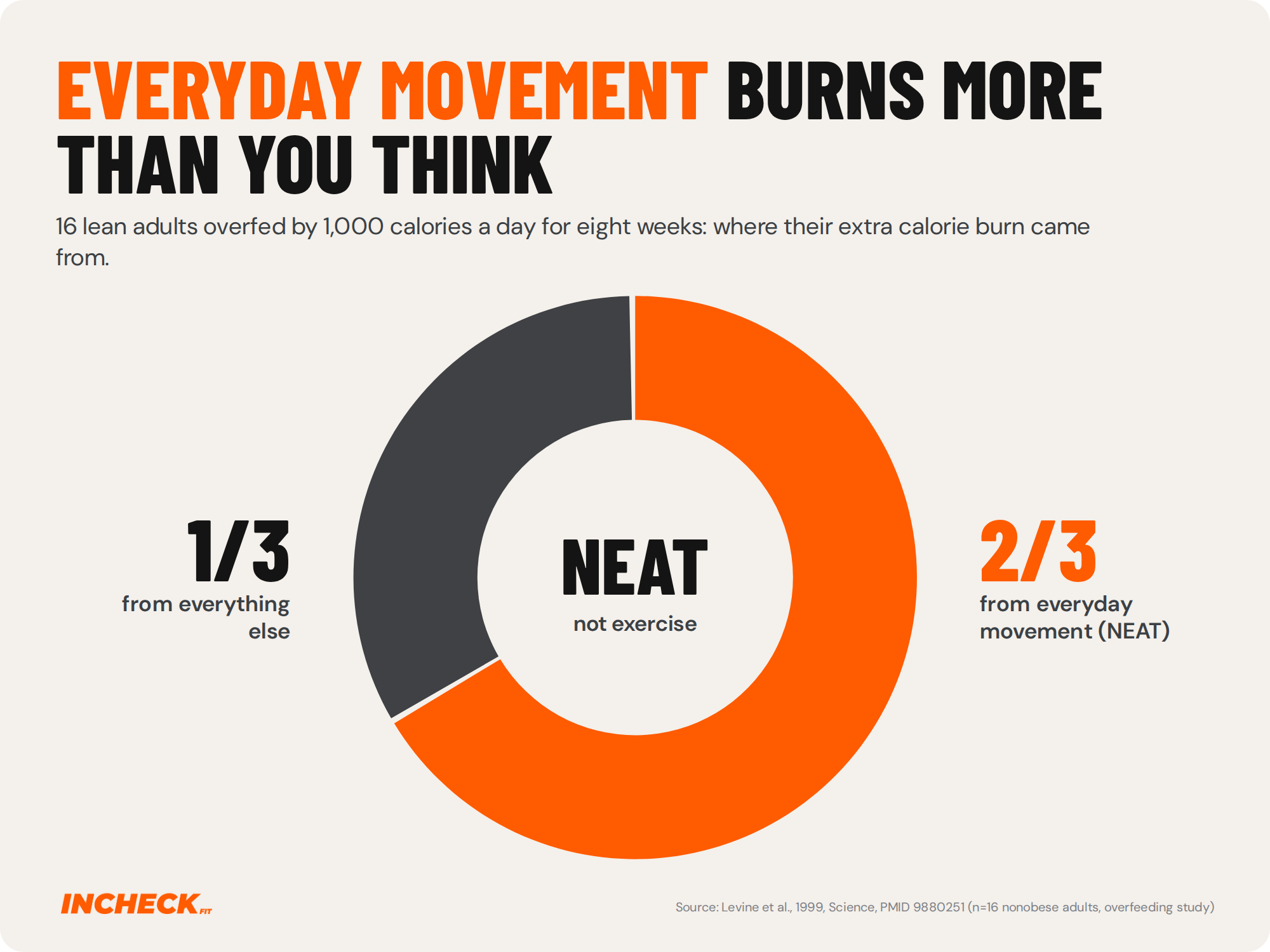 Two people who both sit at a desk for eight hours but move differently through the rest of their day can have vastly different TDEEs, even if every other variable is the same.
Hormonal Factors
Hormones including thyroid hormones, insulin, leptin, and cortisol all influence metabolic rate, appetite regulation, and fat storage. Conditions such as untreated hypothyroidism can reduce metabolic rate, and polycystic ovary syndrome (PCOS) can affect appetite, insulin and weight regulation, making standard calorie calculations less accurate for some people.
If you have been genuinely consistent with your calorie target for three or more weeks and seen no change in body weight at all, a conversation with a GP or accredited practising dietitian is worth having. A calculation is not a diagnosis.
Dieting History and Metabolic Adaptation
The body responds to a sustained calorie deficit by reducing its energy expenditure slightly more than the loss of body size alone would predict. This is called metabolic adaptation, or adaptive thermogenesis. It is real and measurable, and it is considerably smaller than it is usually presented.
A 2022 systematic review of 33 studies covering 2,528 adults found adaptation in most of them, but reported large variation driven mainly by how each study measured it, and concluded that better-designed studies reported lower or non-significant values (Nunes et al., 2022). A randomised trial of 71 adults with obesity measured adaptation at roughly 92 calories a day immediately after weight loss, falling to about 38 calories a day after four weeks of weight stabilisation, and found it did not predict later weight regain (Martins et al., 2020).
In practice, someone with a long dieting history may sit modestly below what the formula predicts, so a slightly more conservative starting target is sensible. What it does not mean is that the deficit stops working.
This is not a permanent state, and it does not mean results are impossible. It means the starting calculation is a hypothesis to be tested and refined, not a fixed prescription to follow indefinitely.
How Protein Fits Into Your Calorie Target
Reaching a calorie target is the primary driver of fat loss, but the composition of those calories matters too, particularly protein.
Research consistently shows that higher protein intake during a calorie deficit helps preserve lean muscle mass, supports better satiety, and slightly increases the thermic effect of food (the calories burned through the process of digestion and absorption). A 2018 meta-analysis of 49 trials in 1,863 healthy adults doing resistance training found that extra protein stopped adding to muscle gains at around 1.6 g per kg of body weight per day (Morton et al., 2018). That analysis was not of people in a deficit. For people who exercise, the International Society of Sports Nutrition recommends 1.4 to 2.0 g per kg a day (Jäger et al., 2017), and for fat loss we suggest 1.7 g per kg for women and 1.8 g for men.
For a person weighing 70 kg, that works out to about 119 to 126 g of protein a day. Here is more on how much protein to eat to lose fat.
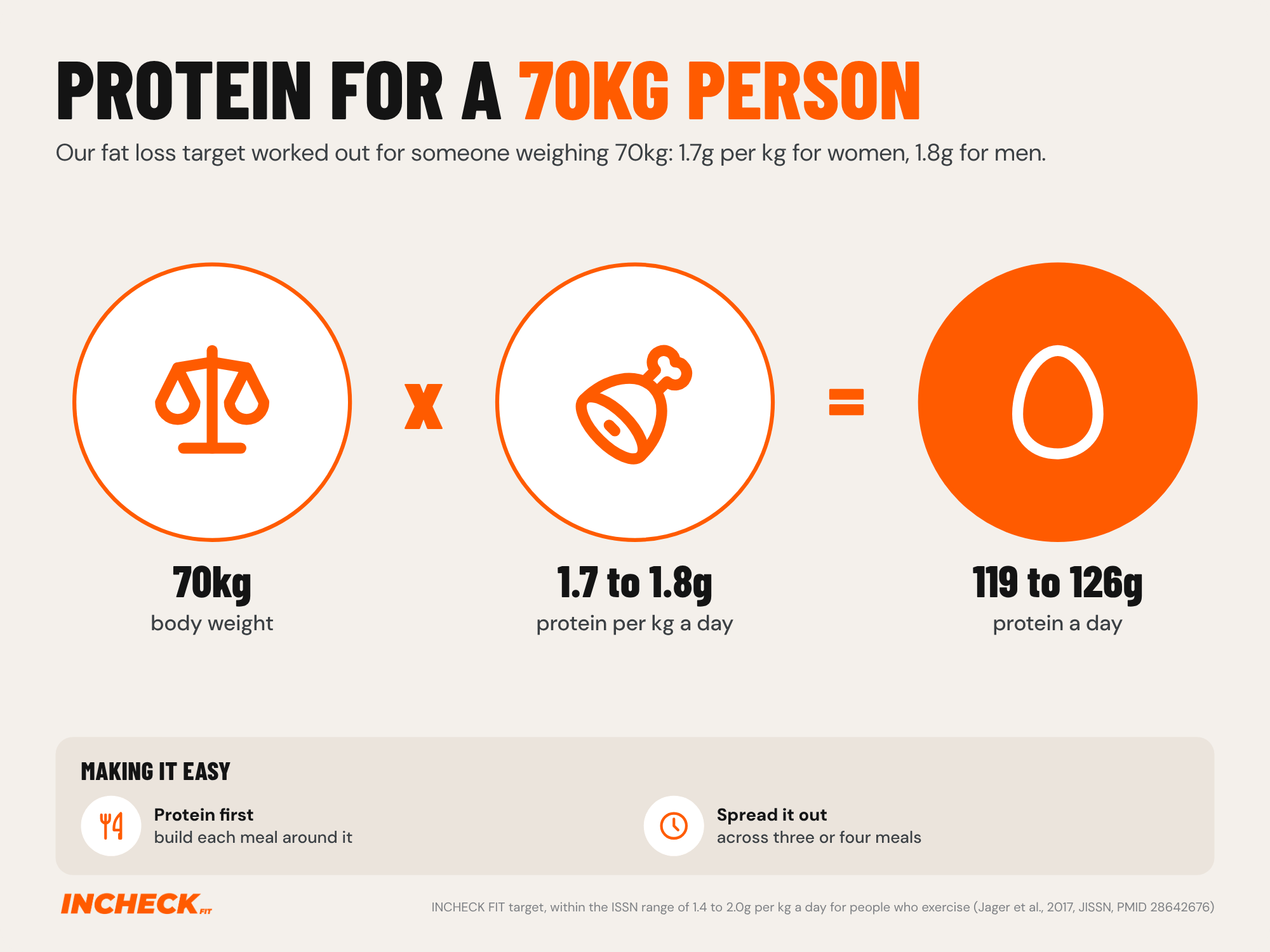 Reaching that target within your calorie budget requires some planning, but it meaningfully improves the quality of fat loss. You lose proportionally more fat and less muscle compared to a lower-protein approach at the same calorie intake. Protein is easy to cover with food, but creatine is the exception: getting enough creatine from food would take over a kilo of meat a day.
Spreading it across three to four meals helps too: here is how much protein per meal to aim for.
We built INCHECK FIT to do this part for you: your weekly meal plan is built to hit both your calorie and protein targets, so you’re not doing the maths meal by meal.
Practical Tips for Using Your Calorie Target Effectively
Knowing your number is only useful if you can apply it consistently. These principles make that considerably more achievable in practice.
Use weekly averages, not daily perfection. A daily target of 1,600 calories equals 11,200 calories per week. Whether you hit exactly 1,600 every day or vary between 1,350 and 1,900 across the week matters far less than the weekly total. Many people find this flexibility makes consistency easier, and there is no evidence that daily precision is needed for results.
Do not rely on exercise calorie burns to offset intake. Fitness trackers are often inaccurate and can overestimate calorie expenditure during exercise. A 2017 Stanford study of 60 adults testing seven wrist-worn trackers found none estimated calorie burn to within 20%, with median errors of 27% to 93% depending on the device (Shcherbina et al., 2017). Your TDEE already accounts for your activity level; treating structured exercise as a separate calorie bank tends to undermine progress rather than support it.
Build meals around protein first. Protein is the most satiating macronutrient. Anchoring each meal to a protein source before filling in carbohydrates and fats makes it considerably easier to stay within your calorie target without persistent hunger. Here’s how to make a macro meal plan step by step.
Expect the number to need adjusting. No formula is perfectly accurate for any individual. If you have been consistently hitting your calorie target for three or more weeks with no change in body weight, reducing your intake by 100–200 calories and reassessing over the following two to three weeks is the appropriate response. The target is a starting point, not a permanent prescription.
How to Know When Your Calorie Target Needs Adjusting
Calorie targets are not static. These are the clearest signals that a change is needed.
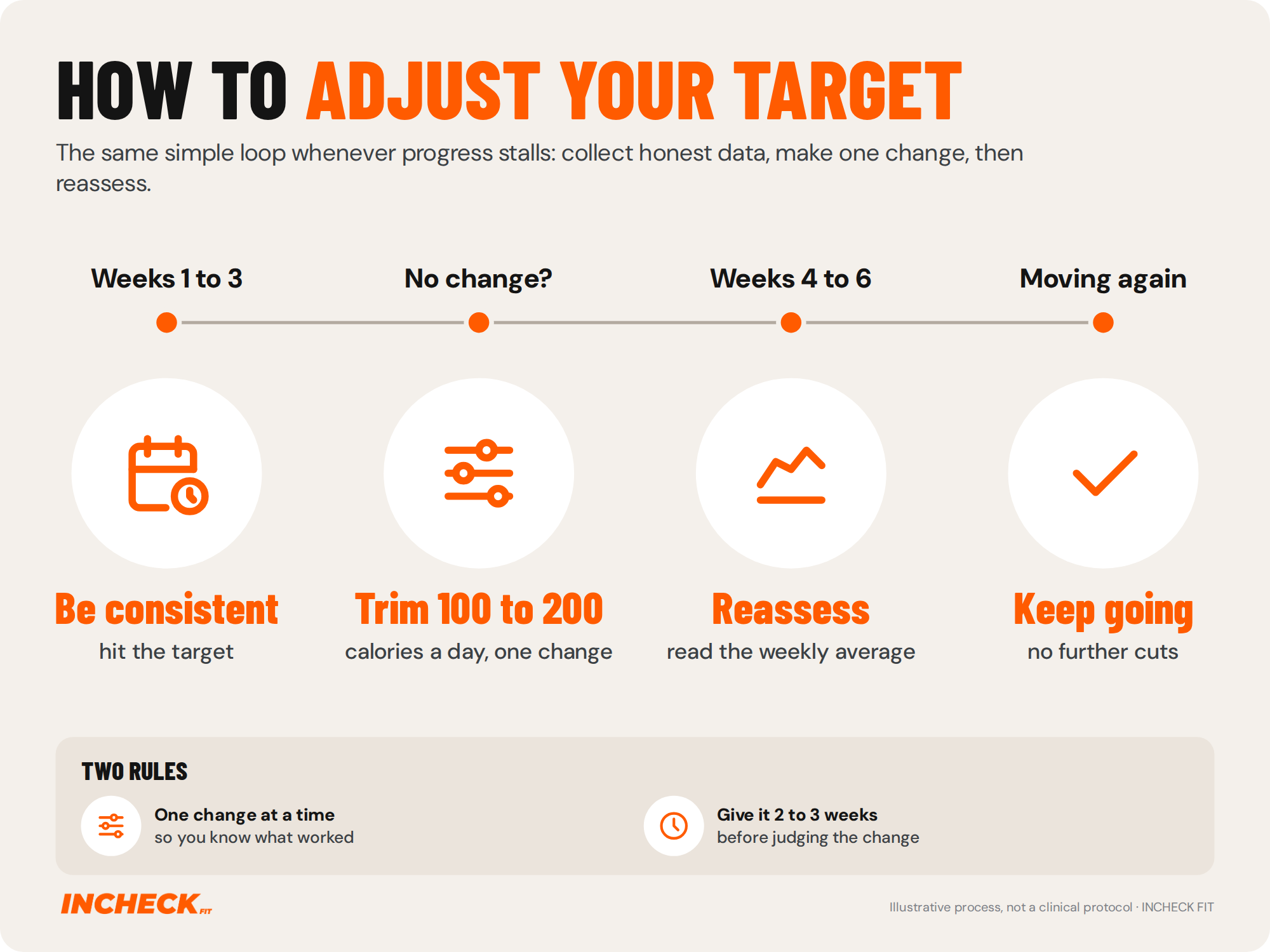
No movement on the scale after three weeks. If you have been genuinely consistent and the scale has not shifted at all, your actual TDEE is likely lower than calculated. Reduce intake by 100–200 calories and monitor for another two to three weeks before drawing conclusions.
Constant hunger or persistent fatigue. A deficit that is too aggressive, typically more than about 750 calories below your TDEE, is more likely to cause strong hunger, low mood and greater muscle loss. If this describes your experience, your target is probably too low. For most people, a smaller deficit they can keep up is more effective than an aggressive one they abandon, so the right pace is the one you can sustain.
Losing weight faster than 1 kg per week. If you are not significantly overweight and are losing weight rapidly, you may be losing muscle alongside fat. Reducing the deficit slightly and ensuring your protein target is being met will help preserve lean mass and improve the long-term quality of your results.
In each of these scenarios, the approach is the same: collect two to three weeks of honest data, make one measured adjustment, and assess the outcome. Changing multiple variables simultaneously makes it impossible to know what is actually driving the result.
INCHECK FIT’s weekly progress review looks at your real progress each week and adjusts your targets when it needs to, so you don’t have to run this calculation yourself. For a side-by-side of the other options, including trackers that adjust your targets, see the best apps to lose weight.
Frequently Asked Questions
-
How many calories should I eat a day to lose fat? Most adults benefit from eating 300–500 calories below their Total Daily Energy Expenditure (TDEE) to lose fat at a sustainable rate. This typically produces 0.3–0.5 kg of fat loss per week. Your specific number depends on your weight, height, age, sex, activity level, and body composition, which is why two people can have very different calorie targets even if they appear to share similar stats.
-
Is 1,200 calories enough to lose weight? For some individuals, 1,200 calories may represent a reasonable fat loss target. For others, particularly those who are taller, more active, or have more lean mass, 1,200 calories would constitute an extreme deficit that is difficult to sustain and risks significant muscle loss alongside fat. Rather than starting from a fixed number, calculate your TDEE first and subtract a deficit from there to arrive at a target that is appropriate for your body specifically.
-
Does everyone need the same number of calories to lose weight? No. While the formula used to calculate a calorie target is consistent, the number it produces varies significantly between individuals. Body composition, age, hormonal status, dieting history, and NEAT levels all influence what a person’s TDEE actually is and therefore what their fat loss target should be. Two people of identical height and weight can have calorie needs that differ by several hundred calories per day.
-
Why am I not losing weight even though I am in a calorie deficit? The most common explanations include underestimating calorie intake (portion sizes are frequently misjudged without precise tracking), overestimating daily energy expenditure, metabolic adaptation from extended periods of prior dieting, or a TDEE that was initially overestimated. If you have been genuinely consistent with your target for three or more weeks with no measurable change, reducing your intake by 100–200 calories and reassessing is a sensible next step before drawing conclusions.
-
How many calories do I need to lose 0.5 kg a week? A deficit of approximately 500 calories per day produces roughly 0.5 kg of fat loss per week, in the early weeks, based on the rule of thumb that one kilogram of body fat stores about 7,700 calories. Progress usually slows over time as your body gets smaller. In practice, weekly results will vary due to water retention, hormonal fluctuations, and measurement timing, so it is more useful to assess progress over two to three week periods rather than day to day.
-
Should I eat the same calories every day? Not necessarily. What matters most is your total weekly calorie intake, not perfect daily consistency. Many people find it more sustainable to vary their intake slightly across the week, eating a little more on more active days and a little less on sedentary ones, while keeping the weekly total on target. Daily precision is not required for results: your weekly total is what drives change.
-
What happens if I eat too few calories? Consistently eating well below your calorie needs, typically more than 1,000 calories below your TDEE, can increase muscle loss, fatigue and hunger, and tends to result in a rebound increase in food intake. For most people, a moderate deficit they can keep up works better than an aggressive one they abandon.
References
-
Mifflin MD, St Jeor ST, Hill LA, Scott BJ, Daugherty SA, Koh YO. “A new predictive equation for resting energy expenditure in healthy individuals.” American Journal of Clinical Nutrition. 1990;51(2):241-247. PMID: 2305711. DOI: 10.1093/ajcn/51.2.241 [Validation study, human, n=498 healthy adults aged 19-78. Record verified 25 Sep 2026 via Europe PMC; coefficients match the paper.]
-
Levine JA, Eberhardt NL, Jensen MD. “Role of nonexercise activity thermogenesis in resistance to fat gain in humans.” Science. 1999;283(5399):212–214. PMID: 9880251. DOI: 10.1126/science.283.5399.212 [Overfeeding study, human, n=16 nonobese adults, 8 weeks at +1,000 kcal/day. Abstract verified 25 Sep 2026 via Europe PMC; two comments, no correction.]
-
Nunes CL, Casanova N, Francisco R, Bosy-Westphal A, Hopkins M, Sardinha LB, Silva AM. “Does adaptive thermogenesis occur after weight loss in adults? A systematic review.” British Journal of Nutrition. 2022;127(3):451-469. PMID: 33762040. DOI: 10.1017/S0007114521001094 [Systematic review, human, 33 studies / 2,528 adults. Verified 17 Sep 2026; corrections checked, none found.]
-
Martins C, Roekenes J, Salamati S, Gower BA, Hunter GR. “Metabolic adaptation is an illusion, only present when participants are in negative energy balance.” American Journal of Clinical Nutrition. 2020;112(5):1212-1218. PMID: 32844188. DOI: 10.1093/ajcn/nqaa220 [Randomised controlled trial, human, n=71 adults with obesity. Verified 17 Sep 2026. Note: three published comments exist (PMIDs 32936882, 33301006, 33301007); the effect direction is not disputed, the framing is.]
-
Morton RW, Murphy KT, McKellar SR, Schoenfeld BJ, Henselmans M, Helms E, et al. “A systematic review, meta-analysis and meta-regression of the effect of protein supplementation on resistance training-induced gains in muscle mass and strength in healthy adults.” British Journal of Sports Medicine. 2018;52(6):376–384. PMID: 28698222 [Meta-analysis, human, 49 trials, n=1,863 healthy adults doing resistance training, not in a deficit. Verified 25 Sep 2026 via Europe PMC; a 2020 erratum exists (PMID 32943392).]
-
Shcherbina A, Mattsson CM, Waggott D, Salisbury H, Christle JW, Hastie T, Wheeler MT, Ashley EA. “Accuracy in wrist-worn, sensor-based measurements of heart rate and energy expenditure in a diverse cohort.” Journal of Personalized Medicine. 2017;7(2):3. PMID: 28538708. DOI: 10.3390/jpm7020003 [Validation study, human, n=60 adults, 7 devices; errors in both directions. Verified 25 Sep 2026 on the publisher page (MDPI).]
-
Hall KD. “What is the required energy deficit per unit weight loss?” International Journal of Obesity. 2008;32(3):573-576. PMID: 17848938. DOI: 10.1038/sj.ijo.0803720 [Mathematical modelling, human data. Verified 25 Sep 2026 via Europe PMC.]
-
Hall KD, Sacks G, Chandramohan D, Chow CC, Wang YC, Gortmaker SL, Swinburn BA. “Quantification of the effect of energy imbalance on bodyweight.” Lancet. 2011;378(9793):826-837. PMID: 21872751. DOI: 10.1016/S0140-6736(11)60812-X [Mathematical modelling, human data. Verified 25 Sep 2026 via Europe PMC.]
-
National Health and Medical Research Council. Clinical Practice Guidelines for the Management of Overweight and Obesity in Adults, Adolescents and Children in Australia. NHMRC, 2013. nhmrc.gov.au [Clinical practice guideline, Australia. Summary guide read 25 Sep 2026 on nhmrc.gov.au: “a 2500 kilojoule per day energy deficit”.]
- Jäger R, Kerksick CM, Campbell BI, et al. “International Society of Sports Nutrition Position Stand: protein and exercise.” Journal of the International Society of Sports Nutrition. 2017;14:20. PMID: 28642676. DOI: 10.1186/s12970-017-0177-8. [Position stand. Abstract and full text verified 12 Oct 2026 via Europe PMC: 1.4 to 2.0g per kg body weight a day for most exercising people; no corrections found.]
Last reviewed: October 2026