The short answer:
- Aim for roughly 0.4g of protein per kilo of body weight at each meal. For most adults that is 20 to 40g.
- Spread it across three to four meals. Tiny, frequent top-ups and one or two huge meals both did worse in the research.
- There is no hard ceiling at 20 to 25g. Bigger servings still get used, so a large meal isn’t wasted.
- Your total for the day still matters most. Get that right first, then spread it out.
For most healthy adults, the research points to three to four protein feedings a day of roughly 0.4g per kilo of body weight each, which is 20 to 40g for most people, rather than one or two very large meals or a constant stream of small snacks. That comes from studies that tested the same total protein split different ways, and from reviews that pulled the per-meal research together.
It is a refinement, not the main event. The total you eat across the day matters more than how you split it. This guide covers what the feeding studies found, what that means per meal for your body weight, whether there is really a per-meal ceiling, and how to hit a meaningful dose with everyday food.
How many times a day should you eat protein?
The best-tested answer is three to four feedings, each with a meaningful dose. The clearest single test of this is a study published in the Journal of Physiology (Areta et al., 2013).
Researchers took 24 healthy, resistance-trained young men and had every one of them drink the same 80g of whey protein over 12 hours of recovery after a leg workout. Only the split changed, with eight men in each group:
- 8 small feeds: 10g every 1.5 hours
- 4 moderate feeds: 20g every 3 hours
- 2 large feeds: 40g every 6 hours
In those 24 trained men, all three patterns raised muscle protein synthesis above resting levels, but four feeds of 20g produced 31 to 48% more muscle protein synthesis across the 12 hours than either eight feeds of 10g or two feeds of 40g.
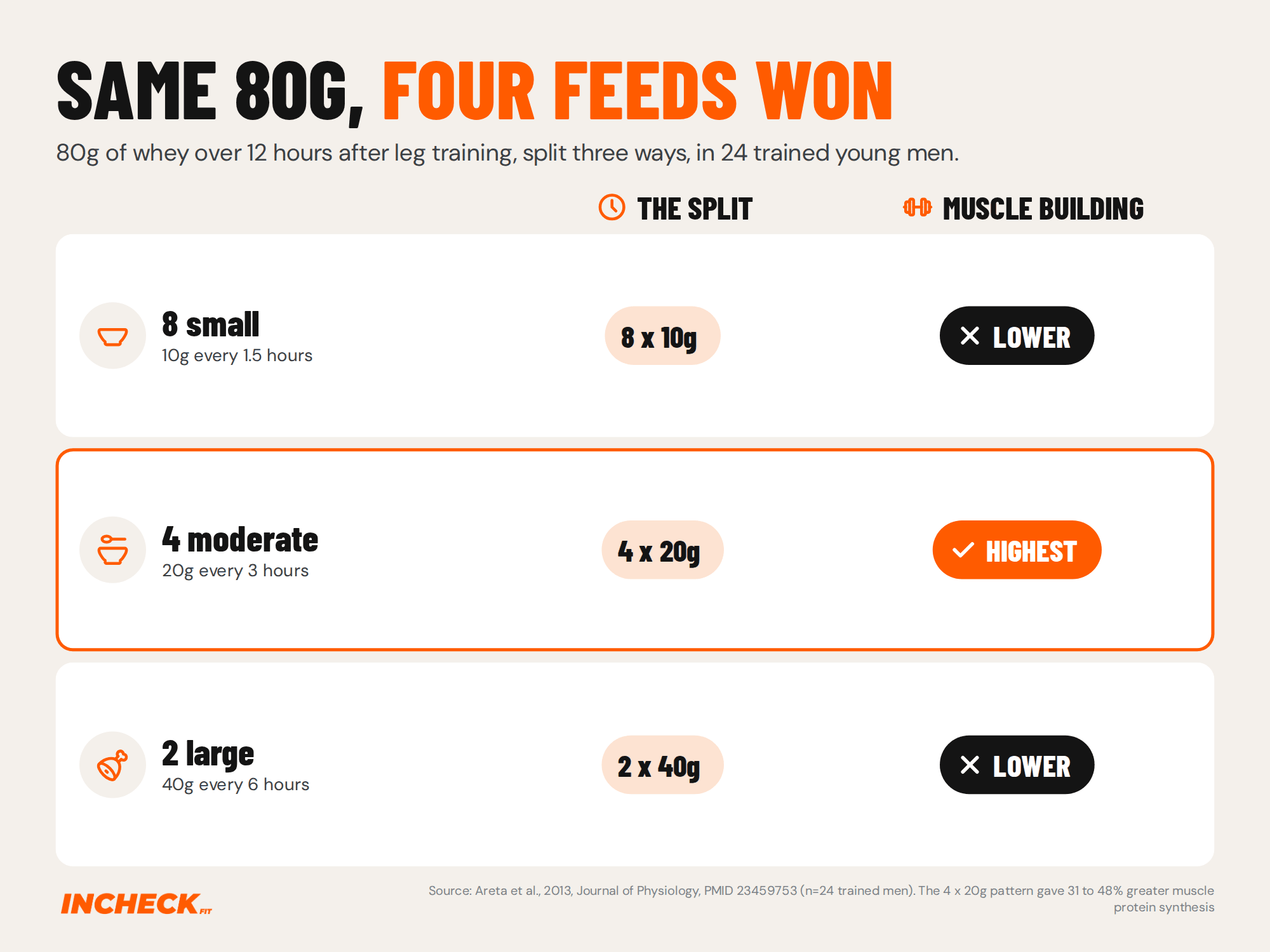
Neither extreme won. Small, frequent feeds spread the dose too thin, and two big feeds left long gaps in between. Four moderate feeds hit the middle ground.
Keep the sample in mind: this was 24 trained young men, measured over one 12-hour recovery period, drinking whey rather than eating mixed meals. It shows the principle clearly, but it is not a long-term trial of muscle growth.
How much protein per meal?
A practical target is about 0.4g of protein per kilo of body weight at each meal, across at least four meals a day. That comes from a review in the Journal of the International Society of Sports Nutrition that pulled together the short-term and long-term research on per-meal protein (Schoenfeld and Aragon, 2018). Four meals at that dose adds up to 1.6g per kilo a day. At the upper end of 2.2g per kilo a day, the same review works out a maximum of about 0.55g per kilo per meal.
The International Society of Sports Nutrition puts 1.4 to 2.0g per kilo a day as enough for most people who exercise (more on that below). At 1.8g per kilo, a 70kg person needs about 126g of protein a day, or roughly 32g at each of four meals.
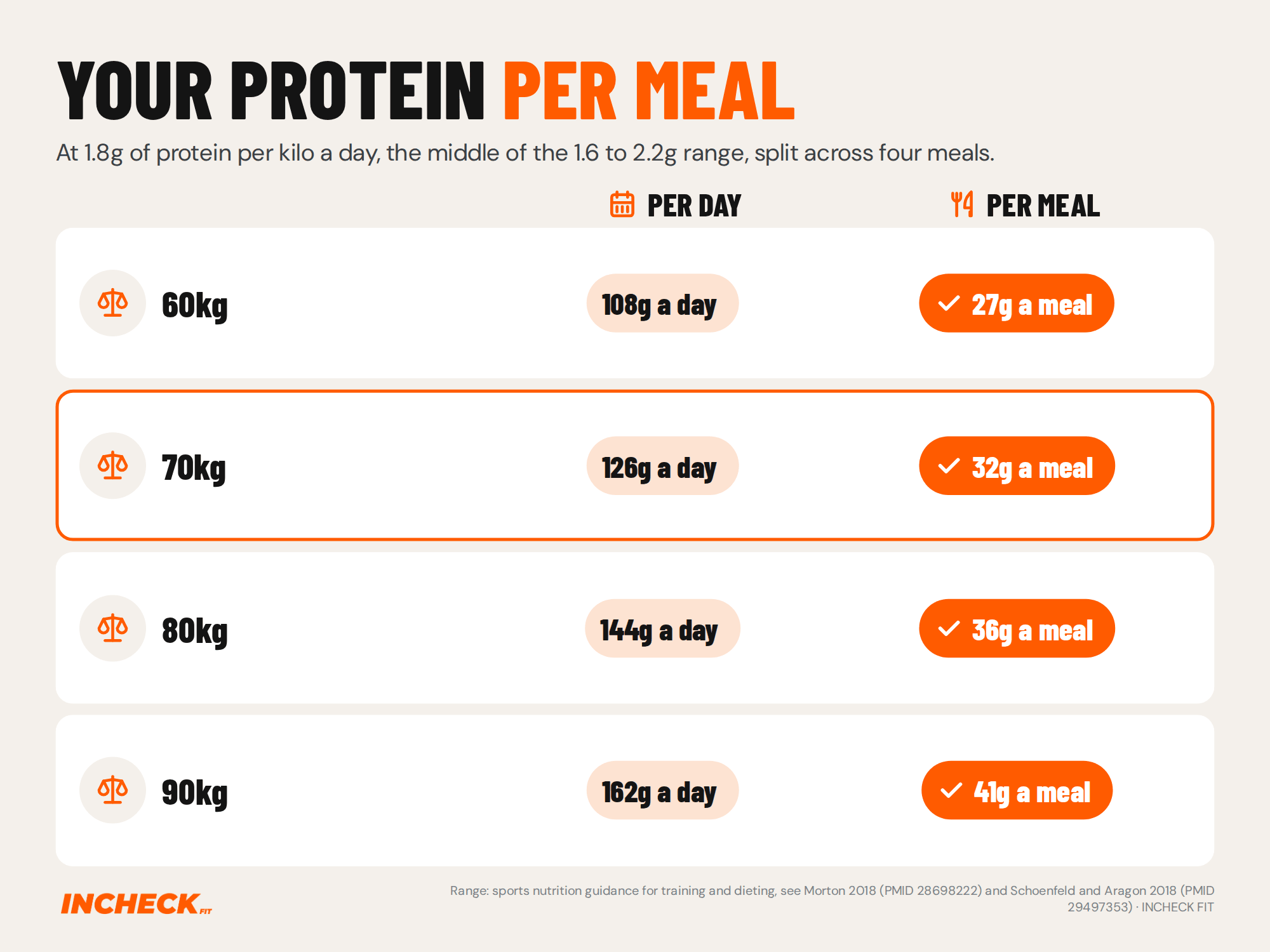
If you’re eating three meals rather than four, the same daily total works out to more per meal, around 42g each for that 70kg person. That is still a well-supported range, as the next sections show.
Does eating protein more often build more muscle?
Not by itself. What matters is whether each feeding actually carries a meaningful dose.
A study using US national survey data looked at 1,081 adults aged 50 to 85 and counted how many of their meals contained at least 30g of protein (Loenneke et al., 2016). Among those 1,081 older adults, people with one or two meals of 30g or more had greater leg lean mass and leg strength than people with none. The association was strongest for meals of roughly 30 to 45g. That is an observational study in older adults, so it shows a link rather than cause and effect, but it points the same way as the feeding trials.
In other words, six snacks of 10g each do not add up to the same thing as three or four meals of 30g, because none of the six small feeds carries enough protein on its own.
What if you eat more protein overall?
One small trial tested frequency at a higher protein intake. In 30 overweight adults, researchers compared a higher-protein diet (about 35% of calories from protein) eaten as either three or six meals a day with a standard diet (about 15% protein) eaten as three meals a day (Arciero et al., 2013). The trial ran for 28 days at maintenance calories, then 28 days in a calorie deficit.
In those 30 overweight adults, both higher-protein groups lost total and abdominal fat. Only the group eating higher protein across six meals increased lean mass during the maintenance phase, and its lean mass stayed higher through the deficit phase.
That can look like it contradicts the “more often isn’t better” finding above, but the difference is the dose. At a higher total intake, six meals still left each one carrying a decent amount of protein. The trial is small, and it cannot separate the effect of meal frequency from everything else that changed, so treat it as supporting evidence rather than a reason to eat six times a day.
Is there a limit to how much protein you can use in one meal?
Not the hard limit people used to think. For years, the working assumption was that muscle building maxes out at around 20 to 25g of protein in one sitting, with anything beyond that wasted.
In a study of 30 resistance-trained young men, 40g of whey after a whole-body workout produced about 20% more muscle protein synthesis than 20g (Macnaughton et al., 2016).
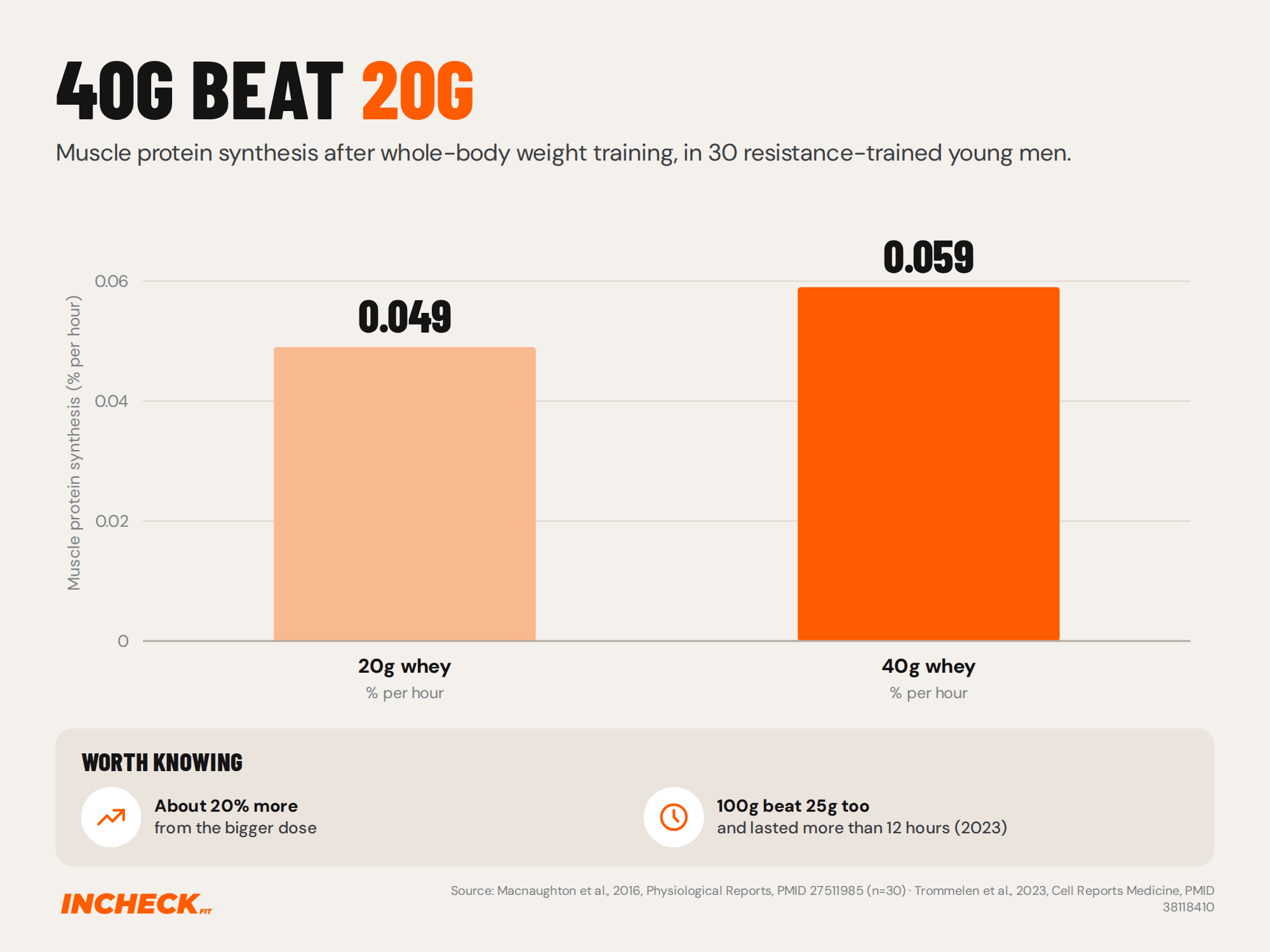
A 2023 study in healthy young men went further, using a more sensitive tracer method. It found that 100g of protein produced a greater and longer-lasting response than 25g, lasting more than 12 hours (Trommelen et al., 2023). Within the doses tested, the researchers found no upper limit.
So a large protein meal is not wasted. What hasn’t changed is the case for spreading your protein out. When the total is held the same, as in the 80g study above, four moderate feeds still beat two large ones across the day.
If you have kidney disease or another relevant medical condition, talk to your GP or an accredited practising dietitian about your protein intake rather than working from a general guide like this one.
Total daily protein still matters most
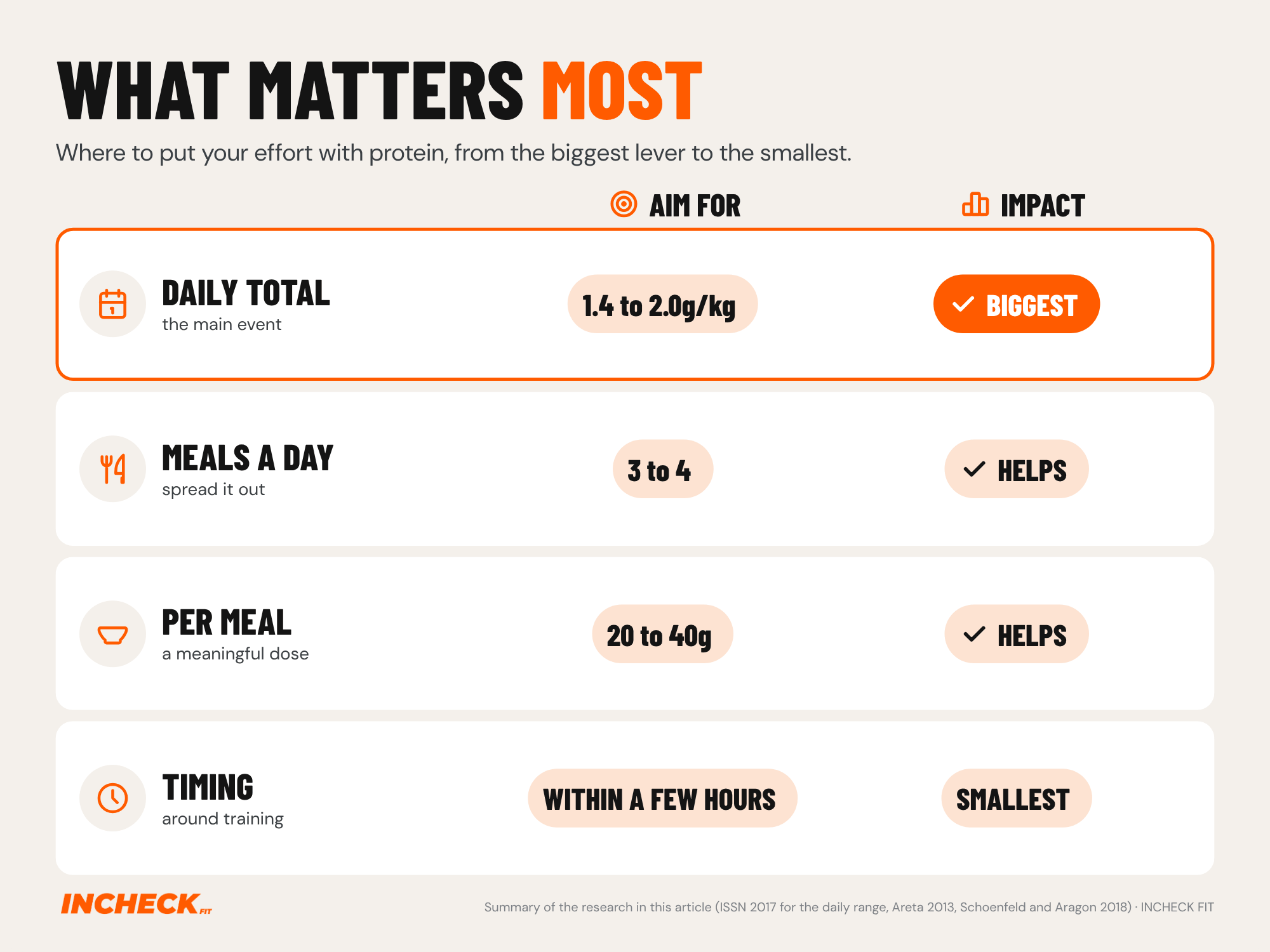
How you split your protein is the fine-tuning. How much you eat in total is the bit that moves results. Spreading an inadequate total across four perfect meals won’t make up for the shortfall.
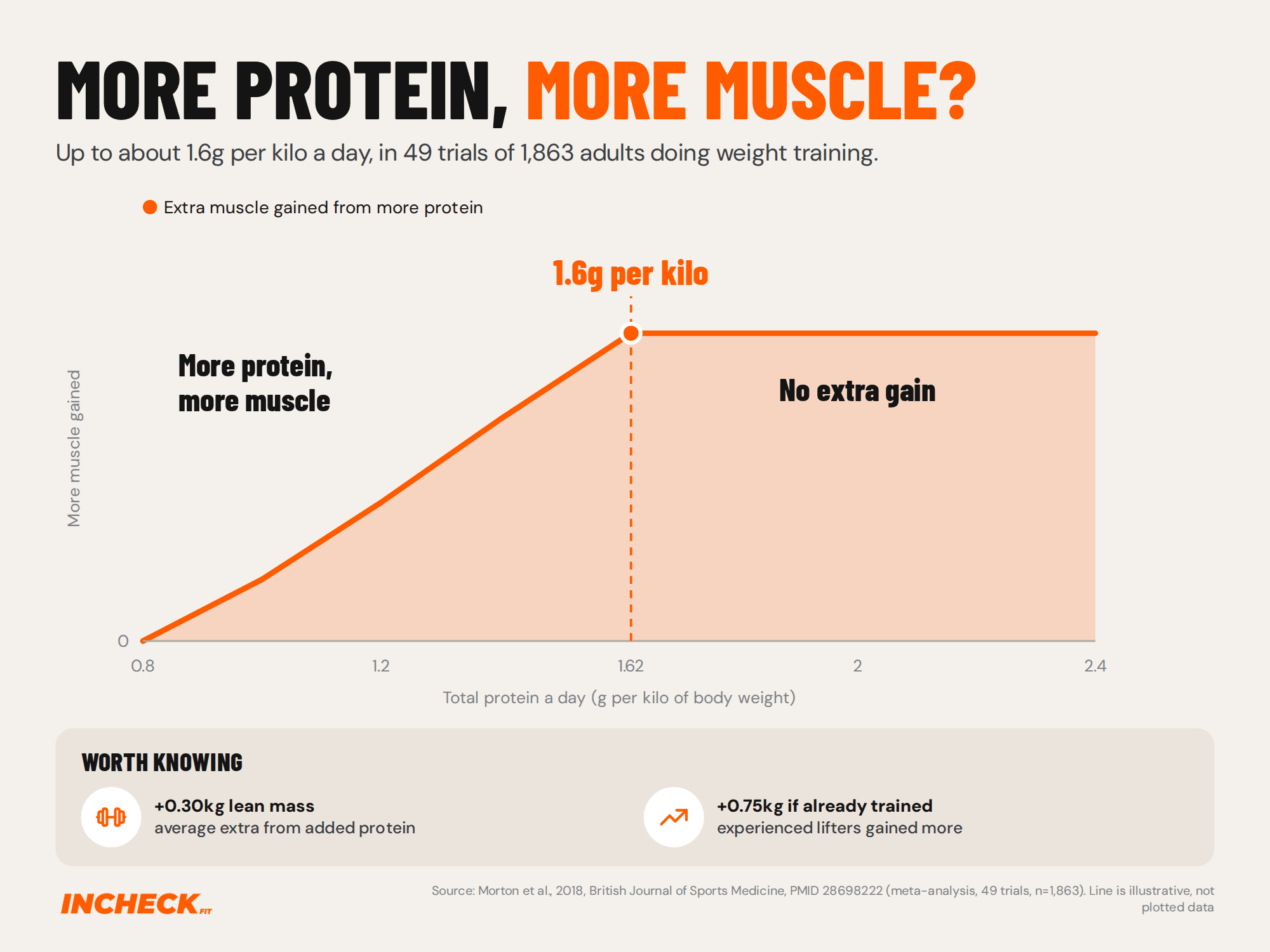
In a 2018 analysis of 49 trials in 1,863 healthy adults doing resistance training, extra protein stopped adding to gains in lean mass at around 1.6g per kilo of body weight a day, though that cut-off wasn’t statistically certain and the likely range ran from about 1.0 to 2.2g (Morton et al., 2018). In those 1,863 adults, added protein increased lean mass gains by about 0.30kg on average, and by about 0.75kg in people who were already resistance trained.
 That analysis was not of people eating in a deficit. For people who exercise, the International Society of Sports Nutrition puts 1.4 to 2.0g per kilo a day as enough for most (Jäger et al., 2017). While losing fat, we recommend about 1.7g per kilo for women and 1.8g for men, alongside a calorie deficit; how much protein to lose fat covers where that comes from. There’s more on setting that number in how many calories to eat to lose fat.
For comparison, Australia’s recommended dietary intake for adults aged 19 to 70 is 0.84g per kilo a day for men and 0.75g per kilo for women (NHMRC). That figure is set to cover the needs of nearly all healthy people, not to support fat loss or muscle retention. If you train or are trying to change your body composition, treat it as a floor rather than a target.
Spreading protein through the day has another practical upside. Protein is the most filling of the three macronutrients, according to a review of high-protein diet research (Halton and Hu, 2004), so a decent dose at each meal helps keep hunger steadier than saving it all for dinner. That matters most in a calorie deficit, where hunger is usually what ends the diet.
This is also why protein comes up so often alongside training for fat loss. Strength training is what protects your muscle in a deficit, and protein is what that muscle is built from.
How to hit 20 to 40g with everyday food
Most people don’t need supplements to get there. Here is roughly what common foods provide per serve.
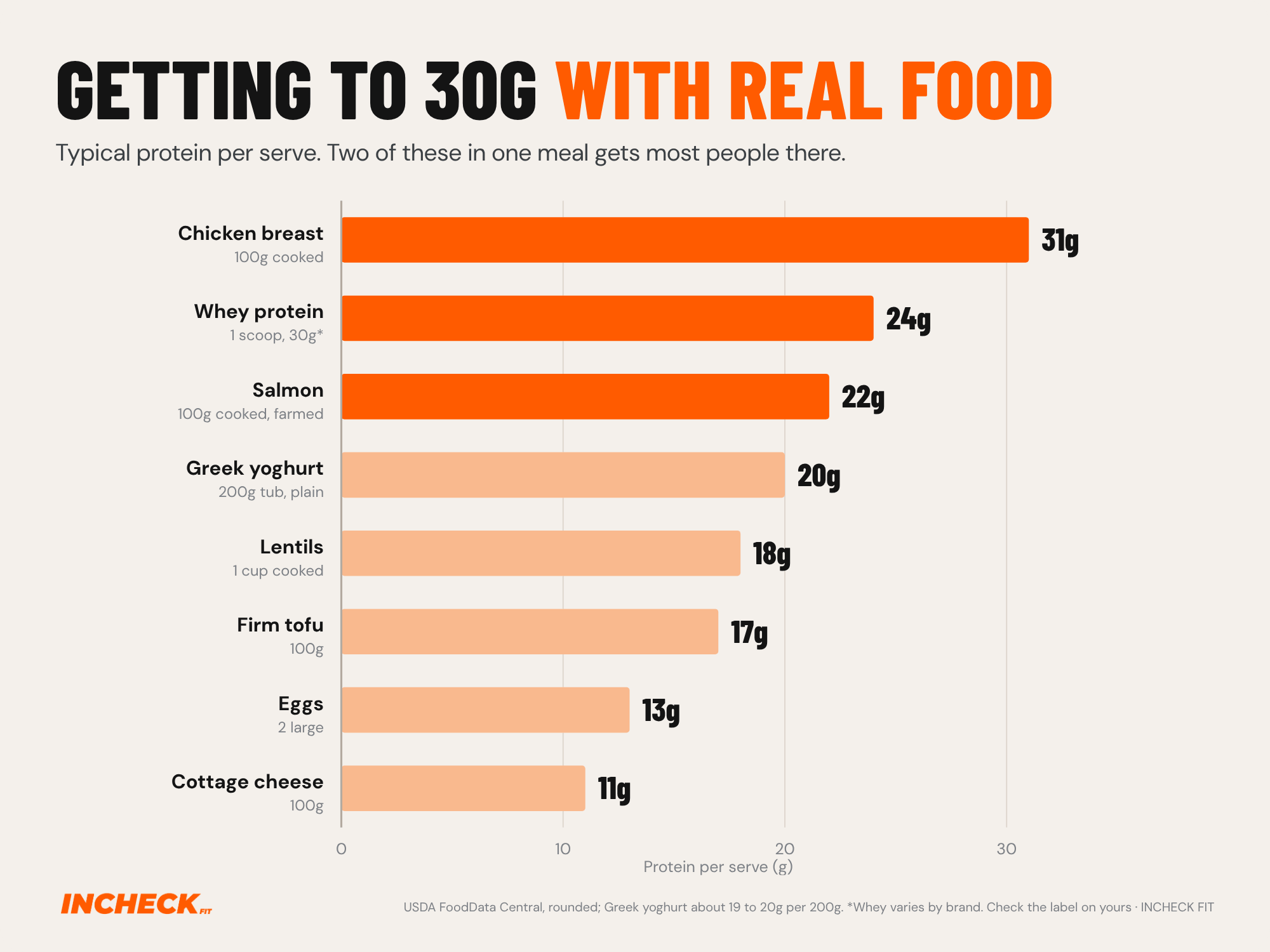
Pairing two of these in one meal, such as eggs with Greek yoghurt or lentils with tofu, gets most people into the 25 to 35g range without an oversized portion of any one food. Values vary by brand and preparation, so check the label on what you’re actually eating.
Working this out meal by meal is the part most people find tedious. It’s what we built INCHECK FIT for: your weekly meal plan is built to hit your calorie and protein targets, with the quantities set out, so the protein is already in the meals rather than something you calculate at every sitting.
Frequently asked questions
-
How much protein should I eat per meal? A practical target is about 0.4g per kilo of body weight per meal, across at least four meals a day, based on a 2018 review of the per-meal protein research (Schoenfeld and Aragon). For most adults that is 20 to 40g a meal, or about 32g for a 70kg person eating 1.8g per kilo a day across four meals.
-
How many times a day should I eat protein? Three to four times a day is the best-supported pattern. In a study of 24 trained young men given the same 80g of whey over 12 hours, four feeds of 20g produced 31 to 48% more muscle protein synthesis than eight feeds of 10g or two feeds of 40g.
-
Is it better to eat protein in 3 meals or 6? What matters most is that each meal carries a meaningful dose. Six small feeds that each fall well short of 20g are less effective than three or four meals of 25 to 40g. In one small trial of 30 overweight adults on a higher-protein diet, six meals a day did show a lean mass benefit, but each of those meals still carried a decent amount of protein.
-
Can your body use more than 30g of protein at once? Yes. In a study of 30 resistance-trained young men, 40g of whey produced about 20% more muscle protein synthesis than 20g, and a 2023 study in healthy young men found 100g produced a greater and longer-lasting response than 25g. The old 20 to 25g “ceiling” came from less sensitive measurement methods.
-
Does eating protein more often build more muscle? Not on its own. In 1,081 US adults aged 50 to 85, having one or two meals with at least 30g of protein was linked to more leg lean mass and strength than having none. The number of meals matters less than whether each one contains enough protein.
-
Do I need protein straight after training? Your total protein across the day, spread over several meals, matters more than precise timing. Having a protein-containing meal within a few hours of training is sensible, but missing a narrow post-workout window will not undo your results.
-
How much protein a day do I need to lose fat? We recommend about 1.7g per kilo of body weight a day for women and 1.8g for men while losing fat, alongside a calorie deficit. For a 70kg person that’s about 119 to 126g a day, or roughly 30 to 32g a meal across four meals.
References
- Areta JL, Burke LM, Ross ML, et al. “Timing and distribution of protein ingestion during prolonged recovery from resistance exercise alters myofibrillar protein synthesis.” Journal of Physiology. 2013;591(9):2319-2331. PMID: 23459753. [Randomised trial, human, n=24 healthy resistance-trained young men, 8 per group, 80g whey over 12 hours. Abstract verified 28 Sep 2026 via PubMed; two published comments, no corrections.]
- Schoenfeld BJ, Aragon AA. “How much protein can the body use in a single meal for muscle-building? Implications for daily protein distribution.” Journal of the International Society of Sports Nutrition. 2018;15:10. PMID: 29497353. [Narrative review of acute and long-term studies. Abstract verified 28 Sep 2026 via PubMed; no corrections found.]
- Loenneke JP, Loprinzi PD, Murphy CH, Phillips SM. “Per meal dose and frequency of protein consumption is associated with lean mass and muscle performance.” Clinical Nutrition. 2016;35(6):1506-1511. PMID: 27086196. [Cross-sectional, human, n=1,081 US adults aged 50 to 85, NHANES 1999 to 2002. Abstract verified 28 Sep 2026 via PubMed; no corrections found.]
- Arciero PJ, Ormsbee MJ, Gentile CL, et al. “Increased protein intake and meal frequency reduces abdominal fat during energy balance and energy deficit.” Obesity. 2013;21(7):1357-1366. PMID: 23703835. [Randomised trial, human, n=30 overweight adults, 28 days energy balance then 28 days deficit. Abstract verified 28 Sep 2026 via PubMed; no corrections found. Only abstract-level findings are used here.]
- Macnaughton LS, Wardle SL, Witard OC, et al. “The response of muscle protein synthesis following whole-body resistance exercise is greater following 40 g than 20 g of ingested whey protein.” Physiological Reports. 2016;4(15):e12893. PMID: 27511985. [Randomised crossover, human, n=30 resistance-trained young men. Abstract verified 28 Sep 2026 via PubMed; no corrections found.]
- Trommelen J, van Lieshout GAA, Nyakayiru J, et al. “The anabolic response to protein ingestion during recovery from exercise has no upper limit in magnitude and duration in vivo in humans.” Cell Reports Medicine. 2023;4(12):101324. PMID: 38118410. [Randomised trial, human, healthy young men, 25g vs 100g protein. Abstract verified 28 Sep 2026 via PubMed; no corrections found.]
- Morton RW, Murphy KT, McKellar SR, et al. “A systematic review, meta-analysis and meta-regression of the effect of protein supplementation on resistance training-induced gains in muscle mass and strength in healthy adults.” British Journal of Sports Medicine. 2018;52(6):376-384. PMID: 28698222. [Meta-analysis and meta-regression, human, 49 trials, n=1,863 healthy adults doing resistance training. Abstract re-verified 28 Sep 2026 via PubMed: FFM +0.30kg (0.09 to 0.52), +0.75kg in resistance-trained people, no further FFM gain beyond 1.62g/kg/day.]
- Jäger R, Kerksick CM, Campbell BI, et al. “International Society of Sports Nutrition Position Stand: protein and exercise.” Journal of the International Society of Sports Nutrition. 2017;14:20. PMID: 28642676. [Position stand. Abstract verified 28 Sep 2026 via PubMed: 1.4 to 2.0g/kg a day for most exercising people, 2.3 to 3.1g/kg during hypocaloric periods in resistance-trained people.]
- Halton TL, Hu FB. “The effects of high protein diets on thermogenesis, satiety and weight loss: a critical review.” Journal of the American College of Nutrition. 2004;23(5):373-385. PMID: 15466943. [Critical review. Existence and details verified 28 Sep 2026 via PubMed; no corrections found.]
- National Health and Medical Research Council. Nutrient Reference Values for Australia and New Zealand: Protein. eatforhealth.gov.au. Adult RDI 0.84g/kg (men) and 0.75g/kg (women), ages 19 to 70. Checked 28 Sep 2026.
- US Department of Agriculture. FoodData Central (SR Legacy), protein per 100g: chicken breast meat only, roasted 31.0g; Atlantic salmon, farmed, cooked 22.1g; Greek yoghurt, plain nonfat 9.5g; lentils, boiled 9.0g; tofu, raw, firm 17.3g; whole egg 12.6g; cottage cheese, creamed 11.1g. Read 12 Oct 2026.
Last reviewed: October 2026 by the INCHECK FIT nutrition team.
Last reviewed: October 2026