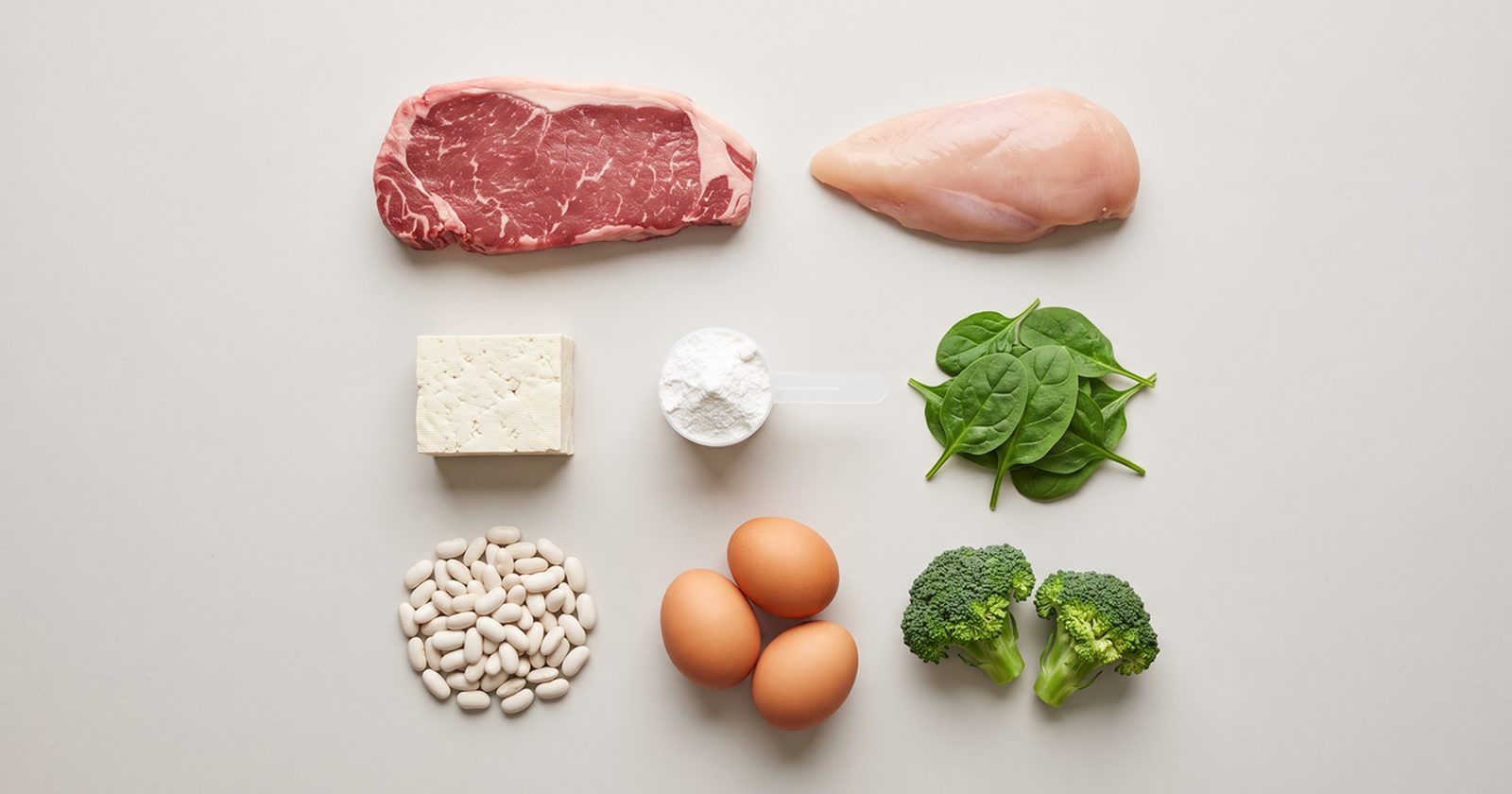
No, not realistically. Meat and fish carry about 4g of creatine per kilogram, so hitting the 5g daily dose used in the muscle research means eating roughly 1.25kg of meat, raw weight, every single day. That is five 250g steaks, around 2,500 calories from the meat alone, and about $57 a day at Woolworths porterhouse prices.
If you have been told a decent diet covers it, this is the article that shows you what “covers it” would actually look like on a plate. We will walk through each food, what the research measured, what people genuinely eat, and the one comparison that makes the decision obvious.
How much creatine do you actually need?
Three different numbers circulate, and they are for three different things. Mixing them up is where most of the confusion online starts.
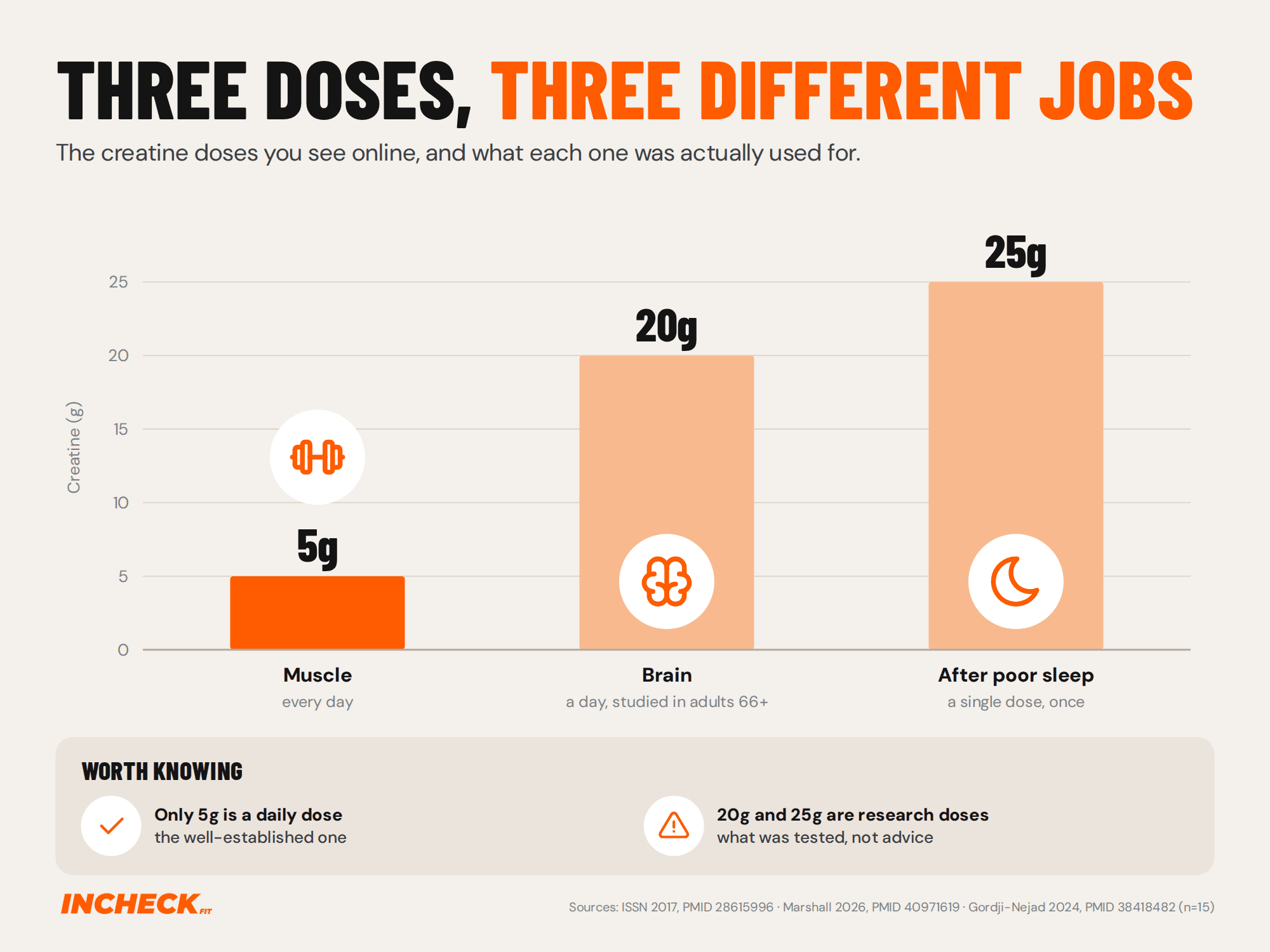
For muscle, 5g a day. The International Society of Sports Nutrition position stand puts the maintenance range at 3 to 5g per day. This is among the least contested numbers in sports nutrition.
For the brain, 20g, and the caveats matter more than the figure. In a 2026 systematic review of creatine and cognition in older adults, both intervention trials in people aged 66 and over loaded at 4 x 5g a day (Marshall et al., 2026). This is a studied dose, not a recommended one: a protocol has been tested, none has been optimised, and the review says so itself. The review has since drawn published letters questioning its methods (Quaresma, 2026), so treat the 20g as a description of what was given, not a recommendation.
For sleep deprivation, 25g, once. A 2024 study of 15 sleep-deprived young adults (average age about 23) gave a single 0.35 g/kg dose and tested them over the following hours, which works out around 25g for a typical adult (Gordji-Nejad et al., 2024). It is a one-off intervention. Turning it into a daily protocol is a common and consequential misreading, and it does not beat actually sleeping.
Worth stating plainly, because the opposite gets repeated constantly: that same study reported no gastric discomfort or other physical complaint at 25g, and the ISSN position stand states there is no evidence creatine increases cramping, dehydration or gastrointestinal upset. Athletes taking creatine experienced significantly less muscle cramping and heat illness. Posts warning about bloating and cramping at high doses have it backwards.
The rest of this article uses 5g, the muscle dose, because that is the one most people are asking about.
How much creatine is in food?
Creatine sits in skeletal muscle, buffering energy for short, hard efforts, and it does that same job across essentially every vertebrate. That is why concentrations in common meats land in a broadly similar band rather than varying wildly.
In a 1997 study, Harris and colleagues measured uncooked beef, chicken and rabbit all at roughly 30 mmol per kilogram of wet weight, which works out to about 3.9g of creatine per kilogram of raw meat. Three species, one measurement, the same answer.
One caution, because it is easy to overstate. The everyday meats people actually eat sit in a similar range, roughly 4 to 5g per kilo. It is not true that all meat and fish are identical: commonly circulated figures put herring at roughly double most other fish and cod meaningfully below, about a threefold spread across the extremes. We could not verify those per-species numbers against a primary source, so they are not used here.
For the foods below, assume about 4g per kilo. Every route then lands somewhere around 1 to 1.3kg a day.
What 5g of creatine looks like on a plate
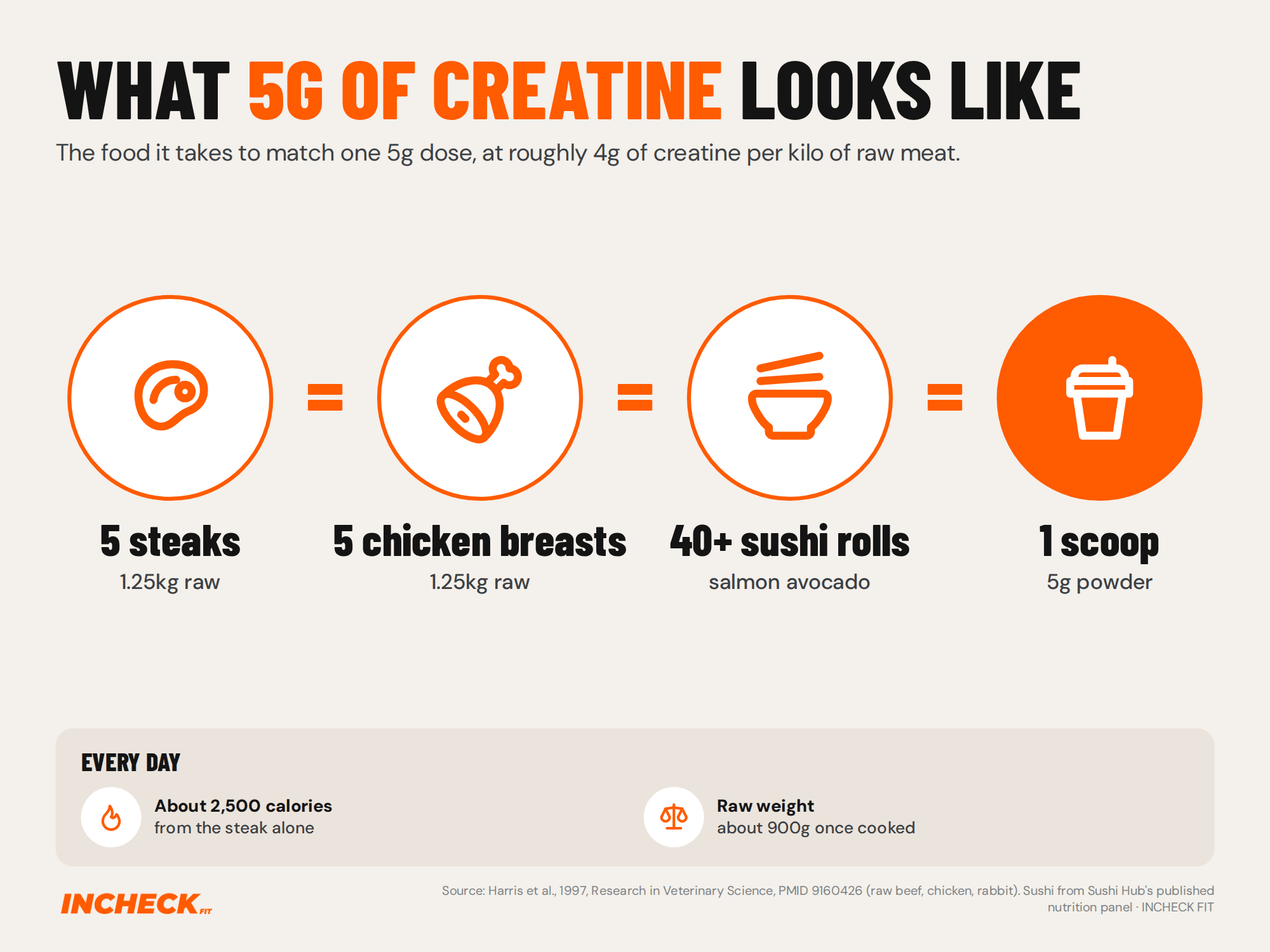
All weights are raw weight. Cooking drives off roughly a third of the mass in water, so 1.25kg raw is around 900g on the plate.
Steak: 1.25kg a day
Five 250g porterhouse steaks. Every day, not once a week. Roughly 2,500 calories from the meat alone and, at around $45.51 per kilo, about $57 a day.
Chicken breast: 1.25kg a day
Five large fillets, roughly 1,400 calories. Much cheaper than steak and exactly the same problem: nobody eats five chicken breasts a day on top of everything else.
Salmon sushi: more than 40 rolls
This one surprises people. By our estimate, a Sushi Hub salmon avocado roll contains only about 28 to 30g of actual salmon, because most of the roll is rice. We worked that back from the chain’s published nutrition panel (258 calories and 10.4g of protein per roll), so treat it as an estimate rather than a disclosed figure. At that amount, you would need more than 40 rolls to reach 5g of creatine, which is around 10,300 calories.
White fish: no shortcut
Lean white fish like King George whiting is often assumed to be a richer source. We could not verify a per-species figure for it, so at the same roughly 4g per kilo it is still about 1.25kg, or around 12 fillets, a day. Fish is not the shortcut it is usually assumed to be.
The foods that give you almost nothing
This is where people get caught out, because several foods with a strong protein reputation contribute essentially no creatine.
- Whey protein: trace. Creatine lives in muscle tissue. Whey is a dairy protein fraction and does not carry it in any meaningful amount.
- Eggs: trace.
- Plants: trace. All of them.
If you are vegetarian or vegan, you are getting close to nothing from food. That is a real dietary difference, not a marketing line.
One thing this does not mean. It is tempting to conclude that eating more meat gives your brain more creatine. It does not appear to work that way. In a small Brazilian study of 14 vegetarians and 14 omnivores, brain creatine was effectively identical (5.999 vs 5.917 IU, P = 0.77) despite a roughly 45-fold difference in dietary intake (0.03 vs 1.34g a day) (Yazigi Solis et al., 2014). The brain synthesises its own supply. Every food figure in this article is about how much food it takes to match the supplement dose, never about how much your brain needs.
What people actually eat
Here is the number that reframes the whole question.
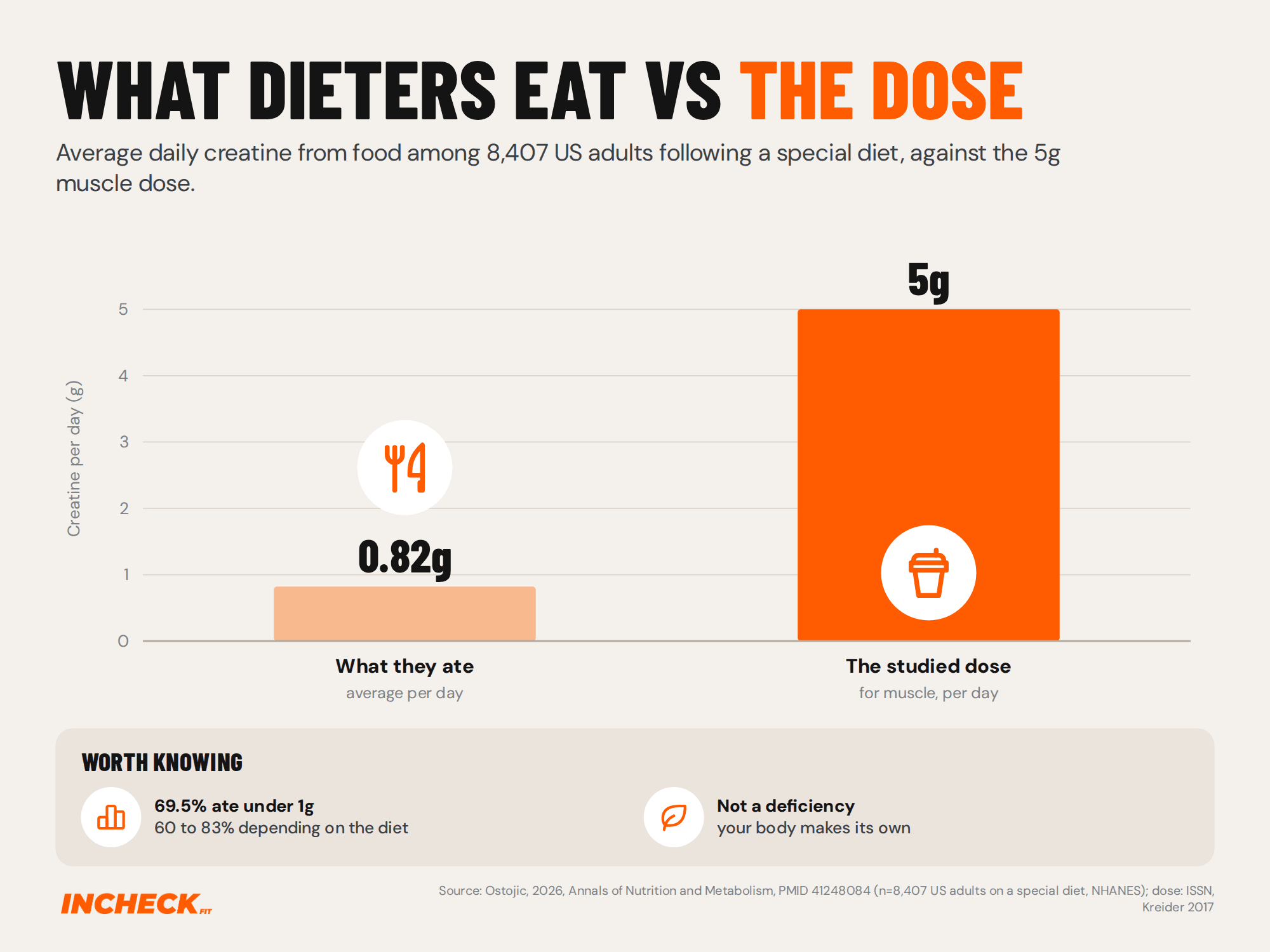
That study used US national survey data (NHANES, 2003 to 2023) and looked specifically at people following a special diet: weight loss, low fat, low carbohydrate, gluten free, diabetic and other categories. Among 8,407 of them, average creatine intake was 0.82g a day and 69.5% took in less than 1g (Ostojic, 2026). The prevalence ranged from 60.4% on renal diets to 83.3% on low fibre ones.
That population matters, and it makes the finding more relevant rather than less, because if you are reading this you are quite likely on one of those diets. It is not a statement about everybody.
We are also deliberately not calling this a deficit. 5g a day is a supplementation dose, not a dietary requirement, and framing intake as a shortfall implies a deficiency the evidence does not support. Your body makes its own creatine. The point is narrower: food and the dose are two very different quantities, and the gap is larger than almost anyone assumes.
The cost, side by side
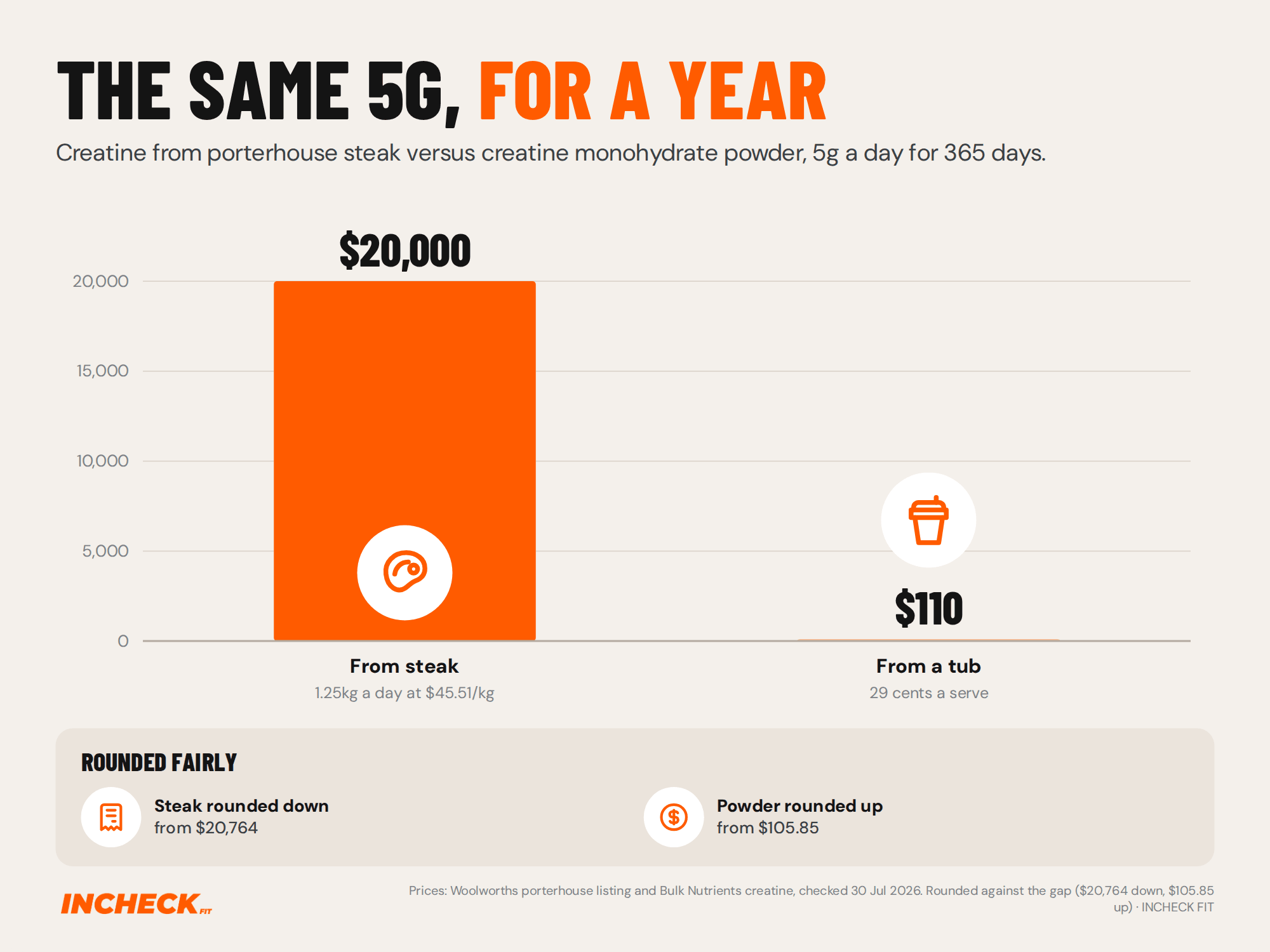
The steak figure is 1.25kg a day at Woolworths’ listed porterhouse price of $45.51 per kilo, across 365 days. The powder figure is Bulk Nutrients’ published price of 29 cents per serve, across 365 days. Both prices were checked in July 2026 and will move over time.
Both numbers are deliberately rounded against the point being made. The steak figure rounds down from $20,764 and the powder figure rounds up from $105.85, so the gap shown is the narrowest the sources support. Anyone who recalculates it will find it wider.
So should you supplement?
The maths answers this fairly plainly. Creatine monohydrate is among the most studied supplements available, the muscle dose is not seriously disputed, and the food route requires a quantity of meat that is impractical, expensive and calorically enormous.
That does not mean food stops mattering. It means creatine is an unusually poor thing to try to solve through food specifically. Protein, fibre and most micronutrients are genuinely achievable by eating well. This one is not, and knowing which is which is most of what good nutrition advice is.
The achievable part is what we built INCHECK FIT for. Your weekly meal plan is built to hit your calorie and protein targets, with the amounts given up front, so you are not left with a target and a hundred decisions in between. Creatine is the one a meal plan cannot sensibly cover, which is why the tub wins here. One thing to know if you are in a calorie deficit: creatine often adds a little water weight when you start taking it, so an early bump on the scale is water, not fat.
Frequently Asked Questions
-
Can you get enough creatine from food alone? Not realistically. Direct measurement of raw beef, chicken and rabbit found roughly 4g of creatine per kilogram, so the 5g dose used in muscle research would take about 1.25kg of raw meat every day. That is around 2,500 calories of steak, or five chicken breasts, daily.
-
How much creatine is in a kilo of beef or chicken? About 3.9g, based on direct measurement of roughly 30 mmol per kilogram of wet weight. Beef, chicken and rabbit all measured at essentially the same concentration.
-
Can vegetarians get enough creatine from food? No. Plant foods contain essentially no creatine, so vegetarians and vegans get close to zero from diet. The body still synthesises its own supply, and in a small study of 14 vegetarians and 14 omnivores, brain creatine measured the same in both groups.
-
Does whey protein contain creatine? Only trace amounts. Creatine is stored in muscle tissue, and whey is a dairy protein fraction, so a protein shake does not meaningfully contribute to creatine intake despite the reputation.
-
Does cooking destroy the creatine in meat? Heat can convert some creatine into creatinine, a breakdown product. In processed products such as canned and dried meats, researchers found creatine had degraded to varying degrees, so the raw-weight figures here are a best case rather than a realistic one.
-
Is 5g of creatine a day safe long term? Creatine monohydrate at standard doses is among the most extensively studied supplements available, and the ISSN position stand found no evidence of increased cramping, dehydration or gastrointestinal upset. Check with your GP if you have kidney concerns or take regular medication.
-
How much does creatine cost compared to getting it from food? Roughly $110 a year from powder at 29 cents a serve, against about $20,000 a year of porterhouse steak for the same 5g daily, at Australian prices checked in July 2026. Both figures are rounded conservatively.
References
-
Kreider RB, Kalman DS, Antonio J, et al. “International Society of Sports Nutrition position stand: safety and efficacy of creatine supplementation in exercise, sport, and medicine.” Journal of the International Society of Sports Nutrition. 2017;14:18. PMID: 28615996. DOI: 10.1186/s12970-017-0173-z [Position stand and review. Checked on PubMed 28 Sep 2026.]
-
Harris RC, Lowe JA, Warnes K, Orme CE. “The concentration of creatine in meat, offal and commercial dog food.” Research in Veterinary Science. 1997;62(1):58-62. PMID: 9160426. DOI: 10.1016/s0034-5288(97)90181-8 [Laboratory measurement of raw meat, offal and pet foods. Abstract read on PubMed 28 Sep 2026.]
-
Ostojic SM. “High prevalence of low creatine intake among individuals following common special diets.” Annals of Nutrition and Metabolism. 2026;82(1):32-35. PMID: 41248084. DOI: 10.1159/000549528 [Cross-sectional, human, n=8,407 US adults following a special diet (NHANES 2003-2023). Abstract read on PubMed 28 Sep 2026.]
-
Yazigi Solis M, de Salles Painelli V, Giannini Artioli G, et al. “Brain creatine depletion in vegetarians? A cross-sectional 1H-magnetic resonance spectroscopy (1H-MRS) study.” British Journal of Nutrition. 2014;111(7):1272-1274. PMID: 24290771. DOI: 10.1017/S0007114513003802 [Cross-sectional, human, 14 vegetarians and 14 omnivores. Abstract read on PubMed 28 Sep 2026.]
-
Gordji-Nejad A, Matusch A, Kleedorfer S, et al. “Single dose creatine improves cognitive performance and induces changes in cerebral high energy phosphates during sleep deprivation.” Scientific Reports. 2024;14:4937. PMID: 38418482. DOI: 10.1038/s41598-024-54249-9 [Human intervention, n=15 young adults, single dose. Abstract read on PubMed 28 Sep 2026.]
-
Marshall S, Kitzan A, Wright J, et al. “Creatine and cognition in aging: a systematic review of evidence in older adults.” Nutrition Reviews. 2026;84(2):333-344. PMID: 40971619. DOI: 10.1093/nutrit/nuaf135 [Systematic review. Checked on PubMed 28 Sep 2026. See also the published challenge below.]
-
Quaresma MVLDS. “Concerns regarding the methodological rigor and interpretation of Creatine and Cognition in Aging.” Nutrition Reviews. 2026;84(10):2215-2218. PMID: 41405942. DOI: 10.1093/nutrit/nuaf240 [Letter to the editor. Checked on PubMed 28 Sep 2026.]
-
Woolworths. Beef porterhouse steak, variable-weight listing ($45.51 per kg). https://www.woolworths.com.au/shop/productdetails/675650/woolworths-beef-porterhouse-steak-medium [Retail price, checked 30 Jul 2026. Prices change.]
-
Bulk Nutrients. Creatine monohydrate (29 cents per serve). https://www.bulknutrients.com.au/products/creatine-monohydrate [Retail price, checked 30 Jul 2026. Prices change.]
-
Sushi Hub salmon avocado roll nutrition panel (258 calories, 10.4g protein per roll), via FatSecret Australia. https://www.fatsecret.com.au/calories-nutrition/sushi-hub/spicy-salmon-avocado/1-serving [Published nutrition panel, checked 30 Jul 2026. Salmon weight per roll is our estimate.]
Last reviewed: September 2026 by the INCHECK FIT nutrition team.
Last reviewed: September 2026