The short answer:
- How much protein you need to lose fat depends on your body weight. We recommend about 1.7g per kg a day for women and 1.8g per kg for men.
- For a 65kg woman that’s about 110g a day. For an 85kg man it’s about 153g.
- That’s a little over double Australia’s recommended intake for adults aged 19 to 70, which is set to cover basic needs, not fat loss.
- Protein doesn’t cause fat loss. A calorie deficit (eating less than you burn) does. Protein is a tool that makes the deficit work better.
- Eating more protein while you diet helps you keep lean tissue (muscle, water and other non-fat tissue) and can help you feel fuller.
- Spread it across three or four meals, with a decent serve at each.
How much protein you need to lose fat comes down to your body weight: we recommend about 1.7g of protein per kg a day for women and 1.8g per kg for men. That sits inside the range the International Society of Sports Nutrition gives for people who exercise, and it’s a little over double Australia’s recommended dietary intake for adults aged 19 to 70.
First, what protein won’t do: it doesn’t cause fat loss by itself. You still need a calorie deficit (eating less than you burn), and no amount of protein replaces it. What protein does is help the deficit work better, which is why the target goes up when you’re losing fat. In a deficit, you usually lose some lean tissue along with fat. Eating more protein helps you hold on to it, and it can help with hunger too. This guide covers where the per kg numbers come from, what your target looks like across a real day, and what changes if you’re carrying a lot of extra weight.
Why protein matters more when you’re losing fat
When you eat less than you burn, you usually lose some lean tissue as well as fat. More protein shifts that balance in your favour.
One review of this combined 24 controlled trials in 1,063 adults on reduced-calorie diets that lasted about 12 weeks on average. Each trial compared a higher-protein diet with a standard-protein one at the same calories, with protein swapped in for carbs. In those 1,063 adults, the higher-protein diets led to about 0.8kg more weight lost, 0.9kg more fat lost and 0.4kg more lean tissue kept than the standard diets.
Those are modest numbers over about three months, but every one points the same way. More protein meant more of the weight lost came from fat.
Protein also helps with hunger, which is often what ends a diet. In that review of 24 trials, people reported feeling fuller on the higher-protein diet in 3 of the 5 trials that measured fullness. In a separate study of 19 people, raising protein from 15% to 30% of calories was followed by them eating about 440 fewer calories a day over 12 weeks, without being told to. Fat was cut at the same time and there was no control group, so treat that as a supporting signal rather than proof that protein alone did it.
How much protein per kg to lose fat?
Guidelines and research give different numbers, because they were set for different people and different goals.
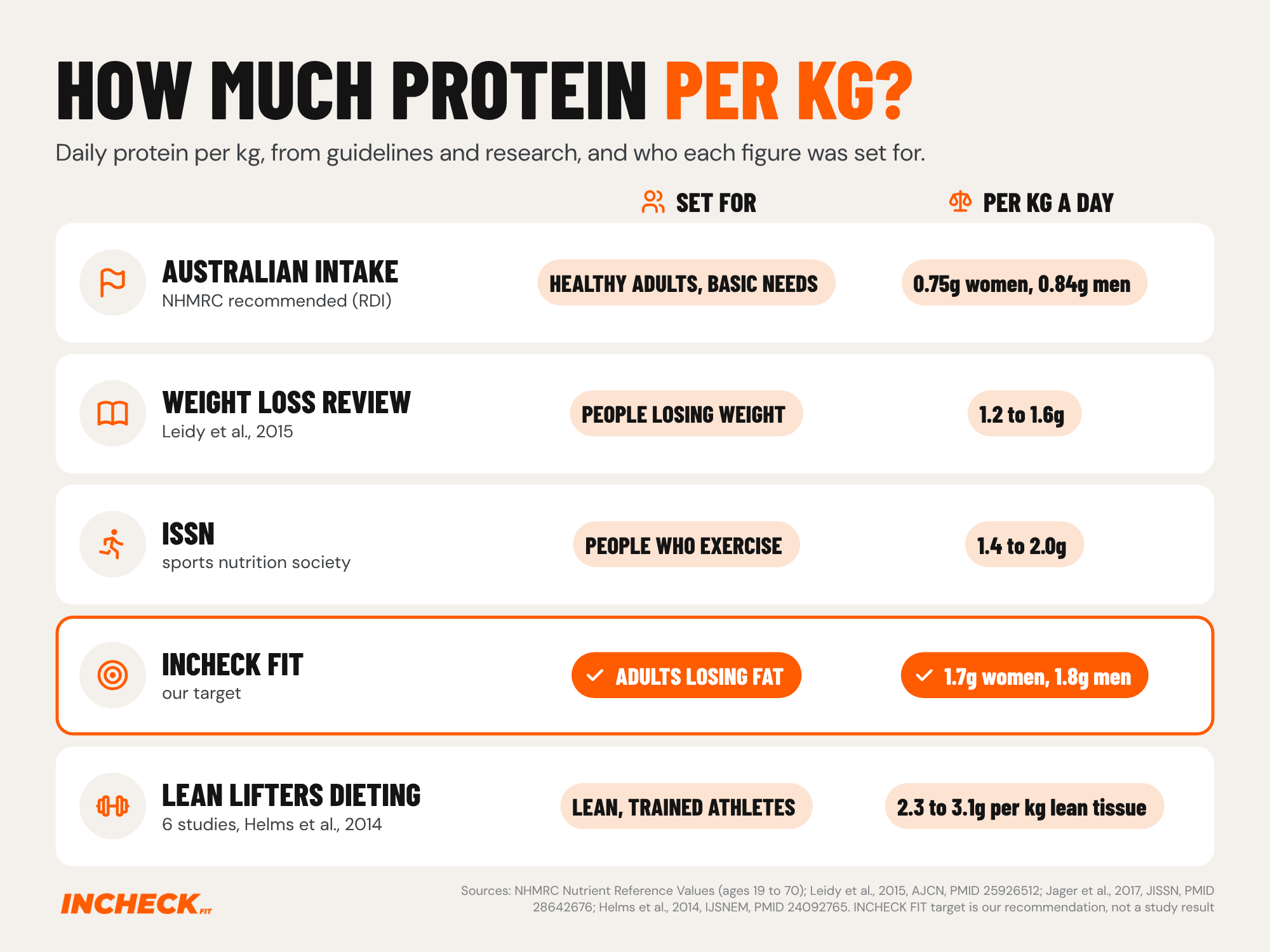
The floor. Australia’s recommended dietary intake for adults aged 19 to 70 is 0.75g per kg a day for women and 0.84g for men. It’s set to cover the needs of nearly all healthy people. It isn’t designed for holding on to muscle while you diet, so treat it as a minimum rather than a target.
For weight loss. A 2015 review of protein in weight loss pointed to higher-protein diets of 1.2 to 1.6g per kg a day for better appetite control and managing body weight.
For people who exercise. The International Society of Sports Nutrition puts 1.4 to 2.0g per kg a day as enough for most people who exercise to build and keep muscle.
For lean lifters dieting hard. A 2014 review of 6 studies in lean, resistance-trained athletes who were dieting suggested 2.3 to 3.1g per kg of lean tissue (your weight minus your fat), with the higher end for leaner people and bigger deficits. That’s per kg of lean tissue, not body weight, and it applies to people who are already lean and trained. Our take: most people don’t need that much.
Our take: we use 1.7g per kg for women and 1.8g for men. It sits inside the range for people who exercise, a little above the weight loss review’s range, and it’s a number most people can reach with normal meals. It’s our recommendation, built from those ranges, rather than a figure any single study tested.
You might also see “1.6g per kg” quoted as the magic number. That figure usually traces back to a 2018 analysis of 49 trials in 1,863 healthy adults doing weight training. In those adults, extra protein stopped adding to gains in lean tissue at about 1.6g per kg a day, though that cut-off wasn’t statistically certain and the likely range was wide, from about 1.0 to 2.2g. Those people weren’t dieting, so it’s a muscle-building figure, not a fat loss one.
What 1.7g per kg looks like in a day
The maths is your body weight times 1.7 if you’re a woman, or 1.8 if you’re a man.
- 65kg woman: 65 x 1.7 = about 110g a day.
- 85kg man: 85 x 1.8 = about 153g a day.
Here’s how the 65kg woman could get there with four ordinary meals.
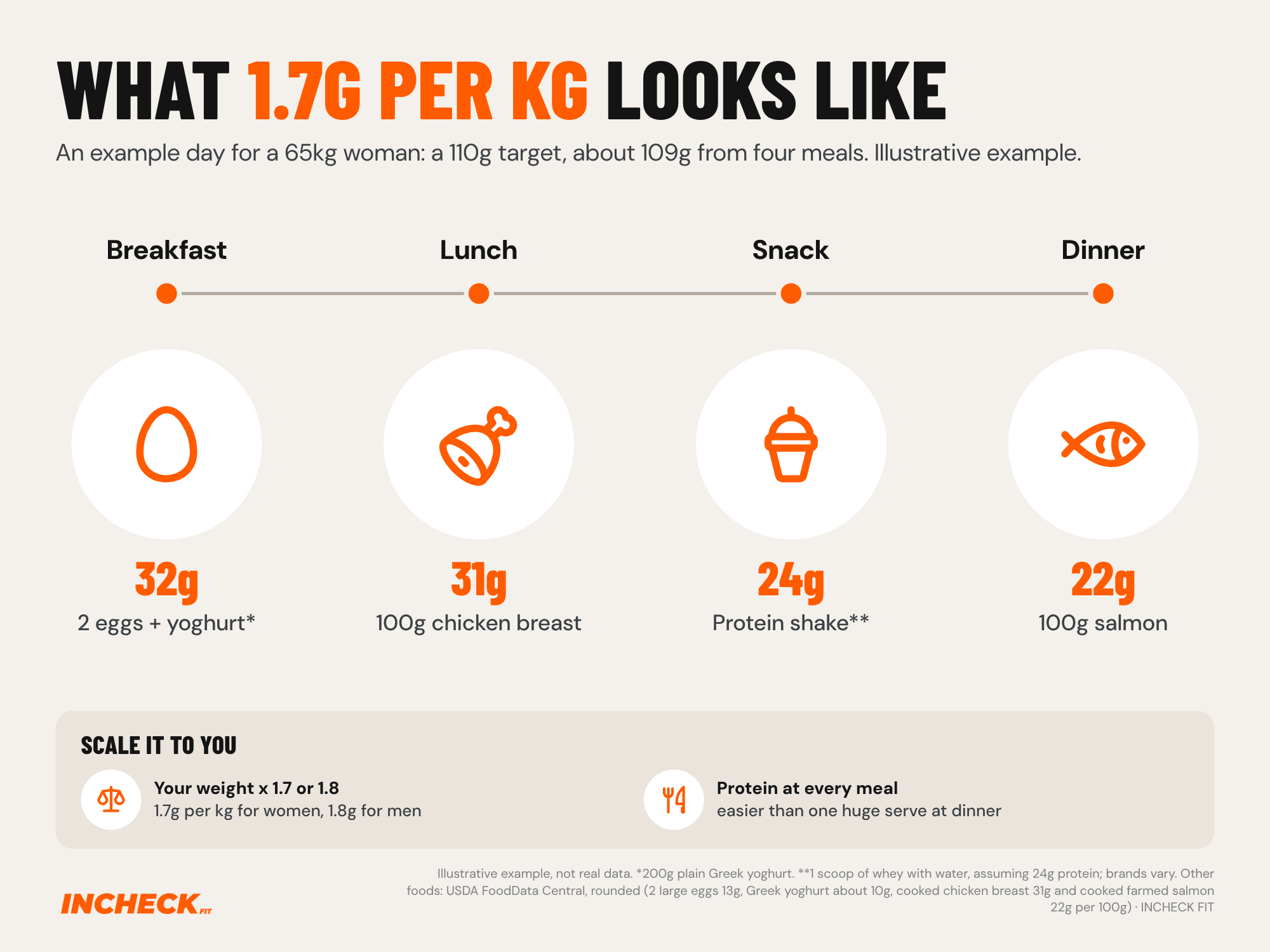
For the 85kg man, scale it up. Have three eggs with the yoghurt at breakfast, 150g of chicken at lunch, the same protein shake and 200g of salmon at dinner. That’s roughly 153g, before the smaller amounts in bread, rice and vegetables.
These protein values are typical figures from food composition data, rounded. The shake assumes a scoop of whey with about 24g of protein. Protein varies a lot between yoghurts and protein powders, and farmed salmon has a little less than wild, so check the label on what you’re actually eating. If you want to split your target evenly, our guide to how much protein per meal covers how many meals to spread it across.
Should you use your current weight or goal weight?
INCHECK FIT uses your current body weight. It’s simple, and the research ranges above are mostly given per kg of body weight.
There’s a catch if you’re carrying a lot of extra weight. At 110kg, 1.8g per kg is about 198g a day, which can be hard to eat. These ranges are mostly written per kg of body weight, and none of them says which weight someone carrying a lot of extra weight should use. We found no study that tested whether people with more body fat do better basing their target on current weight, goal weight or lean mass.
Our take: start from your current weight. If the number feels unrealistic, getting closer to it each week still moves you in the right direction. The 24-trial review above defined higher protein by its share of calories, not one exact per kg figure, and in those 1,063 adults the higher-protein diets still did better than standard ones.
Does more protein mean more fat loss?
It can, when you’re in a calorie deficit. Protein doesn’t burn fat by itself. What it mainly changes is how much of the weight you lose comes from fat rather than lean tissue, and it may make the deficit easier to stick to.
One trial shows this well, under tough conditions. Researchers put 40 young men on a diet about 40% below their energy needs for 4 weeks. All of them did weight training and interval sessions (short bursts of hard effort with rests) 6 days a week. Half ate 1.2g of protein per kg a day and half ate 2.4g.
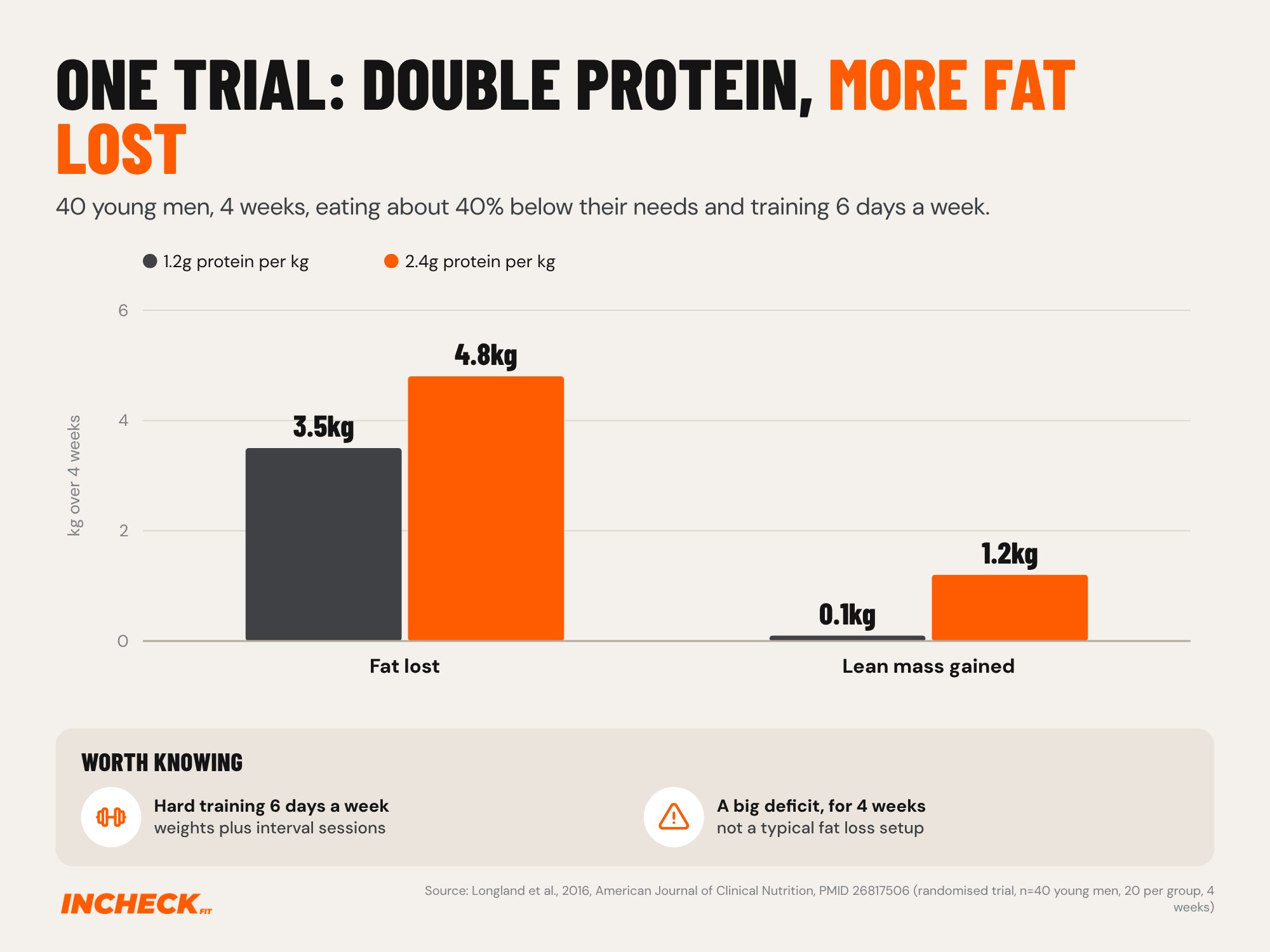
In those 40 young men, the higher-protein group lost 4.8kg of fat against 3.5kg, and gained 1.2kg of lean mass (lean tissue) against 0.1kg. Both groups improved their exercise performance by a similar amount.
That’s a big deficit and a heavy training load, held for only 4 weeks, in young men. It shows what protein can do in a hard cut. It doesn’t mean most people need 2.4g per kg, or that you’ll gain lean tissue in a deficit just by eating more protein.
A second trial points the same way in a broader group. In a trial of 39 men and women who ate 0.8g, 1.6g or 2.4g of protein per kg a day, people lost about 3.2kg on average during a 21-day deficit (about 40% below their needs), whichever protein level they ate. The two higher-protein groups lost less of that weight as lean tissue, and more of it as fat, than the 0.8g group.
This is also why lifting matters while you diet. Our take: strength training gives your body a reason to keep its muscle, and protein supplies the building blocks.
Can you eat too much protein?
For healthy adults, a higher-protein diet doesn’t appear to harm the kidneys. A review of 28 trials in 1,358 healthy adults without kidney disease looked at this. Kidney function changed no differently on higher-protein diets than on lower or normal-protein diets.
That finding only applies to people without kidney disease. If you have kidney disease, diabetes affecting your kidneys or another relevant condition, talk to your GP or an accredited practising dietitian before raising your protein.
The more practical limit is your calorie budget. Protein has calories like any other food. Our take: once you’re at your target, extra protein mostly takes up room that carbs could use to fuel your training.
How to hit your protein target
- Work out your number: body weight x 1.7 for women, or x 1.8 for men, or let our free calorie calculator do it alongside your calories.
- Put protein in every meal. Three or four meals with a decent serve each is easier than one huge dinner.
- Build meals around a protein food: meat, fish, eggs, Greek yoghurt, cottage cheese, tofu or legumes.
- Keep your deficit moderate. Our take: a deficit you can hold for months usually beats a harsh one you give up on. Here’s how many calories to eat to lose fat.
- Plan it ahead. It’s much easier to hit a number you planned for than one you try to catch up on at dinner.
Working this out meal by meal is the tedious part. INCHECK FIT builds your weekly meal plan to hit your calorie and protein targets, with the quantities set out, so the protein is already in the meals. If you’re comparing options, here’s our roundup of the best meal planner apps in 2026.
Frequently asked questions
-
How much protein a day for fat loss? We recommend about 1.7g per kg of body weight a day for women and 1.8g for men, alongside a calorie deficit, because protein supports fat loss but doesn’t cause it. For a 65kg woman that’s about 110g, and 153g for an 85kg man. It sits inside the 1.4 to 2.0g per kg range the International Society of Sports Nutrition gives for people who exercise. It’s a little above the 1.2 to 1.6g range from a 2015 review of weight loss diets.
-
Is 100 grams of protein enough for fat loss? It depends on your weight. At 1.7g per kg, 100g is about right for a woman of around 59kg, and at 1.8g per kg it suits a man of around 56kg. For anyone heavier, 100g falls short of our fat loss target. Our take: getting closer to your target each week still helps.
-
How much protein for a 70kg person? On our fat loss targets, a 70kg woman would aim for about 119g a day (70 x 1.7) and a 70kg man about 126g (70 x 1.8). Australia’s recommended intake for adults aged 19 to 70 at that weight is about 53g for a woman and 59g for a man, which covers basic needs rather than fat loss.
-
Should I base my protein on my current weight or my goal weight? INCHECK FIT uses your current weight, because the research ranges are mostly given per kg of body weight. No study we found has tested which works better for people carrying a lot of extra weight. If your number feels unrealistic, aim to get closer to it each week rather than giving up on it.
-
Do women need less protein than men to lose fat? In Australia’s guidelines the per kg difference is small: 0.75g for women and 0.84g for men aged 19 to 70. Our fat loss targets follow the same pattern: 1.7g per kg for women and 1.8g for men.
-
Can you eat too much protein when trying to lose weight? For healthy adults, a review of 28 trials in 1,358 people without kidney disease found kidney function changed no differently on higher-protein diets than on lower or normal-protein diets. If you have kidney disease or another relevant condition, check with your GP or dietitian first. Our take: beyond your target, extra protein mainly uses up calories.
-
Can protein help burn belly fat? No food targets fat in one area. Protein helps you lose fat overall in a calorie deficit while keeping more lean tissue. In 24 trials of reduced-calorie diets in 1,063 adults, higher-protein diets led to about 0.9kg more fat lost over roughly 12 weeks than standard-protein diets at the same calories.
-
Is 1g of protein per pound too much? One gram per pound is about 2.2g per kg. That’s above our target. In healthy adults without kidney disease, a review of 28 trials in 1,358 people found kidney function changed no differently on higher-protein diets. Our take: most people losing fat don’t need that much.
-
Do I need protein shakes to lose fat? No. Shakes are just a convenient way to add protein. Our take: most people can reach their target with meat, fish, eggs, dairy, tofu and legumes spread across three or four meals.
References
- Wycherley TP, Moran LJ, Clifton PM, Noakes M, Brinkworth GD. “Effects of energy-restricted high-protein, low-fat compared with standard-protein, low-fat diets: a meta-analysis of randomized controlled trials.” American Journal of Clinical Nutrition. 2012;96(6):1281-1298. PMID: 23097268. DOI: 10.3945/ajcn.112.044321. [Meta-analysis of RCTs, human, 24 trials, n=1,063 adults, mean 12.1 weeks. Weight -0.79kg, fat mass -0.87kg, fat-free mass +0.43kg versus standard protein; greater satiety in 3 of 5 studies. Abstract verified 12 Oct 2026 via Europe PMC; no corrections found.]
- Leidy HJ, Clifton PM, Astrup A, et al. “The role of protein in weight loss and maintenance.” American Journal of Clinical Nutrition. 2015;101(6):1320S-1329S. PMID: 25926512. DOI: 10.3945/ajcn.114.084038. [Narrative review. Abstract verified 12 Oct 2026 via Europe PMC: “between 1.2 and 1.6 g protein · kg-1 · d-1”; no corrections found.]
- Jäger R, Kerksick CM, Campbell BI, et al. “International Society of Sports Nutrition Position Stand: protein and exercise.” Journal of the International Society of Sports Nutrition. 2017;14:20. PMID: 28642676. DOI: 10.1186/s12970-017-0177-8. [Position stand. Abstract and full text verified 12 Oct 2026 via Europe PMC: 1.4 to 2.0g per kg body weight a day for most exercising people; no corrections found.]
- Helms ER, Zinn C, Rowlands DS, Brown SR. “A systematic review of dietary protein during caloric restriction in resistance trained lean athletes: a case for higher intakes.” International Journal of Sport Nutrition and Exercise Metabolism. 2014;24(2):127-138. PMID: 24092765. DOI: 10.1123/ijsnem.2013-0054. [Systematic review, human, 6 studies, energy-restricted, resistance-trained lean adults. “2.3-3.1g/kg of FFM”. Abstract verified 12 Oct 2026 via Europe PMC; no corrections found.]
- Morton RW, Murphy KT, McKellar SR, et al. “A systematic review, meta-analysis and meta-regression of the effect of protein supplementation on resistance training-induced gains in muscle mass and strength in healthy adults.” British Journal of Sports Medicine. 2018;52(6):376-384. PMID: 28698222. DOI: 10.1136/bjsports-2017-097608. [Meta-analysis and meta-regression, human, 49 trials, n=1,863 healthy adults doing resistance training, not energy-restricted. Breakpoint 1.62g/kg/day (95% CI 1.03 to 2.20; segmental model p=0.079). Abstract and full text verified 12 Oct 2026 via Europe PMC. One correction (2020, PMID 32943392) adds a competing-interest statement and does not change these figures.]
- Longland TM, Oikawa SY, Mitchell CJ, Devries MC, Phillips SM. “Higher compared with lower dietary protein during an energy deficit combined with intense exercise promotes greater lean mass gain and fat mass loss: a randomized trial.” American Journal of Clinical Nutrition. 2016;103(3):738-746. PMID: 26817506. DOI: 10.3945/ajcn.115.119339. [Randomised trial, human, n=40 young men (20 per group), 4 weeks, about 40% energy deficit, resistance training plus HIIT 6 days a week. LBM +1.2 vs +0.1kg; fat mass -4.8 vs -3.5kg. Abstract verified 12 Oct 2026 via Europe PMC; no corrections found.]
- Pasiakos SM, Cao JJ, Margolis LM, et al. “Effects of high-protein diets on fat-free mass and muscle protein synthesis following weight loss: a randomized controlled trial.” FASEB Journal. 2013;27(9):3837-3847. PMID: 23739654. DOI: 10.1096/fj.13-230227. [Randomised trial, human, n=39 adults, 31 days (10 days maintenance, 21 days deficit), 0.8, 1.6 or 2.4g/kg/day. 3.2kg lost regardless of protein; lower proportion of fat-free mass lost at 1.6 and 2.4g/kg. Abstract only, verified 12 Oct 2026 via Europe PMC; no corrections found.]
- Weigle DS, Breen PA, Matthys CC, et al. “A high-protein diet induces sustained reductions in appetite, ad libitum caloric intake, and body weight despite compensatory changes in diurnal plasma leptin and ghrelin concentrations.” American Journal of Clinical Nutrition. 2005;82(1):41-48. PMID: 16002798. DOI: 10.1093/ajcn/82.1.41. [Sequential diet study, no control group, human, n=19. Protein 15% to 30% of energy with fat 35% to 20%; spontaneous intake fell 441 kcal/day. Abstract verified 12 Oct 2026 via Europe PMC; two published comments, no corrections.]
- Devries MC, Sithamparapillai A, Brimble KS, et al. “Changes in kidney function do not differ between healthy adults consuming higher- compared with lower- or normal-protein diets: a systematic review and meta-analysis.” Journal of Nutrition. 2018;148(11):1760-1775. PMID: 30383278. DOI: 10.1093/jn/nxy197. [Systematic review and meta-analysis of RCTs, human, 28 trials, n=1,358 adults without kidney disease. Change in GFR did not differ between diets. Abstract verified 12 Oct 2026 via Europe PMC; no corrections found.]
- National Health and Medical Research Council. Nutrient Reference Values for Australia and New Zealand including Recommended Dietary Intakes. 2006, version 1.2 2017. Protein: RDI 0.84g/kg/day (men) and 0.75g/kg/day (women), ages 19 to 70. Read 12 Oct 2026 from the NHMRC PDF (nhmrc.gov.au). [RDI defined by NHMRC as meeting “the nutrient requirements of nearly all (97-98 per cent) healthy individuals”. Values and definition re-read 12 Oct 2026 on eatforhealth.gov.au in Chrome.]
- US Department of Agriculture. FoodData Central (SR Legacy), protein per 100g: chicken breast meat only, roasted 31g; Atlantic salmon, farmed, cooked 22.1g (wild 25.4g); Greek yoghurt, plain nonfat 9.5g; cottage cheese, 2% fat 10.4g; whole egg 12.6g. Read 12 Oct 2026.
Last reviewed: October 2026 by the INCHECK FIT nutrition team.
Last reviewed: October 2026