
The short answer:
- In a calorie deficit, weights and cardio lose a similar amount of fat.
- The difference is muscle. Strength training protects it; cardio alone protects less.
- If you only have time for one, lift. If you can do both, do both.
- The deficit does most of the fat loss, whichever you choose.
If you can only pick one, pick weights. Not because weights burn more fat, because in a calorie deficit they do not by any meaningful margin. The deficit does most of the fat loss whichever you choose. What strength training changes is what else comes off with the fat, and that is your muscle. If you can do both, both is a strong choice.
Most people asking this question want the same outcome: less body fat and a toned, defined shape underneath. That goal is really two goals at once, lose fat and keep muscle, and the two training styles are not equally good at the second one. This article covers what the research shows for fat, what it shows for muscle, why cardio still earns its place, and how to put it together in a normal week.
First, be clear on the goal
“Fat loss” and “weight loss” are not the same outcome. You can lose weight by losing fat, muscle, water or a mix, which is also why weight gain and fat gain are not the same thing either. For most people, the shape they are after comes from losing fat while holding onto the muscle they have.
That is why the question “which burns more?” is the wrong place to start. The more useful question is “which gives me the best result in the mirror for the effort I can sustain?”
What the research shows for fat
A 2025 network meta-analysis pooled 62 randomised controlled trials covering 4,429 healthy participants, all of whom were eating in a calorie deficit (Xie et al., 2025). The trials compared diet alone with diet plus aerobic training, diet plus resistance training, and diet plus a mix of the two, at different intensities.
Across those 62 trials, every approach reduced fat mass compared with control, and the estimates for aerobic, resistance and mixed training sat close together with overlapping confidence intervals. In plain terms, when everyone was in a deficit, no single training style was a clear winner for fat lost.
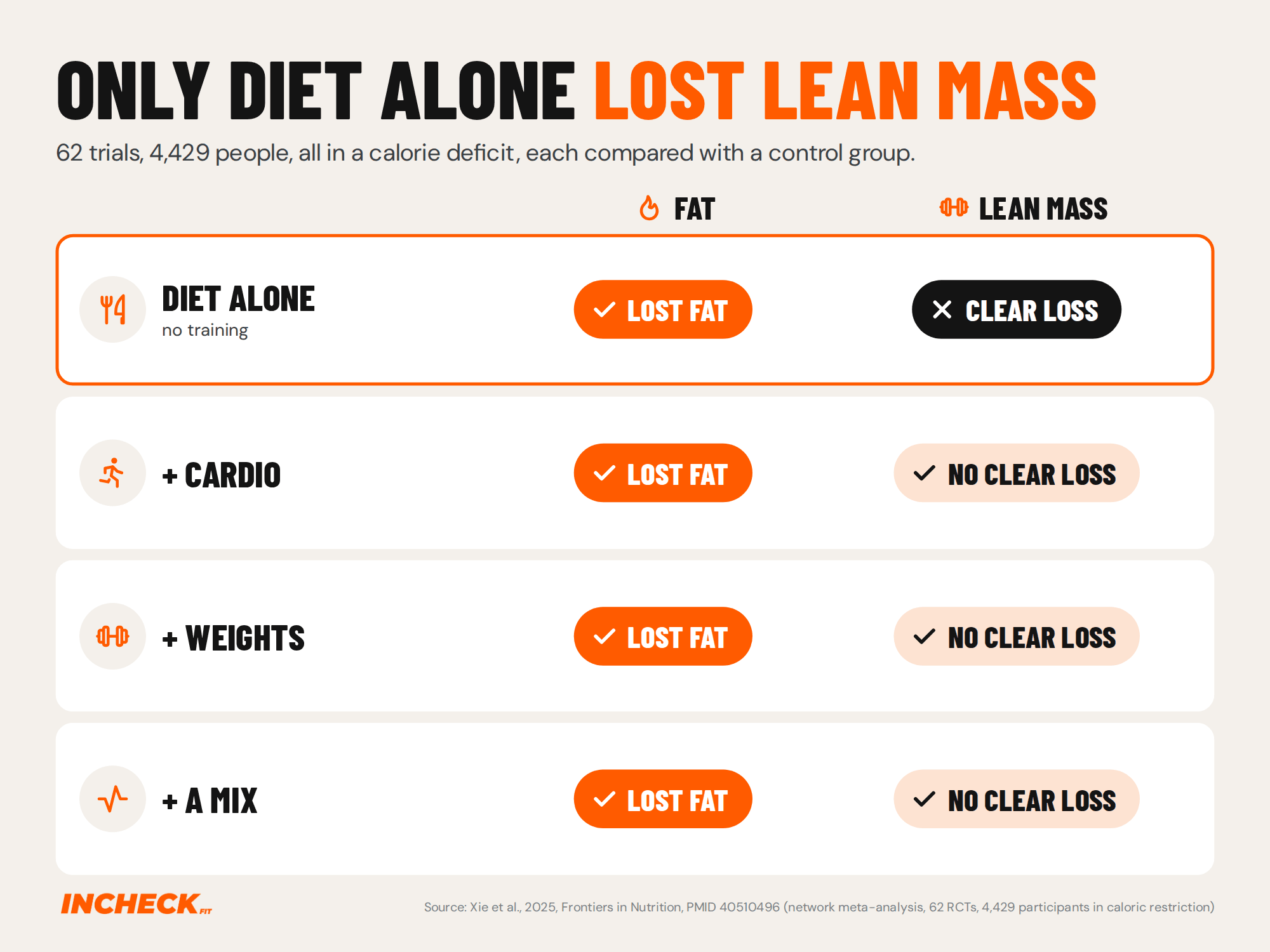
That matches what most coaches see. The deficit is the main driver of fat loss. Training adds to it, but the difference between training styles is smaller than the marketing suggests.
What the research shows for muscle
This is where the answer lives.
In the same 2025 analysis of 62 trials, diet alone was the approach that ranked worst for preserving lean body mass, and it was the only approach whose lean mass loss was clearly different from zero (Xie et al., 2025). When exercise was added, lean mass change was no longer statistically distinguishable from zero, and it sat closest to zero with moderate or low intensity resistance training and with mixed training. The authors concluded that combining moderate and low intensity resistance or aerobic exercise with calorie restriction optimises fat loss while preserving lean body mass.
A randomised trial published in the New England Journal of Medicine shows the difference more concretely. It put 160 adults aged 65 and over with obesity on the same diet for 26 weeks and split them into aerobic, resistance, combined or no exercise groups (Villareal et al., 2017).
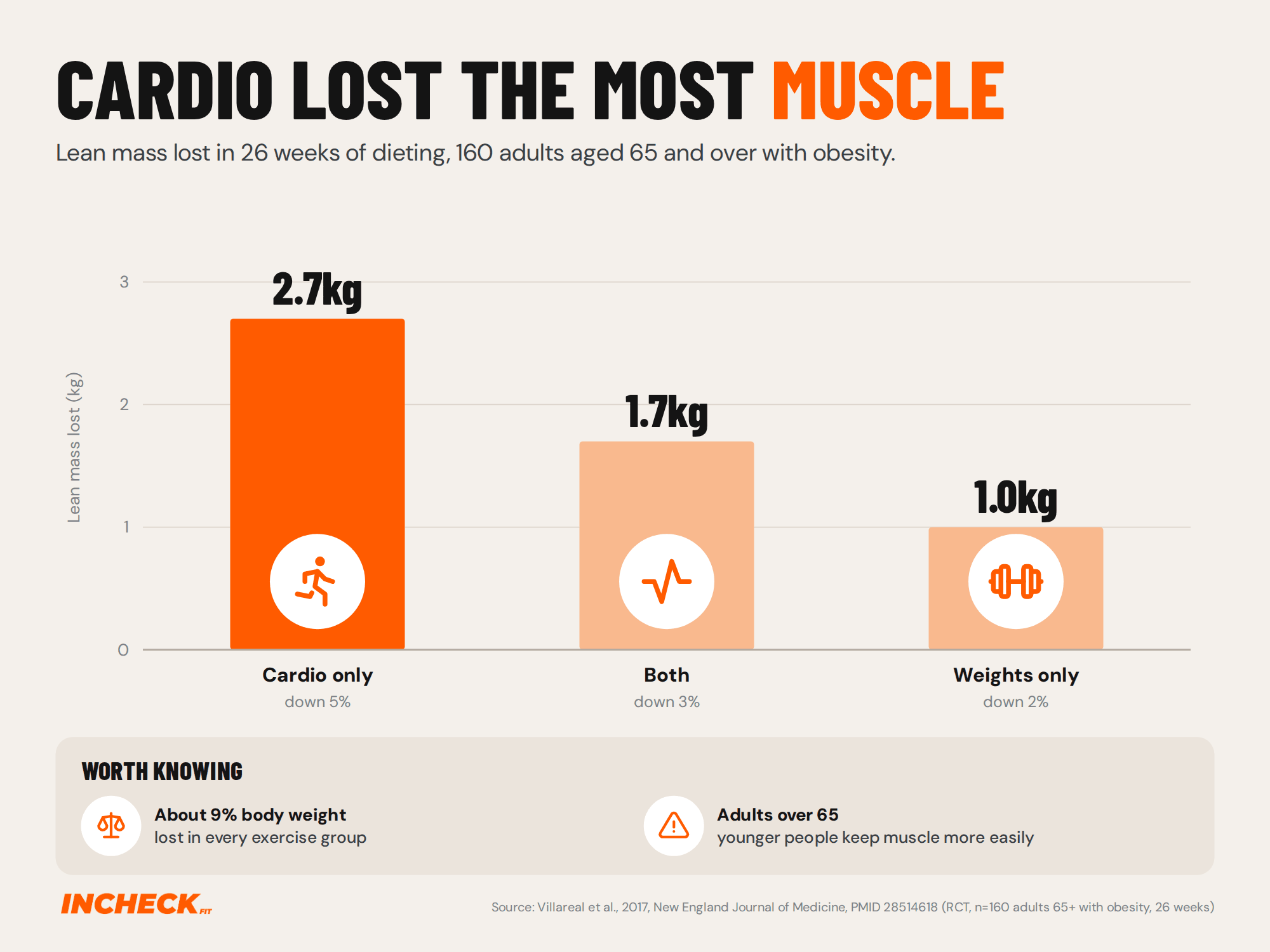
In that trial of 160 older adults with obesity, body weight fell by about 9% in all three exercise groups. Lean mass did not fall equally. Average lean mass dropped 2.7kg (5%) in the aerobic group, 1.0kg (2%) in the resistance group and 1.7kg (3%) in the combined group. Same weight lost, very different amounts of muscle kept.
That trial studied adults over 65, who lose muscle more easily than younger people, so the exact percentages should not be applied to a 30 year old. The direction, though, matches the wider body of research: in a deficit, strength training is what tells your body the muscle is still needed.
Why muscle matters for the result you want
Keeping muscle while you lose fat is what produces the defined, toned look most people describe as their goal. Lose the fat and the muscle together and you end up smaller but softer, which is a common and frustrating outcome of dieting without resistance training.
Muscle also supports strength and everyday function, and it matters more with age, when muscle loss rather than a slowing metabolism drives much of the change. The trial above was designed around exactly that concern in older adults.
So is cardio pointless?
No. Cardio is good for your heart, your fitness and your mood, and for many people it makes a deficit easier to hold because it feels good and fits easily into a day. The 2025 analysis only looked at body composition and did not measure cardiovascular health, which its authors list as a limitation. Cardio’s biggest benefits sit outside what that analysis measured.
The 160-person trial did measure fitness, and it shows each type of training doing its own job. Over 26 weeks of dieting, peak aerobic fitness rose 18% with cardio only, 17% with both combined and 8% with weights only, while strength rose 4%, 18% and 19% respectively (Villareal et al., 2017). Combining the two was the only approach that improved both substantially.
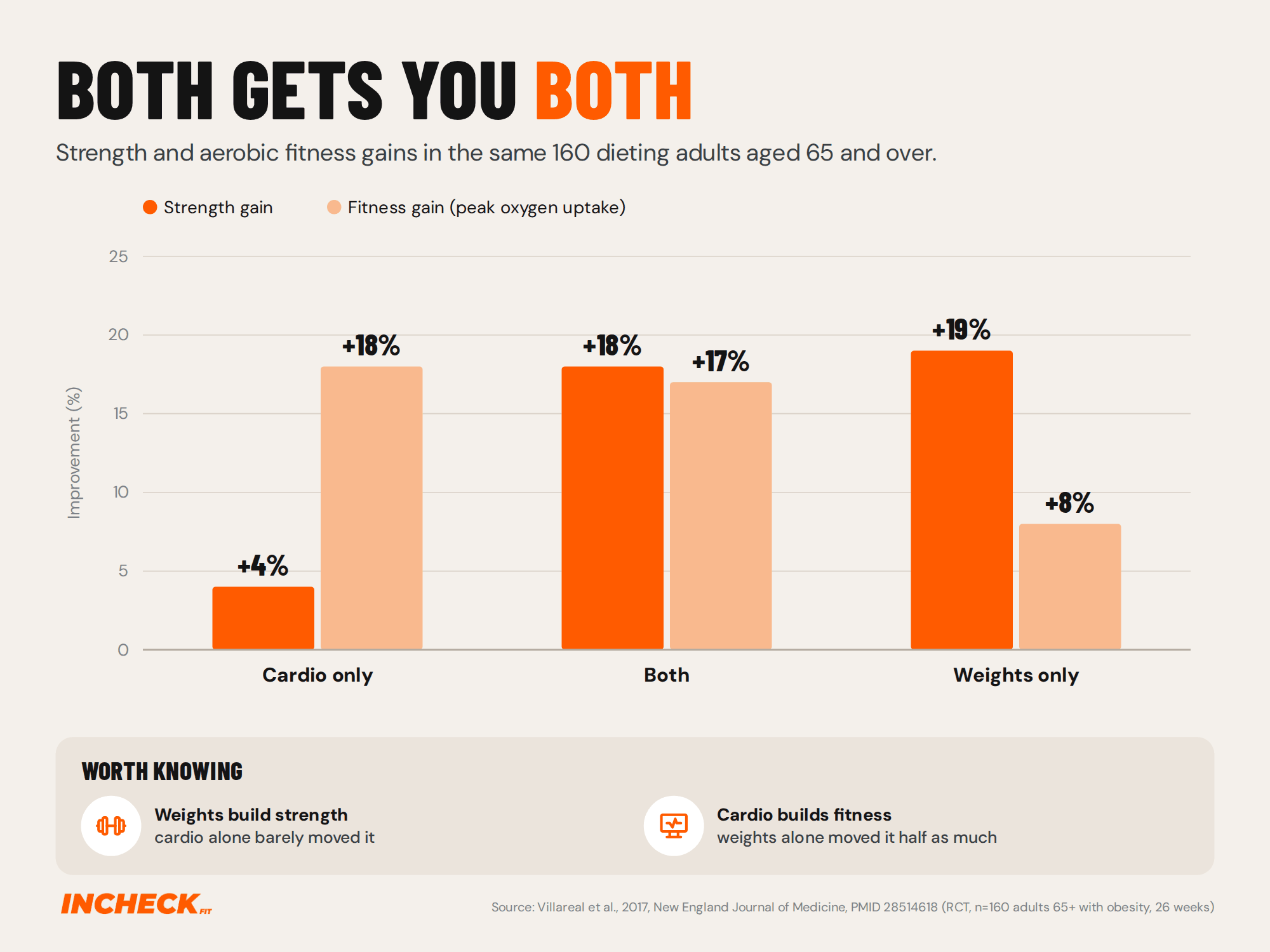
It is just not the fat loss lever it is often sold as. Adding another spin class will not outrun a diet that is not in a deficit, and on its own it does less than weights to protect your muscle.
What this looks like in a real week
A practical setup for most people, based on the research above and practitioner experience:
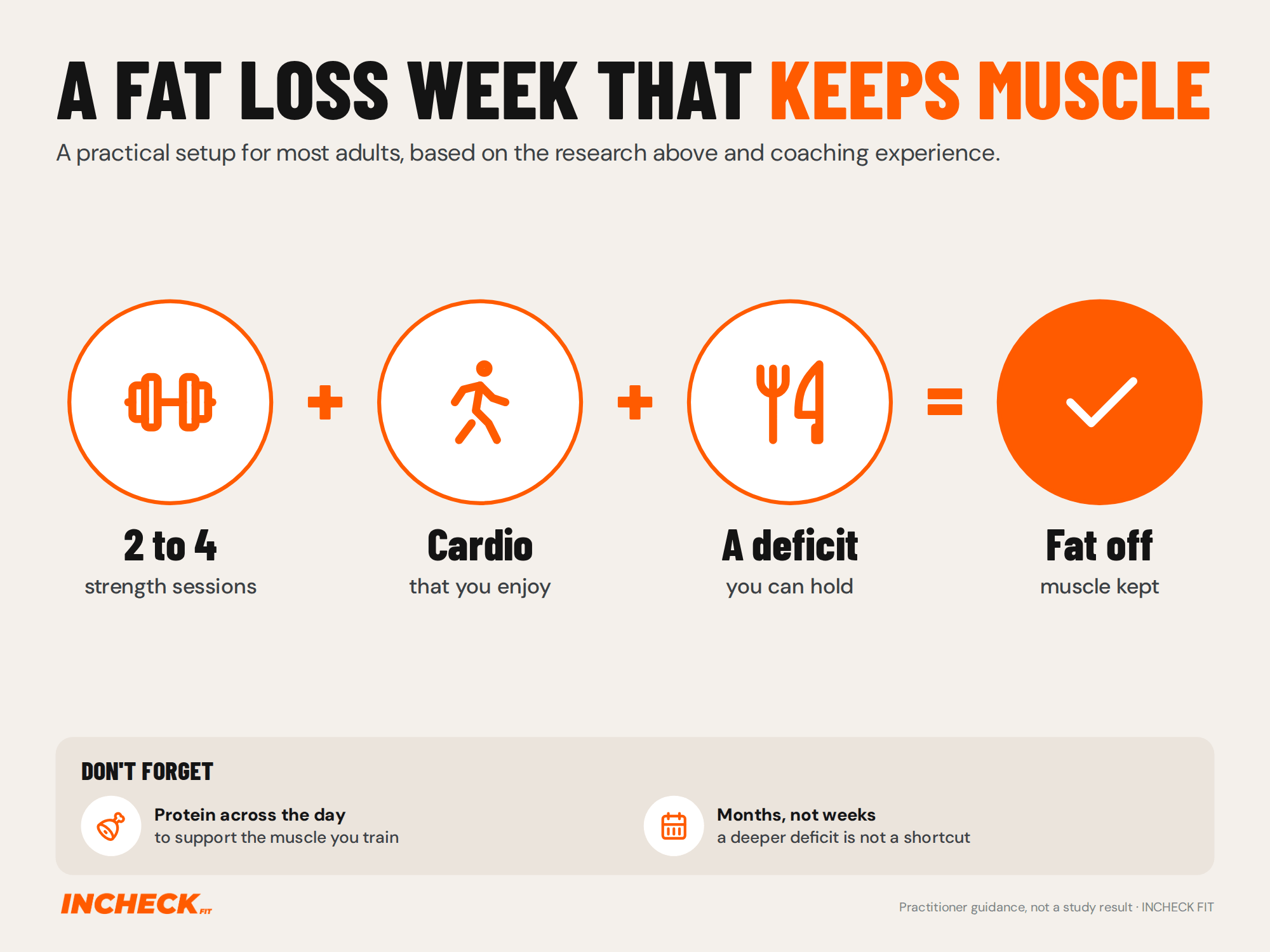
- Two to four strength sessions a week covering the whole body, with the weights challenging enough that the last few reps are hard.
- Cardio you enjoy, on top, whether that is walking, cycling, running or classes. Walking counts.
- A moderate calorie deficit you can hold for months, not an aggressive one you abandon in three weeks. A deeper deficit is not a shortcut, and it makes keeping muscle harder.
- Enough protein across the day to support the muscle you are training. Here is how much protein per meal to aim for.
The food side is where most people get stuck, because it asks for decisions every day. That is the part INCHECK FIT is built for: it gives you a weekly meal plan built to your calorie and protein targets, with the quantities set out, and a weekly progress review adjusts those targets as your body changes. The food is decided, and you get on with the training.
If you have a medical condition, are new to exercise, or are over 65, check in with a GP or an accredited exercise physiologist before starting a new program.
Frequently asked questions
-
Is weight training or cardio better for fat loss? In a calorie deficit, they lose a similar amount of fat. A 2025 network meta-analysis of 62 trials and 4,429 healthy participants found no clear winner between aerobic, resistance and mixed training for fat lost. The difference is muscle, and resistance training does more to protect it.
-
If I can only do one, should I lift or do cardio? Lift. In a randomised trial of 160 dieting adults aged 65 and over, all exercise groups lost about 9% of body weight, but lean mass fell 2.7kg (5%) with cardio alone and 1.0kg (2%) with weights alone. Weights help make sure the weight you lose is mostly fat.
-
Is doing both weights and cardio better? Combining the two is a strong option. In the 2025 analysis of 62 trials, mixed training was among the approaches that best preserved lean mass during a deficit. You also get the heart and fitness benefits of cardio.
-
Does dieting without exercise lose muscle? It can. In the 2025 network meta-analysis of 62 trials in healthy people eating in a deficit, diet alone was the only approach with a clear loss of lean body mass. Adding exercise, especially resistance training, reduced that loss.
-
Does cardio burn muscle? Cardio does not directly burn muscle, but in a calorie deficit it does less than strength training to protect it. In a trial of 160 dieting older adults, the cardio-only group lost 2.7kg (5%) of lean mass on average, compared with 1.0kg (2%) in the weights-only group.
-
Do I need to lift heavy to keep muscle while losing fat? Not necessarily. The 2025 analysis of 62 trials in healthy people found that moderate and low intensity resistance training ranked well for preserving lean mass during a deficit. What matters most is that the training is challenging and consistent.
-
How much fat loss comes from training versus diet? In the research above, the calorie deficit drives most of the fat loss, and adding training increases it only modestly. Training’s bigger contribution in a deficit is protecting muscle, which shapes how the result looks.
References
- Xie Y, Gu Y, Li Z, Zhang L, Hei Y. “Comparing exercise modalities during caloric restriction: a systematic review and network meta-analysis on body composition.” Frontiers in Nutrition. 2025;12:1579024. PMID: 40510496. DOI: 10.3389/fnut.2025.1579024. PMCID: PMC12158682 [Systematic review and network meta-analysis, human, 62 RCTs, 4,429 healthy participants, all in caloric restriction, PROSPERO CRD42024588241. Results verified 24 Sep 2026 via the publisher page; abstract, PMID and corrections re-checked 28 Sep 2026 via PubMed, none found. Diet alone was the only arm whose lean mass change versus control excluded zero. Effect sizes are not quoted in this article because their units could not be confirmed.]
- Villareal DT, Aguirre L, Gurney AB, et al. “Aerobic or Resistance Exercise, or Both, in Dieting Obese Older Adults.” New England Journal of Medicine. 2017;376(20):1943-1955. PMID: 28514618. DOI: 10.1056/NEJMoa1616338 [Randomised controlled trial, human, n=160 adults aged 65 and over with BMI 30 or above, 26 weeks, 141 completed. Lean mass: aerobic 55.0 to 52.3kg, combined 56.5 to 54.8kg, resistance 58.1 to 57.1kg. Figures verified 24 Sep 2026 against a full-text copy and re-checked 28 Sep 2026 against the abstract via Europe PMC. Three published comments (PMIDs 28792875, 28813125, 29230758), no errata or retractions.]
Last reviewed: September 2026 by the INCHECK FIT nutrition team.
Last reviewed: September 2026