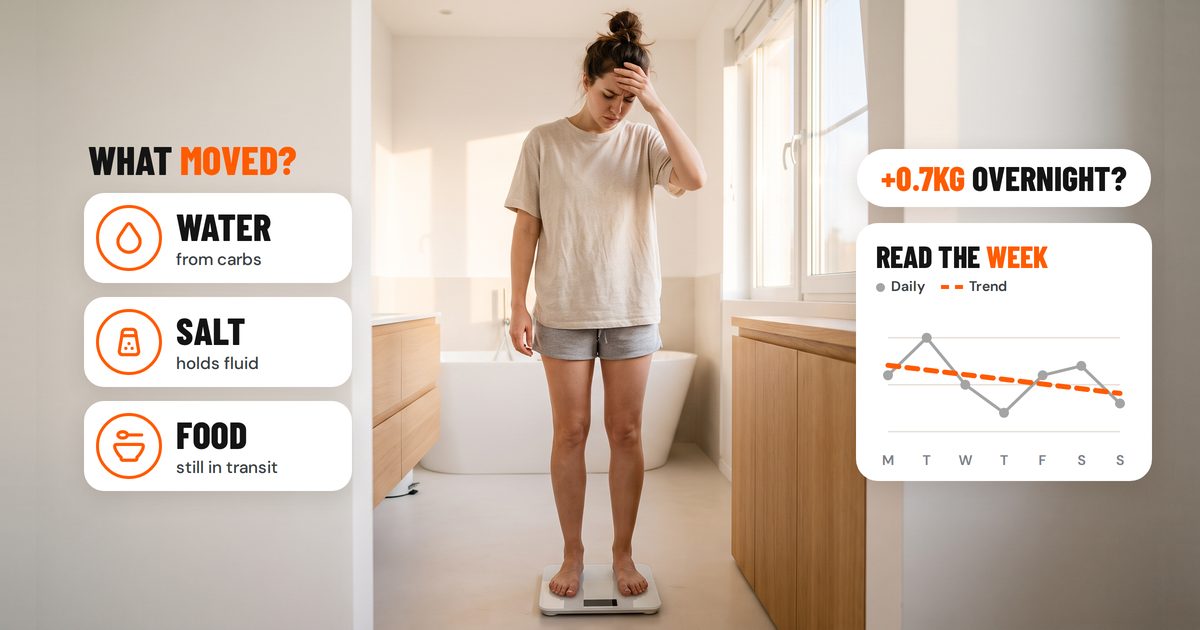
If your weight went up overnight, it is almost certainly not fat. One kilogram of body fat holds roughly 7,700 calories, so gaining a kilo of fat in a single day would mean eating about 7,700 calories on top of everything else you ate. Nobody does that by accident. What moved the number is water, food still in transit, and the other things your body carries from one hour to the next.
Weight gain and fat gain are not the same thing, and treating them as the same thing is one of the fastest ways to abandon a plan that is actually working. This article covers what the scale is really measuring, the arithmetic that rules fat out, the everyday causes of an overnight jump, and how to weigh yourself in a way that gives you a useful answer, if you choose to weigh at all.
What the scale is actually measuring
A bathroom scale measures how hard gravity pulls on everything you are carrying at that moment. That includes fat, but it also includes the water in your muscles and blood, the food in your stomach and gut, your bones and organs, and the glycogen stored in your liver and muscles.
The scale gives you the total. It never gives you the breakdown. A reading that is 1.5kg higher than yesterday tells you the total changed. It says nothing on its own about which part of the total changed.
That is why a single reading is such a poor guide to fat loss. Fat changes slowly. Water and gut contents change quickly. On any given morning, the fast-moving parts easily drown out the slow-moving one.
The 7,700 calorie test
The standard figure used in nutrition science is that 1kg of body fat is equivalent to about 7,700 calories of stored energy. It comes from the long-standing rule of 3,500 calories per pound, which Kevin Hall, then at the US National Institutes of Health, describes as 32.2 megajoules per kilogram (Hall, 2008). Hall’s modelling shows the rule is an approximation that works best for people with more body fat, but it is the right order of magnitude for the question here.
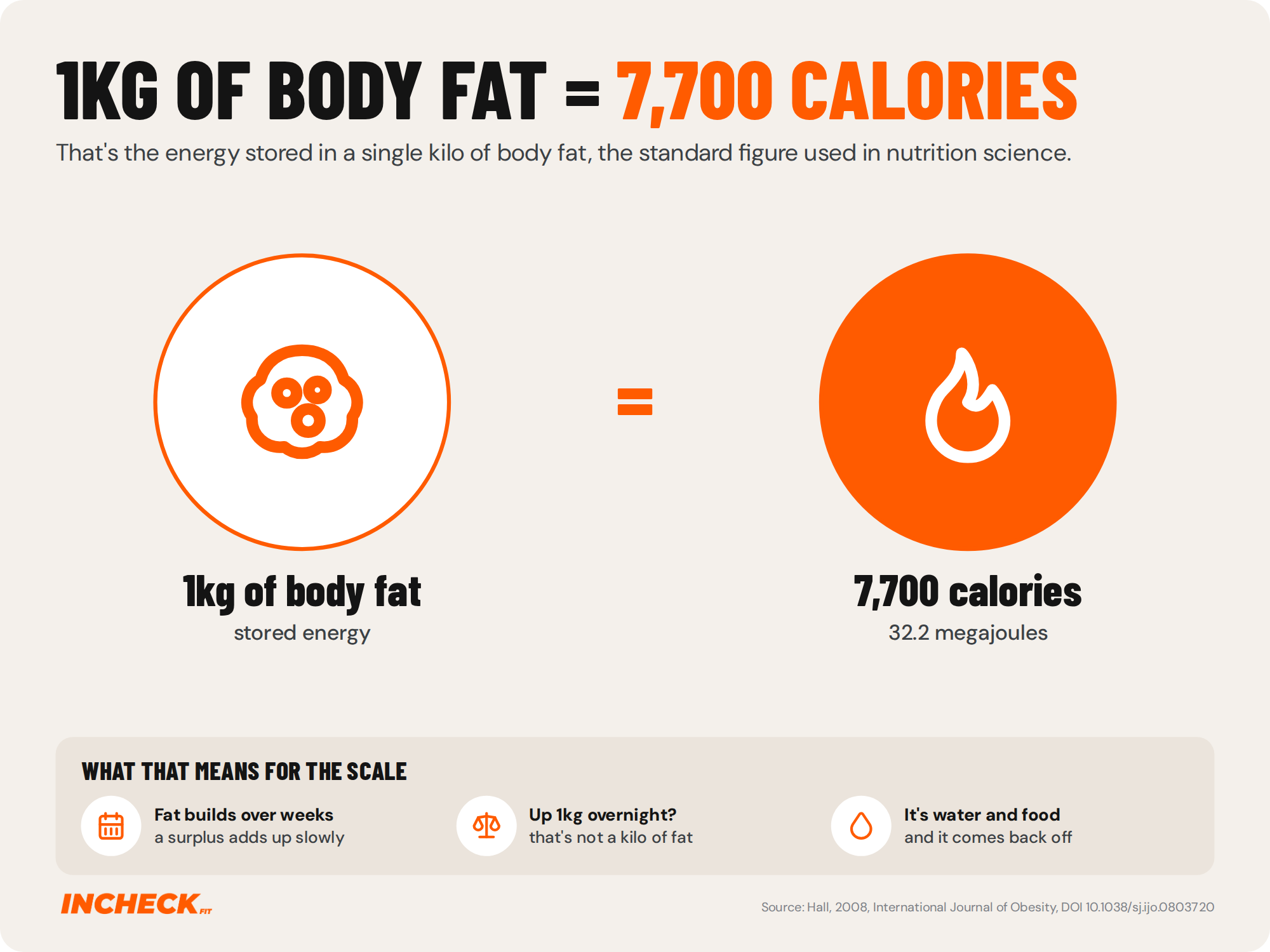
Now put that against a normal day. Australian food labels use 8,700 kilojoules, roughly 2,080 calories, as the reference daily intake for an average adult. To gain 1kg of fat overnight, an average adult would need to eat that full day of food and then roughly 3.7 more days’ worth on top, all before the next morning.
That is the test worth running any time the scale jumps. If you did not eat several extra days of food yesterday, the jump is not fat.
What actually moves the scale overnight
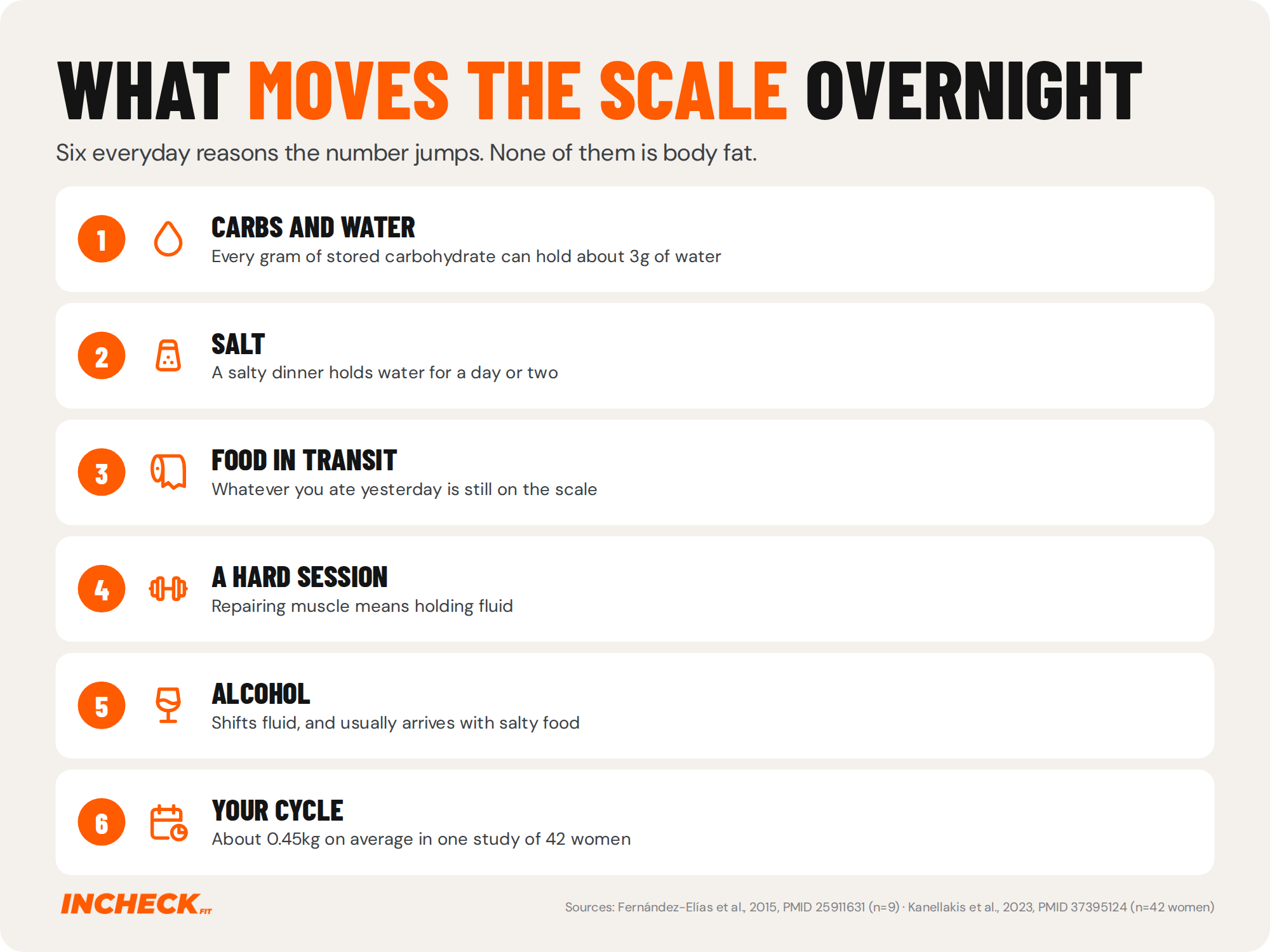
The normal day-to-day swing is often somewhere between half a kilo and two kilos, in either direction. That range is based on practitioner experience with clients rather than a single controlled study, and your own range may be smaller or larger. The causes below are the usual ones.
Carbohydrates and the water they hold
Your body stores carbohydrate as glycogen, in your muscles and liver, and glycogen is stored with water. In a study of nine aerobically trained adults recovering from a long cycling session in the heat, each gram of glycogen stored in muscle was stored with at least 3 grams of water (Fernández-Elías et al., 2015). The authors describe this as agreeing with the long-held notion of roughly 1:3.
So a higher carbohydrate day, a pasta dinner or a weekend of eating out, refills glycogen and brings water in with it. The scale goes up. None of that is fat.
Salt
A salty meal makes your body hold onto more water for a day or two while it rebalances. Restaurant food, takeaway and processed snacks are the common triggers.
Food still moving through you
Everything you ate yesterday that has not yet left your body is on the scale. A full gut can account for a meaningful amount of weight on its own, and a day of constipation shows up the same way.
A hard training session
Training, especially heavy or unfamiliar strength work, causes small amounts of muscle damage. Repairing it involves inflammation and fluid, so the day or two after a hard session often reads higher. This is a sign of your body adapting, not of fat gain. If you are deciding how to train while losing fat, here is whether weights or cardio is better for fat loss.
Alcohol
Alcohol can shift your fluid balance for a day or so, and it usually arrives with salty food, bigger portions and a late night. The combination makes the next few days noisy.
Hormones and your cycle
For women, hormonal changes across the menstrual cycle change how much water the body holds. In a study that weighed 42 women twice a week across their cycle, average body weight was about 0.45kg higher during menstruation than in the first week, driven by extra water outside the cells (Kanellakis et al., 2023). That is a group average, and individual swings can be noticeably larger or smaller, so it is more useful to learn your own pattern across a few cycles than to rely on any single figure.
Weekends leave a pattern too
Weight has a weekly rhythm for many people. In a study that analysed 4,657 weight measurements from 80 adults aged 25 to 62, weight rose from Saturday, peaked on Sunday and Monday, and fell again from Tuesday to Friday (Orsama et al., 2014). Among those 80 adults, the pattern was strongest in the people who went on to lose or maintain weight.
That last point matters. A Monday that reads higher than a Friday is normal, and it was most visible among the people who were succeeding.
Does this make the scale useless?
No. It makes a single reading unreliable. One reading is noise. The trend across weeks is the signal.
If you want the scale to be useful, the goal is to strip out as much of the noise as you can and then look at the average.
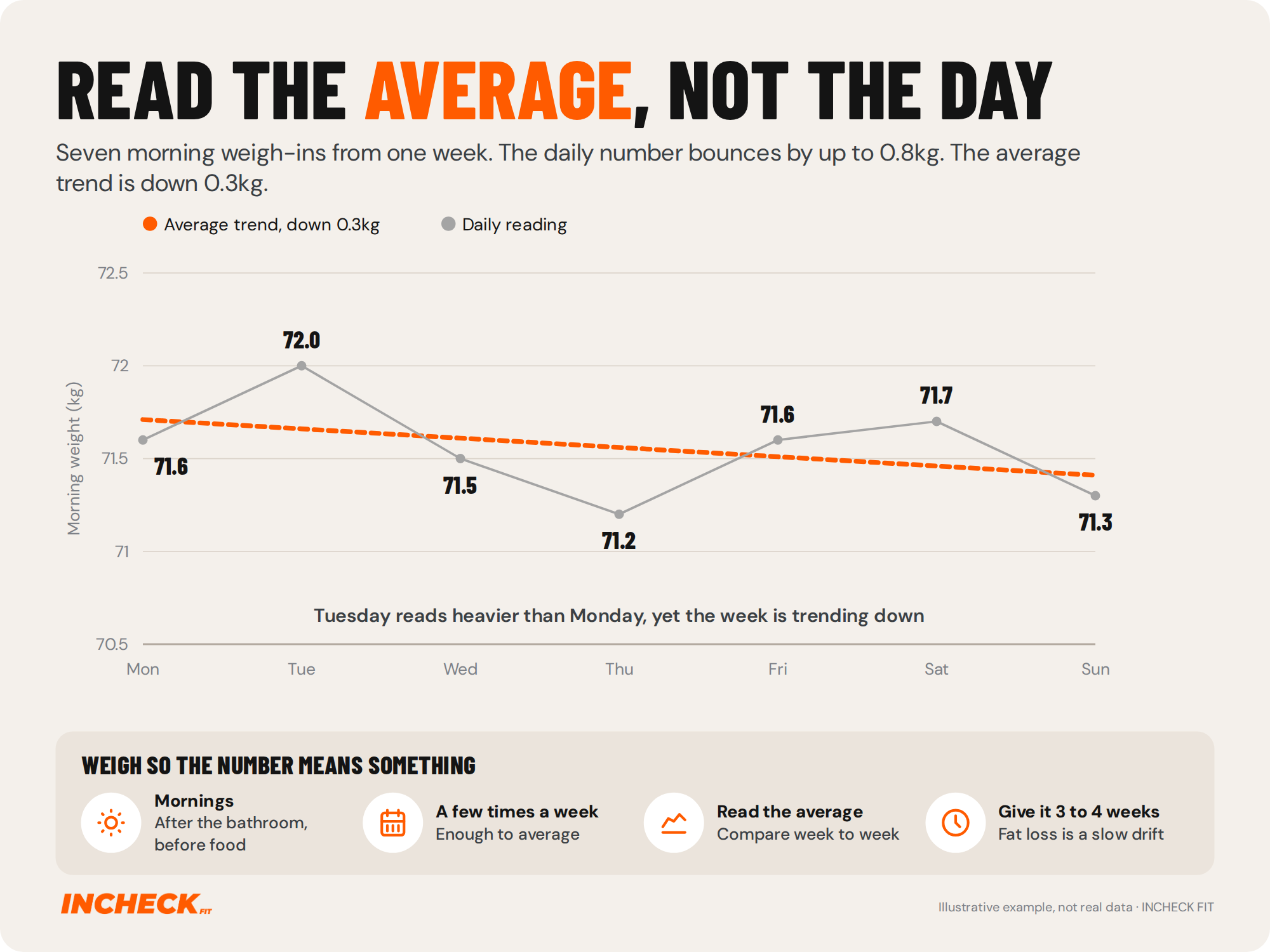
In the example week above, individual mornings bounce by up to 0.8kg and Tuesday even reads heavier than Monday, yet the average trend is down 0.3kg. Judge by one day and you’d think it went backwards. Judge by the week and it’s working. The readings are invented to show the principle, but the pattern is what most people see on their own scale.
How to weigh yourself so the number means something
If you are going to weigh, a few habits make the result far more trustworthy.
- Same time, same conditions. First thing in the morning, after the bathroom, before food or drink, in the same clothes or none.
- Weigh a few times a week, not once. A couple of readings across the week gives you something to average.
- Only read the weekly average. Compare this week’s average with last week’s. Ignore individual days.
- Write down the context. When a reading jumps after a salty dinner, a big training session or at a particular point in your cycle, note it and move on.
- Judge progress over three to four weeks. Fat loss shows up as a slow downward drift in the averages, not as a line that falls every morning.
INCHECK FIT reviews your progress weekly rather than daily for the same reason: it gives the trend time to show before your targets change.
Weighing is optional. For some people, the scale causes more stress than it is worth, and that is a legitimate reason not to use it. Measurements, how your clothes fit, energy, and progress in the gym are all valid ways to track change. If weighing is affecting how you feel about food or yourself, it is worth talking to a GP or an accredited practising dietitian.
What this means for fat loss
Fat loss happens when you are in a sustained calorie deficit over weeks. It does not happen, or reverse, in a night. The reverse is also true: a falling scale is not always falling fat. In one small two-week diet study of 10 adults, short sleep meant far less of the weight lost was fat. When the scale jumps, the most useful response is to check it against the 7,700 calorie test, note the likely cause, and keep doing what you were doing.
That consistency is also the hardest part for most people, because the decisions pile up day after day. It is the reason we built INCHECK FIT to plan the meals and handle the numbers, so the weekly average reflects a plan you could actually stick to rather than a guess.
Frequently asked questions
-
Why did I gain 1kg overnight? Almost certainly not from fat. One kilogram of body fat holds about 7,700 calories, so gaining it overnight would take around 7,700 calories on top of a normal day. The usual causes are extra water from carbohydrates or salt, food still in your gut, a hard training session, alcohol or hormonal changes.
-
Can you gain 2kg of fat in a day? Not realistically. Using the standard figure of about 7,700 calories per kilogram of body fat, 2kg of fat would take roughly 15,400 calories beyond what your body used that day. A 2kg overnight jump is water, food and gut contents.
-
How much does weight normally fluctuate in a day? In practice, a day-to-day swing of somewhere between half a kilo and two kilos is common, in either direction. That range comes from practitioner experience rather than a single controlled study, and it varies between people. Carbohydrates, salt, food in transit, training, alcohol and the menstrual cycle are the main drivers.
-
How much water does carbohydrate hold? In a study of nine aerobically trained adults recovering from prolonged exercise, each gram of glycogen stored in muscle was stored with at least 3 grams of water. That is why a higher carbohydrate day can raise the scale without any change in fat.
-
Is it normal to weigh more on a Monday? Yes, for many people. In a study of 80 adults and 4,657 weigh-ins, weight rose over the weekend, peaked on Sunday and Monday, and fell during the week. That pattern was strongest among the people in that study who lost or maintained weight.
-
How often should I weigh myself? If you choose to weigh, a few times a week under the same conditions, first thing in the morning, is enough to calculate a weekly average. Compare averages week to week rather than reacting to single readings. Weighing is optional, and other measures such as how your clothes fit are valid too.
-
How much weight can my period add? In a study that weighed 42 women twice a week across their cycle, average weight was about 0.45kg higher during menstruation than in the first week, mostly from extra water. Individual swings vary and can be larger, so tracking your weekly average across a few cycles shows your own pattern more reliably than any general figure.
References
- Hall KD. “What is the required energy deficit per unit weight loss?” International Journal of Obesity. 2008;32(3):573-576. PMID: 17848938. DOI: 10.1038/sj.ijo.0803720 [Mathematical modelling paper, human physiology. States the 3,500 kcal per pound rule as 32.2 MJ/kg (about 7,700 kcal/kg) and shows it approximates the energy density of lost weight best in people with more than 30kg of body fat, overestimating it for leaner people. Abstract verified 24 Sep 2026 via the publisher page; Crossref record checked 24 Sep 2026, no correction or retraction linked.]
- Fernández-Elías VE, Ortega JF, Nelson RK, Mora-Rodriguez R. “Relationship between muscle water and glycogen recovery after prolonged exercise in the heat in humans.” European Journal of Applied Physiology. 2015;115(9):1919-1926. PMID: 25911631. DOI: 10.1007/s00421-015-3175-z [Crossover trial, human, n=9 aerobically trained subjects, muscle biopsy. Abstract verified 24 Sep 2026 via the publisher page; Crossref record checked 24 Sep 2026, no correction or retraction linked. Note: the water-to-glycogen ratio is debated in the wider literature; this paper supports “at least 3g”, the bottom of the commonly cited 3 to 4g range.]
- Kanellakis S, Skoufas E, Simitsopoulou E, Migdanis A, Migdanis I, Prelorentzou T, Louka A, Moschonis G, Bountouvi E, Androutsos O. “Changes in body weight and body composition during the menstrual cycle.” American Journal of Human Biology. 2023;35(11):e23951. PMID: 37395124. DOI: 10.1002/ajhb.23951 [Observational, human, n=42 women measured twice weekly across the menstrual cycle; body weight about 0.45kg higher during menstruation than in week one, mainly from extracellular water. Abstract verified word for word 24 Sep 2026 via Europe PMC: weight 0.450kg higher during menstruation than in week one, extracellular water up 0.474kg. No correction or retraction linked.]
- Orsama AL, Mattila E, Ermes M, van Gils M, Wansink B, Korhonen I. “Weight rhythms: weight increases during weekends and decreases during weekdays.” Obesity Facts. 2014;7(1):36-47. PMID: 24504358. DOI: 10.1159/000356147 [Observational, human, n=80 adults aged 25 to 62, BMI 20.0 to 33.5, 4,657 weight measurements. Abstract re-verified word for word 24 Sep 2026 via the Karger publisher page; no correction, retraction or expression of concern linked. Co-author Brian Wansink had other, unrelated papers retracted from 2018; this paper is not among the linked notices.]
- Food Standards Australia New Zealand. Australia New Zealand Food Standards Code, Standard 1.2.8 Nutrition information requirements: 8,700kJ reference daily energy intake for an average adult, used for percentage daily intake labelling. [Regulatory reference value, not a study. Checked 24 Sep 2026 against FSANZ’s Labelling Review Recommendation 17 report, which quotes Standard 1.2.8 subclause 7(3): “based on an average adult diet of 8700 kJ”.]
Last reviewed: September 2026 by the INCHECK FIT nutrition team.
Last reviewed: September 2026