If you eat well most of the time and still cannot shift weight, you are not alone, and you are probably not doing something fundamentally wrong. The most common explanation is actually straightforward: eating nutritious food does not automatically create a calorie deficit, and without a calorie deficit, weight loss does not occur. This is not a reflection of your discipline or your effort. It is simply how human metabolism works. This article explains exactly why food quality and calorie balance are two separate things, which “healthy” foods are easiest to underestimate, and what actually needs to shift to start seeing real progress.
The One Rule That Overrides Everything Else
Weight loss comes down to energy balance. Your body burns a certain number of calories each day to keep you alive, functional, and moving. That number is your Total Daily Energy Expenditure (TDEE). When you consistently consume fewer calories than your TDEE, your body draws on stored fat for fuel and your weight decreases over time. When you consume the same or more, your weight holds steady or increases.
This is not a theory. It is a well-established physiological principle backed by decades of controlled research and reflected in guidance from major health bodies, including the World Health Organization.
The critical point: this rule applies regardless of the nutritional quality of the food you eat. Nutrient-dense foods can absolutely contribute to a calorie surplus. And a sustained calorie surplus produces weight gain whether the food causing it is avocado toast or a packet of biscuits. In energy terms, a sustained surplus is a surplus, whichever food it comes from.
Why “Healthy” and “Low Calorie” Are Not the Same Thing
This is where most people get stuck, and it is genuinely not their fault. Health food marketing often blurs the line between “good for you” and “good for weight loss.” The two things genuinely overlap in many ways, but they are not the same concept.
Nutrient-dense, whole foods are excellent for your health. They support energy levels, reduce inflammation, improve gut function, and lower long-term disease risk. But many of them are also calorie-dense, meaning they pack a significant number of calories into a relatively small serving size.
Calorie density is the key concept here. Nuts, nut butters, oils, avocado, granola and toasted muesli, dried fruit, and natural sweeteners like honey can all be legitimately good for you while still contributing far more calories than most people account for. The problem is not the food itself. The problem is the assumption that because it is healthy, it is also neutral from a calorie perspective.
Healthy Foods That Are Commonly Underestimated
The table below shows foods that appear regularly in the diets of people who eat well but cannot understand why the scales will not move. The gap between the labelled serving and a generous real-world portion is where a lot of unaccounted calories live.
| Food | Labelled Serving | Calories | A Generous Real-World Portion | Calories |
|---|---|---|---|---|
| Avocado | 100g (about two-thirds of an avocado) | about 155 kcal | 200g (a whole large avocado) | about 310 kcal |
| Almonds | 30g, about 23 nuts | 170 kcal | 60g, two relaxed handfuls | 340 kcal |
| Almond butter | 16g | about 100 kcal | 50g | about 300 kcal |
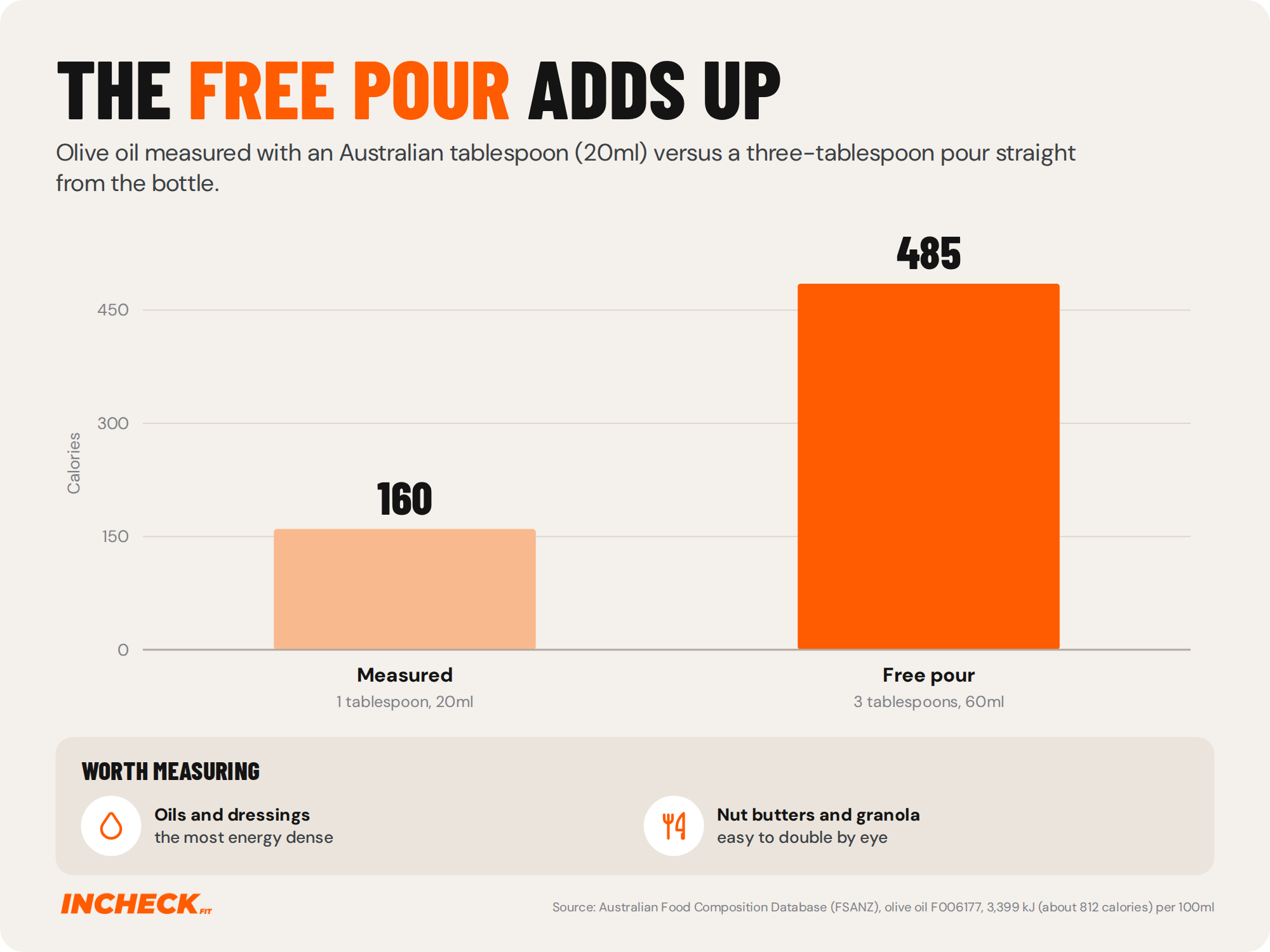
| Olive oil | 1 tablespoon (20ml) | about 160 kcal | 2 to 3 tablespoons per cook (40 to 60ml) | about 320 to 480 kcal |
| Granola | ½ cup (50g) | about 210 kcal | 1 full bowl (100g+) | 425+ kcal |
| Fruit juice | 1 glass (250ml) | about 90 kcal | Full 500ml bottle | about 180 kcal |
| Dried fruit (e.g. raisins) | 30g, a small handful | 90 kcal | 80g, sprinkled freely | 240 kcal |
Values from the Australian Food Composition Database, except almond butter (USDA). Granola and juice vary by brand, so check the label. An Australian tablespoon is 20ml.
Now consider a day built around these foods: avocado on sourdough for breakfast, a smoothie mid-morning, almond butter on rice cakes at lunch, dinner cooked in olive oil, and granola-topped yoghurt for dessert. That is an entirely reasonable, genuinely nutritious day of eating. It is also a day that could easily deliver 2,200 to 2,600 calories before a single piece of processed food enters the picture. For someone whose TDEE sits around 1,900 to 2,100 calories, which is common for smaller or less active adults, that represents a consistent daily surplus, not a deficit.
The issue is never the quality of the food. The issue is the assumption that quality automatically takes care of quantity.
The Portion Estimation Problem
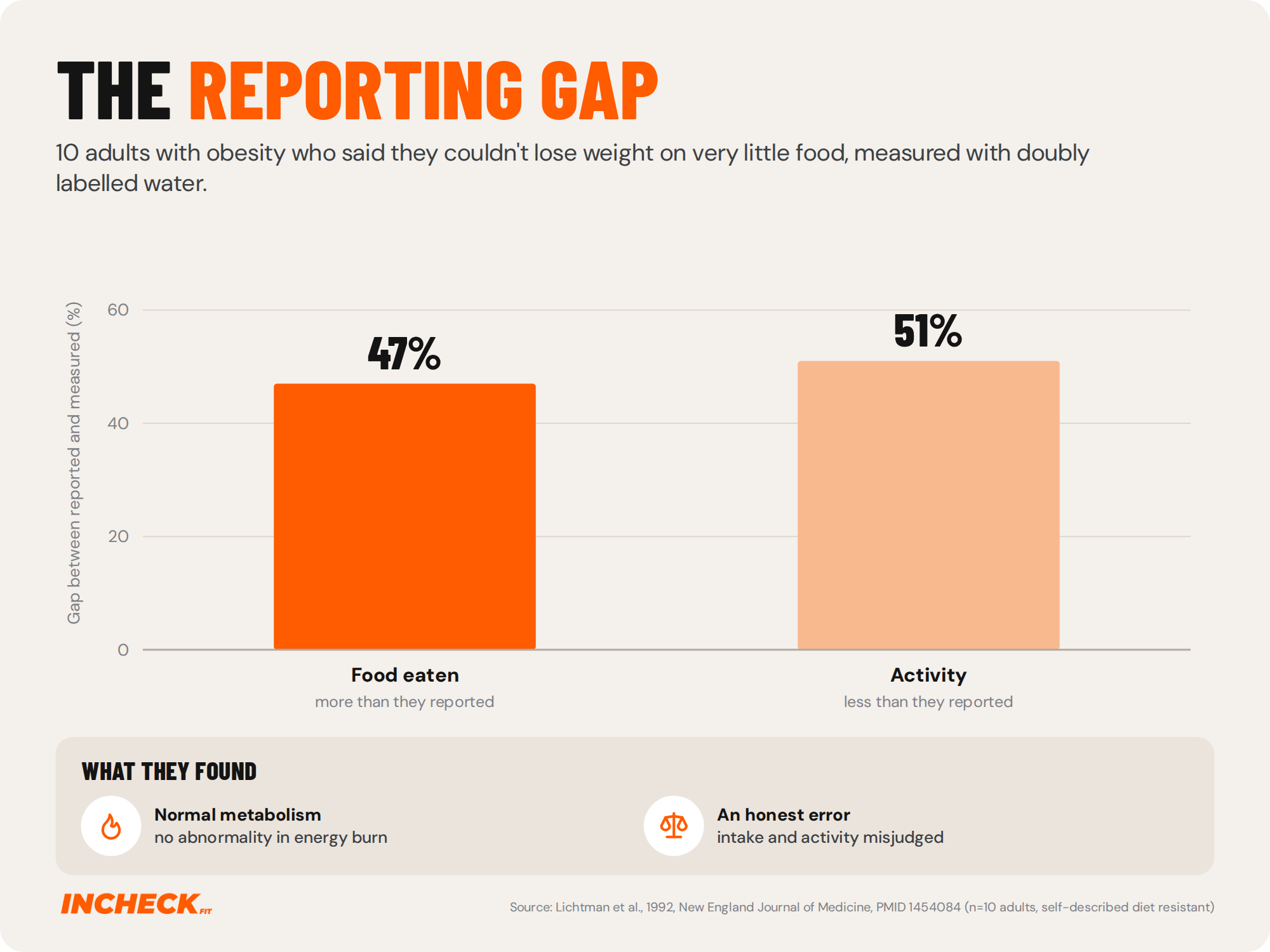
Even when people know which foods are calorie-dense, portion size remains a significant blind spot. A widely cited 1992 study in The New England Journal of Medicine followed 10 adults with obesity who said they could not lose weight despite eating very little. Measured with doubly labelled water, they had underreported their calorie intake by an average of 47% and overreported their physical activity by 51% (Lichtman et al., 1992). The researchers found no metabolic abnormality. The gap came from intake and activity being misjudged, which is a very human error rather than a sign of dishonesty.
Pouring olive oil rather than measuring it, scooping nut butter with a spoon instead of a tablespoon, and estimating a serving of granola by eye introduces meaningful calorie creep. A tablespoon of olive oil can easily be poured as two or three, and a single serve of almond butter can easily be doubled. Across every meal, every day, these small inaccuracies add up and can account for much of the gap between what people believe they eat and what they actually consume.
This does not require obsessive measurement forever. But for most people, spending even a short period measuring and weighing key foods is genuinely eye-opening, particularly for high-fat, calorie-dense staples.
It is also the problem we built INCHECK FIT to take off your plate. Every meal in your plan is built to your calorie and macro targets, so the portions are set before you start cooking rather than estimated by eye.
Liquid Calories Are Particularly Easy to Overlook
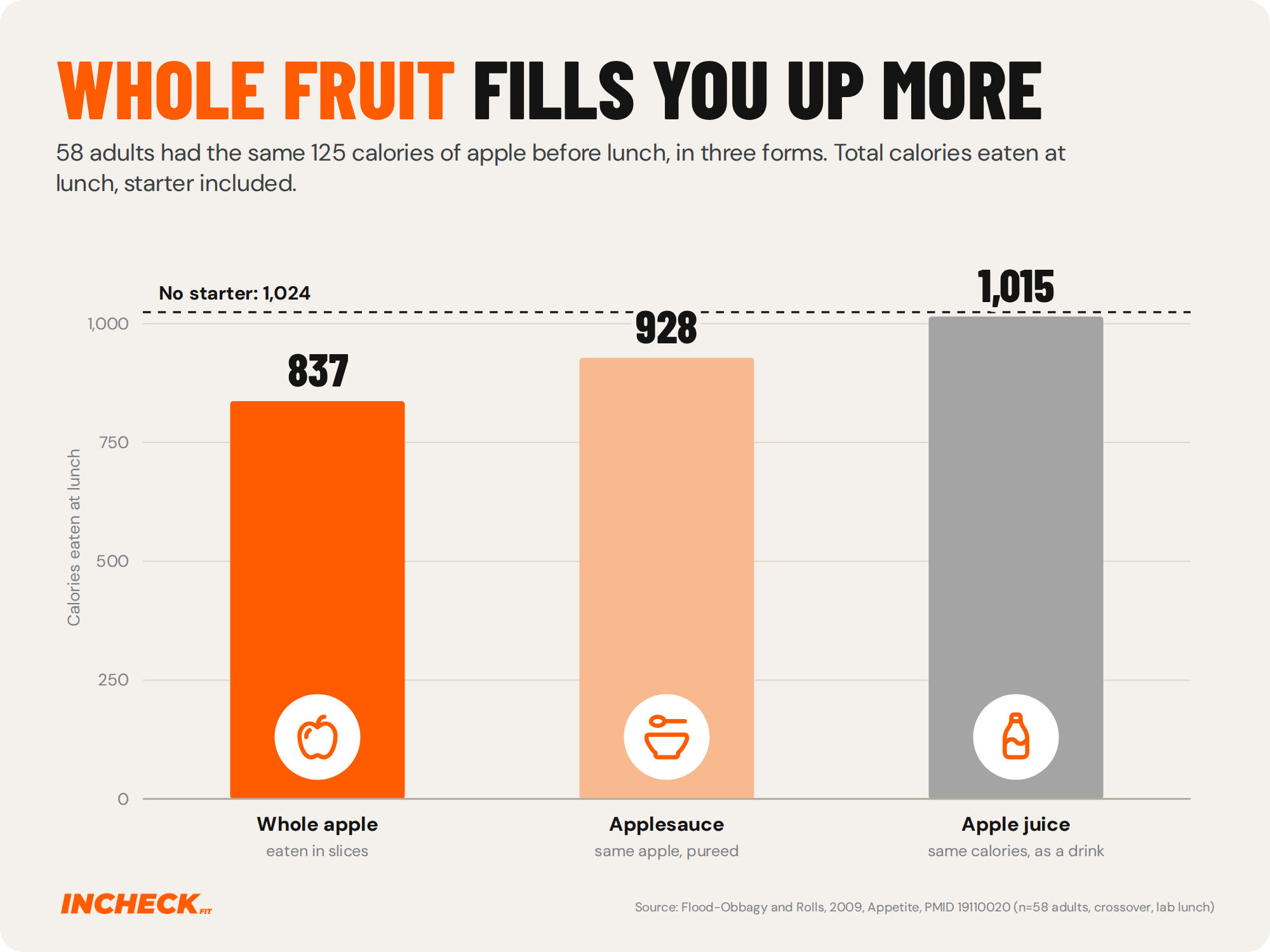
Drinks deserve separate attention because satiety research generally shows that drinks, especially sugary ones, do not fill you up the way the same calories from solid food do. In one lab study, 58 adults had the same 125 calories of apple before lunch on different days. As a whole apple, they ate about 187 fewer calories across the whole lunch than when they had no starter at all. As apple juice, the same calories made almost no difference to how much they ate in total (Flood-Obbagy and Rolls, 2009).
A 500ml bottle of juice can carry around 150 to 250 calories, a large oat milk latte around 200 more, and a protein smoothie built around banana, peanut butter and honey can reach 400 to 500, often without reducing hunger in any meaningful way.
This is not an argument against smoothies or lattes. It is an argument for recognising how much energy they contribute to your daily total, particularly when consumed in addition to regular meals rather than instead of them. A “healthy” afternoon smoothie that adds 400 calories on top of three substantial meals is a common reason why someone who eats well finds themselves in a consistent surplus.
Why Food Quality Still Matters (Just Not How You Think)
Understanding calorie balance does not make food quality irrelevant. It matters enormously. The distinction is that high-quality foods support the conditions that make a calorie deficit easier to achieve and maintain over time.
High-protein foods tend to be more satiating than foods high in fat or refined carbohydrate, meaning they help you feel fuller for longer and reduce the drive to overeat later in the day. Many high-fibre foods, particularly those rich in soluble fibre such as oats and legumes, slow digestion and can help you feel full. Protein also carries a higher thermic effect of feeding, meaning your body burns more energy digesting it compared to fat or carbohydrate (Westerterp, 2004).
A diet built on whole, minimally processed foods also tends to be far more sustainable than one built on restriction, and sticking with an approach is one of the biggest factors in lasting results. You are not going to maintain something you hate. Food quality shapes how liveable a calorie deficit feels. It just cannot create one on its own.
What Actually Needs to Change
If you eat well but are not losing weight, the most likely explanation is one of the following: your overall calorie intake is at or above your TDEE, your portions are larger than you are estimating, or calorie-dense healthy foods are consuming more of your daily energy budget than you realise. We rank every factor, from the deficit itself down to supplements, in our guide to not losing weight in a calorie deficit.
The practical solution is not to stop eating well. It is to get a clearer picture of what your body actually needs and to build your eating around that number. This means establishing an accurate TDEE based on your body stats, age, and activity level, then creating a genuine, sustainable deficit beneath it. Our free calorie calculator gives you that number in under a minute. For most people, this does not require overhauling their entire diet. It requires greater awareness around quantities, particularly for the calorie-dense foods they have been eating freely under the assumption that healthy means harmless.
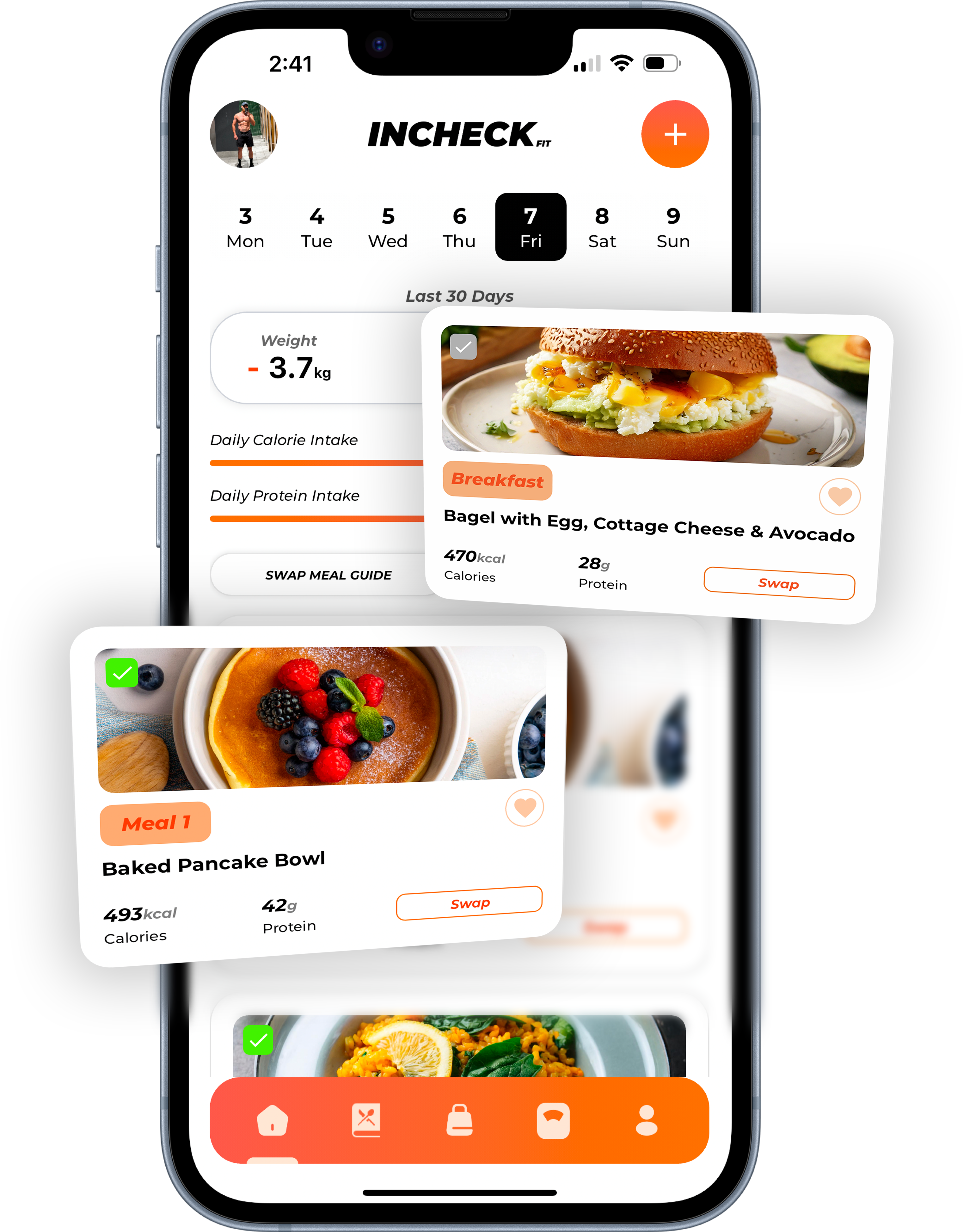
That is exactly what we built INCHECK FIT to do. It creates a personalised weekly meal plan built to your calorie and macro targets, worked out from your body stats, goal and activity level. Each week it reviews your actual progress and adjusts your targets if needed, so you stay in a deficit without logging a single meal. Weighing a few calorie-dense staples for the first couple of weeks still helps, so the plan matches what actually ends up on your plate.
Frequently Asked Questions
-
Can you gain weight eating only healthy food? Yes. Weight gain is determined by calorie balance, not nutritional quality. If your total calorie intake consistently exceeds the amount your body burns each day, weight gain will occur regardless of how nutritious those calories are. Nuts, avocado, olive oil, and granola are all genuinely good for you and all calorie-dense enough to cause a surplus when portions are not considered.
-
Do I need to count calories if I eat healthy? Not necessarily in the traditional sense, but you do need some level of awareness around your overall intake. Whether that means logging calories explicitly, working from a structured meal plan that accounts for your targets, or becoming more deliberate about portion sizes for high-calorie staples, the goal is to ensure your intake reliably creates a deficit rather than a surplus.
-
Why isn’t my weight changing even though I eat salads every day? Salads can vary significantly in calorie content depending on what goes into them. A salad containing avocado, feta, toasted seeds, smoked salmon, and an olive oil dressing can deliver 600 to 800 calories per serve. Dressings are easy to underestimate, because oil is so energy dense. The salad itself may be entirely nutritious, but if it contributes to a daily total that meets or exceeds your TDEE, weight loss will not occur.
-
Does eating healthy food speed up metabolism? No food meaningfully accelerates metabolism in a sustained way. Protein does carry a higher thermic effect than fat or carbohydrate, meaning the body burns slightly more energy digesting it. High-fibre foods may contribute marginally as well. But these effects are modest and do not override the fundamental role of calorie balance in determining weight change over time.
-
Is a calorie deficit the only way to lose weight? Every evidence-based approach to weight loss works because it creates a calorie deficit, whether that is made explicit or not. Low-carbohydrate diets, intermittent fasting, high-protein approaches, and time-restricted eating all produce weight loss when they reduce total calorie intake. The mechanism is always energy balance. The approaches differ only in how they achieve it.
-
How do I know if I’m actually in a calorie deficit? The most reliable indicator is gradual, consistent weight loss over several weeks. Judge it by the weekly average rather than single mornings, because day-to-day readings bounce with water and food. If your weight has not moved in three to four weeks despite your best efforts, your intake is likely matching or exceeding your expenditure. The starting point is establishing an accurate TDEE based on your body stats, age, and activity level, then building your intake around a realistic deficit beneath that figure. And if you have been in a genuine deficit for weeks with no change, starvation mode is very unlikely to be the reason.
References
-
Lichtman SW, Pisarska K, Berman ER, et al. “Discrepancy between self-reported and actual caloric intake and exercise in obese subjects.” New England Journal of Medicine. 1992;327(27):1893-1898. PMID: 1454084. DOI: 10.1056/NEJM199212313272701 [Human study, n=10 adults with obesity describing themselves as diet resistant (from 224 screened), intake measured by doubly labelled water. Abstract read via Europe PMC; citation details checked against the NEJM record, Sep 2026.]
-
Flood-Obbagy JE, Rolls BJ. “The effect of fruit in different forms on energy intake and satiety at a meal.” Appetite. 2009;52(2):416-422. PMID: 19110020. DOI: 10.1016/j.appet.2008.12.001 [Randomised crossover lab study, n=58 adults (30 men, 28 women), 266g, 125 calorie apple preloads. Figures from Table 3 of the full text (PMC2664987), read 25 Sep 2026.]
-
Westerterp KR. “Diet induced thermogenesis.” Nutrition & Metabolism. 2004;1:5. PMID: 15507147. DOI: 10.1186/1743-7075-1-5 [Review. Verified Sep 2026 via DOAJ abstract.]
-
World Health Organization. “Obesity and overweight” fact sheet. https://www.who.int/news-room/fact-sheets/detail/obesity-and-overweight [Guideline source. Checked Sep 2026.]
-
Food Standards Australia New Zealand. Australian Food Composition Database, Release 3. Food keys F000162 (Hass avocado, 653 kJ per 100g), F006081 (almond, raw, 2,386 kJ per 100g), F006177 (olive oil, 3,399 kJ per 100ml), F007610 (raisin, 1,282 kJ per 100g), F009807 (granola, toasted, 1,776 kJ per 100g), F004731 (orange and mango juice, 152 kJ per 100ml), F006131 (oat beverage, 236 kJ per 100ml). [Food composition data, not a population study. Each value read directly on the FSANZ AFCD site, 25 Sep 2026.]
-
US Department of Agriculture. FoodData Central, almond butter, plain (about 98 to 101 calories per 16g tablespoon). [Food composition data. Checked Sep 2026 via a secondary source displaying USDA values; no AFCD entry exists.]
Last reviewed: September 2026