
Yes. Bad sleep costs you twice.
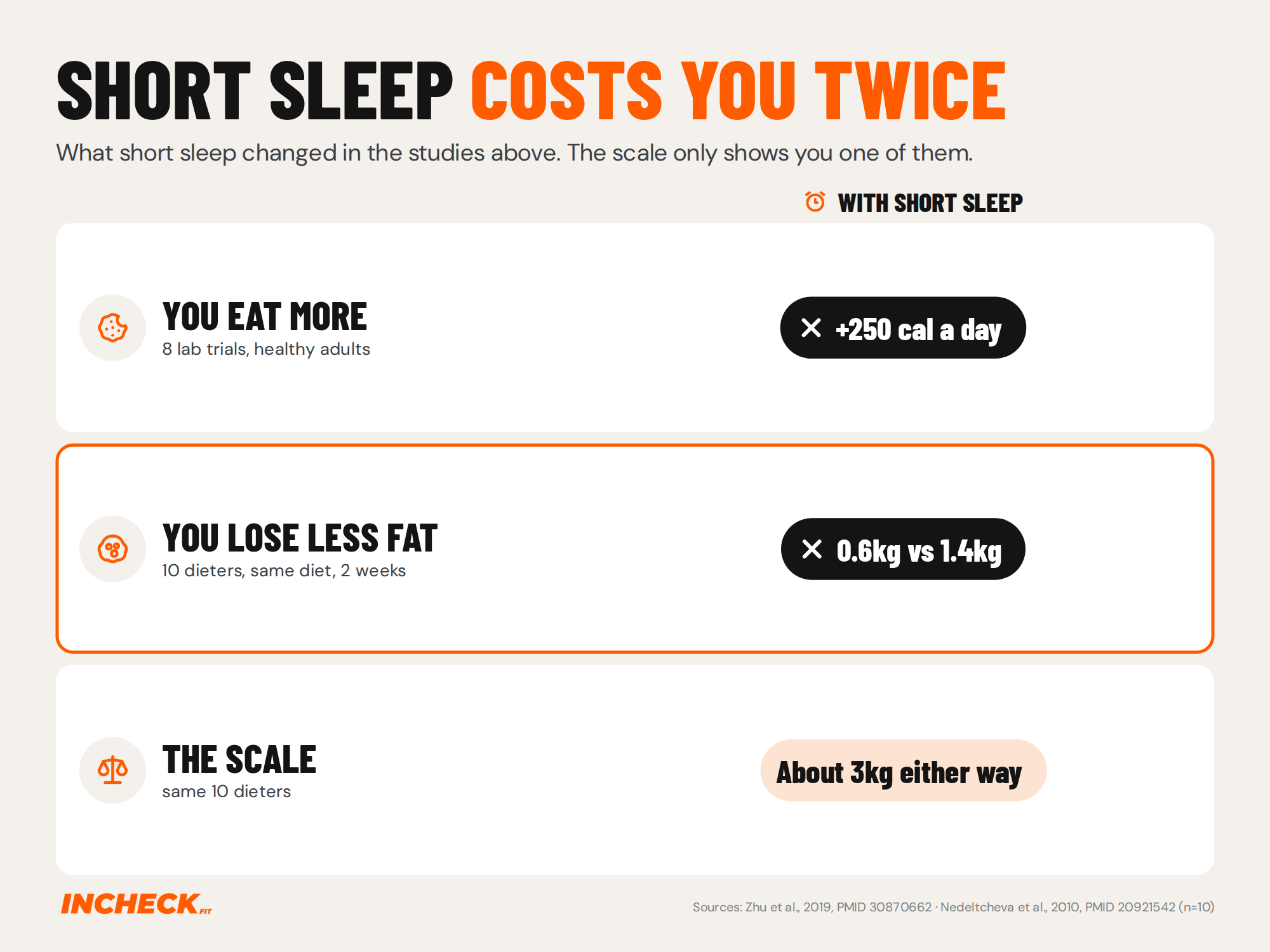
First, you tend to eat more. When researchers cut people’s sleep in the lab, they ate about 250 extra calories a day.
Second, it changes what you lose. In one small study, dieters lost about the same weight on short sleep, but much less of it was fat.
So your calories still decide whether you lose weight. Your sleep has a say in what that weight is made of.
Cost one: you eat more
When you’re short on sleep, you tend to eat more. That’s been tested in the lab: across 8 trials in healthy adults, people whose sleep was cut ate about 253 more calories a day than with normal sleep.
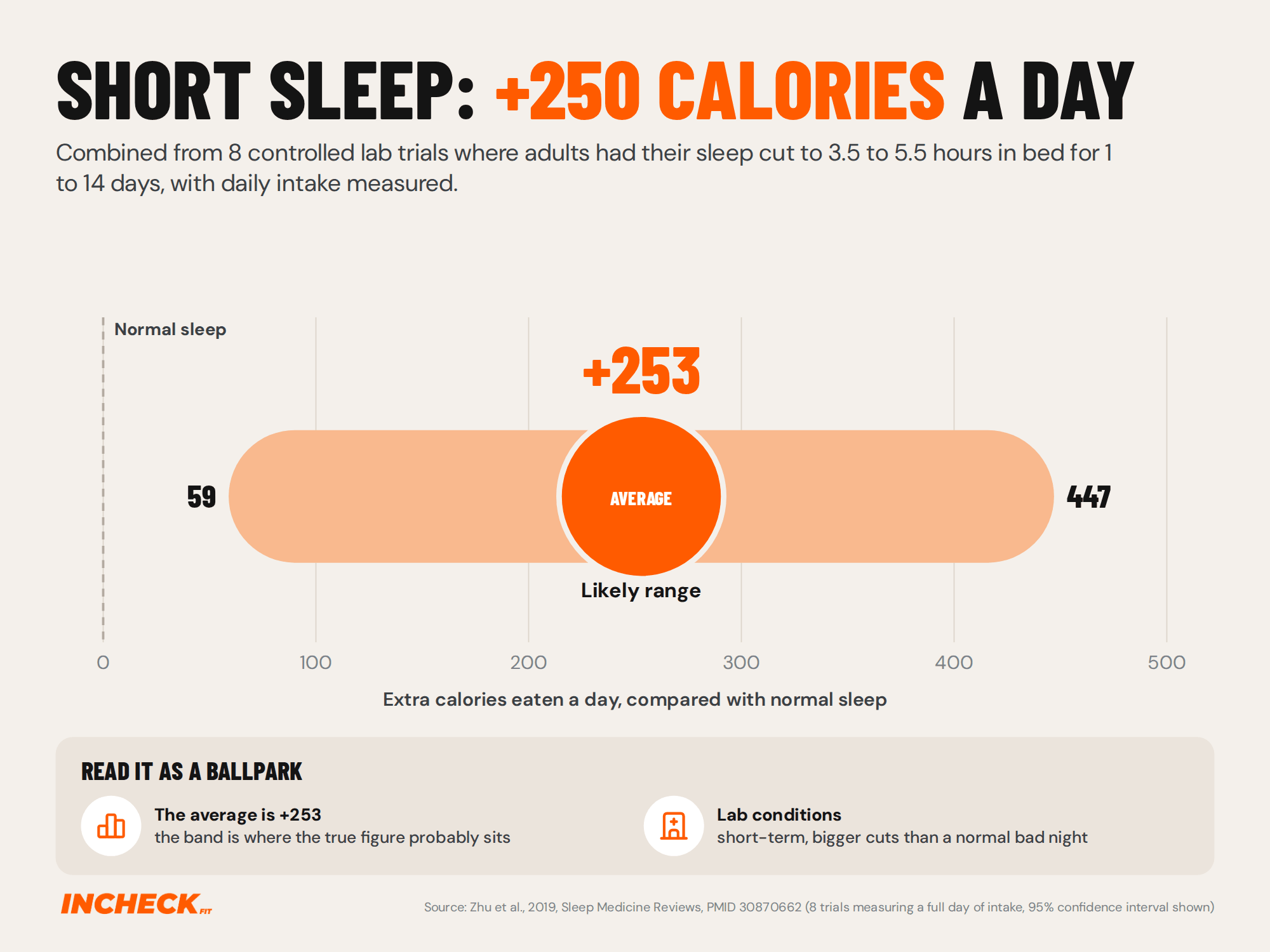
Take that number as a rough guide, not a promise. It’s an average with a lot of uncertainty around it: the true figure is likely somewhere between about 60 and 450 calories. And these were big sleep cuts: around 3.5 to 5.5 hours in bed, for up to two weeks. So one rough night at home won’t cost you exactly 250 calories. The direction is what matters. Our take: if short nights are your normal, a few hundred extra calories a day is the kind of thing that quietly adds up.
It’s the snacks, not the meals
In the one study that split it out, the extra food wasn’t bigger meals. In it, 11 adults spent two weeks at 5.5 hours in bed and two weeks at 8.5 hours. Their meals stayed about the same, but their snacking went up by roughly 220 calories a day.
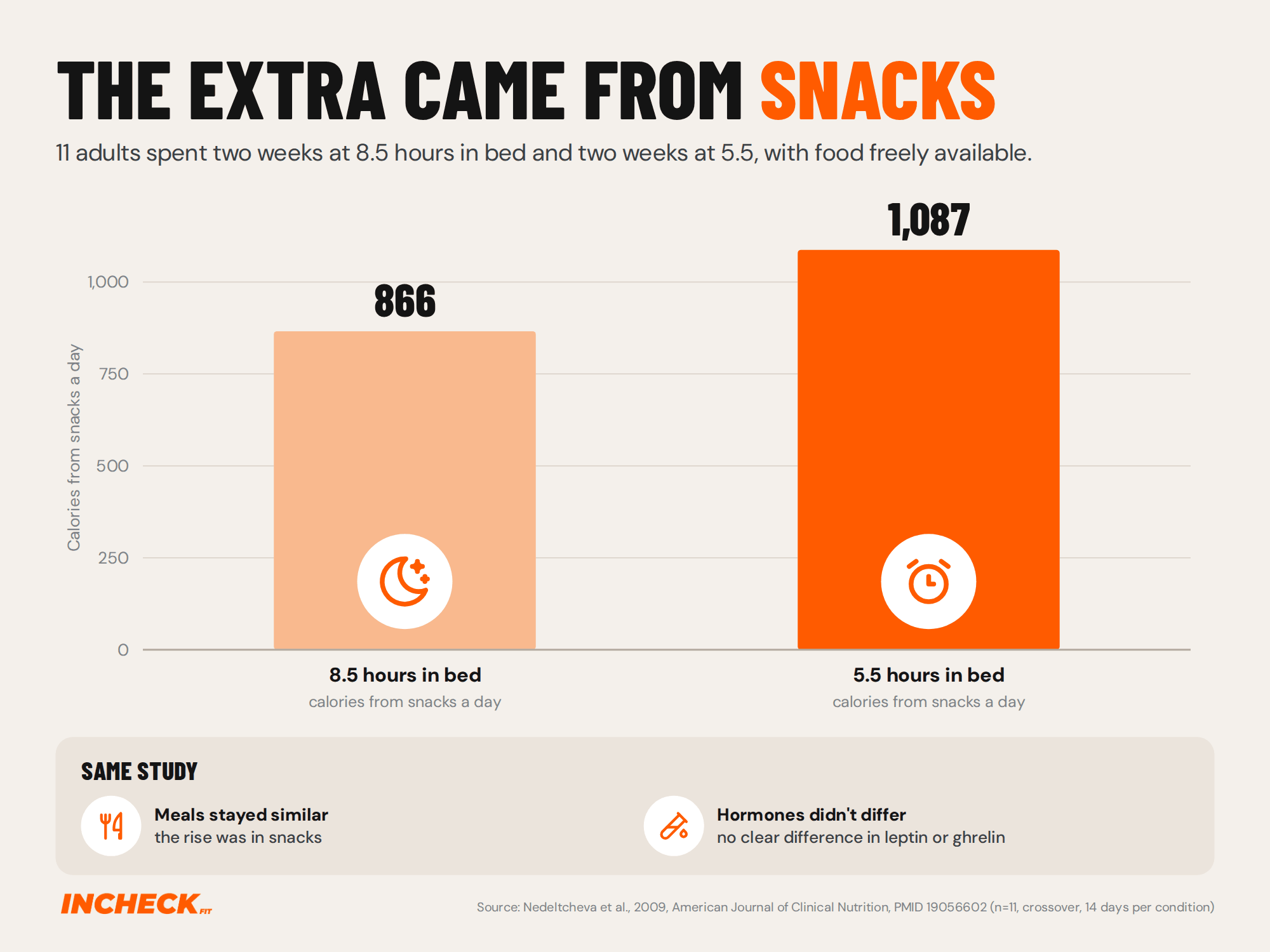
Why snacks? Our take: tired decisions are worse decisions. Your regular meals tend to hold up after a bad night. It’s the in-between choices, like the quick grab from the pantry or the servo, that slip. The study didn’t measure decision-making, so that’s our explanation rather than a proven one, but it fits what the study found.
So don’t blame your willpower. Look at where the extra came from: the eating between meals. It can also be one quiet reason people end up eating healthy but not losing weight.
Cost two: you lose less fat
This is the part most people miss.
In one tightly controlled study, 10 overweight adults went on the same reduced-calorie diet for two weeks, twice. The only planned difference was sleep: 8.5 hours in bed one time, 5.5 hours the other.
The scale barely noticed. They lost 2.9kg with 8.5 hours in bed and 3.0kg with 5.5 hours.
About 3kg either way, but not the same 3kg. With 8.5 hours in bed, about 1.4kg of it was fat. With 5.5 hours, only about 0.6kg was fat, and the rest was lean tissue (everything in your body that isn’t fat, like muscle, water and stored carbs).
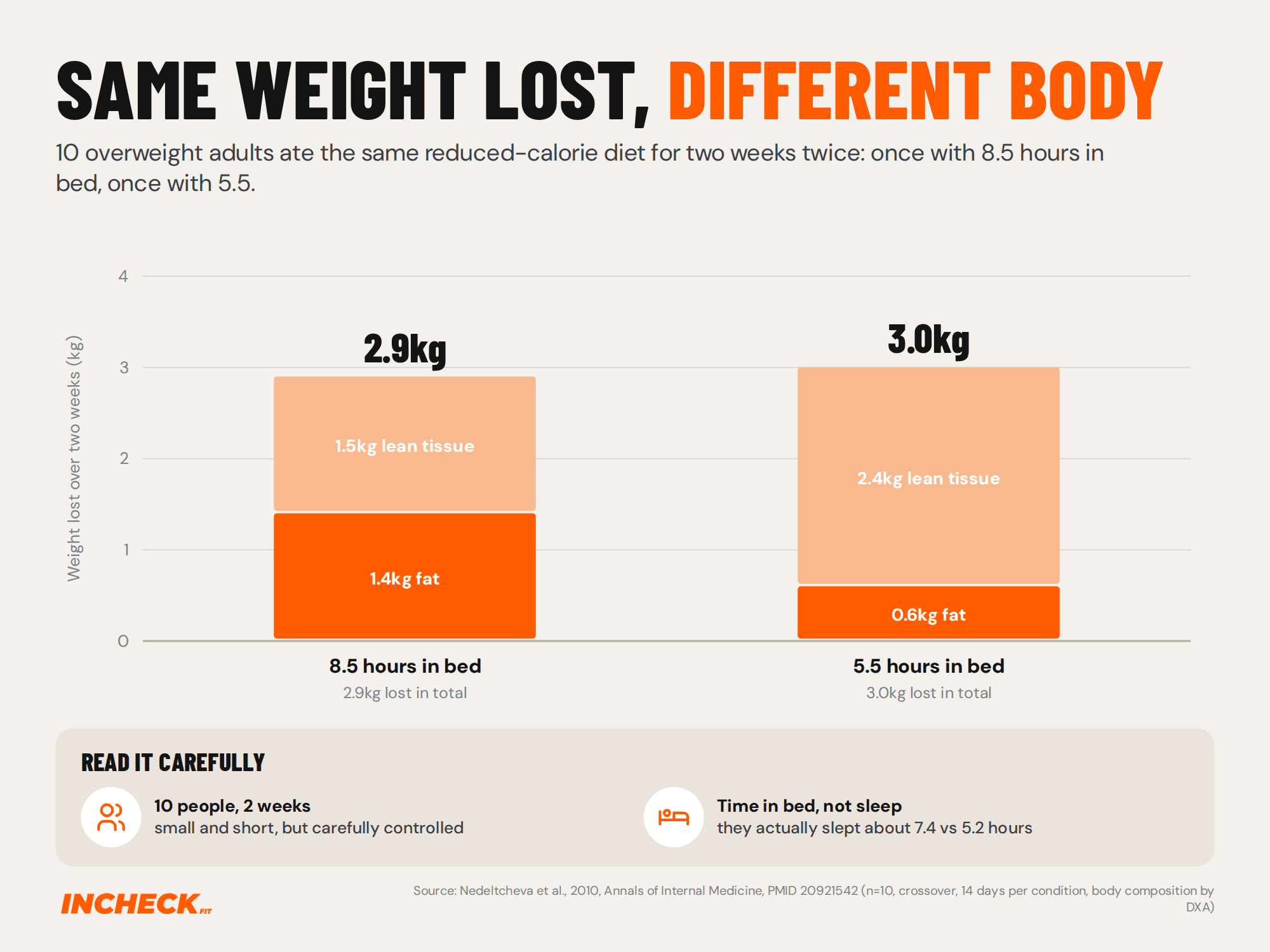
Same number on the scale, very different result underneath. It’s the same lesson as weight gain vs fat gain: the scale shows you a total, not what’s inside it.
How much to read into it: it was a small, two-week study, and results varied a lot between people. Treat it as an early signal, not the final word. Two more details: “8.5 hours in bed” meant about 7.4 hours of actual sleep, and 5.5 meant about 5.2. And because lean tissue isn’t just muscle, we’re not saying short sleep burns muscle.
What about hunger hormones?
You’ve probably heard that bad sleep “wrecks your hunger hormones”. The evidence is mixed. Ghrelin is a hormone linked to feeling hungry, and leptin to feeling full. One 2020 review of 21 studies covering 2,250 people found ghrelin a little higher in short sleepers. But a 2019 review of controlled lab trials in healthy adults found no strong sign that cutting sleep changes either one. And in people kept awake or very short of sleep, the 2020 review found leptin actually went up, the opposite of the popular story.
What’s much clearer is the behaviour. Combining 8 lab trials, healthy adults with their sleep cut ate about 250 more calories a day. And in the study of 11 adults above, snacking rose even though their leptin and ghrelin showed no clear difference between 5.5 and 8.5 hours in bed. So whatever the reason, in the lab short sleep shows up as extra eating, and you don’t need the hormone story to take sleep seriously.
What to do about it
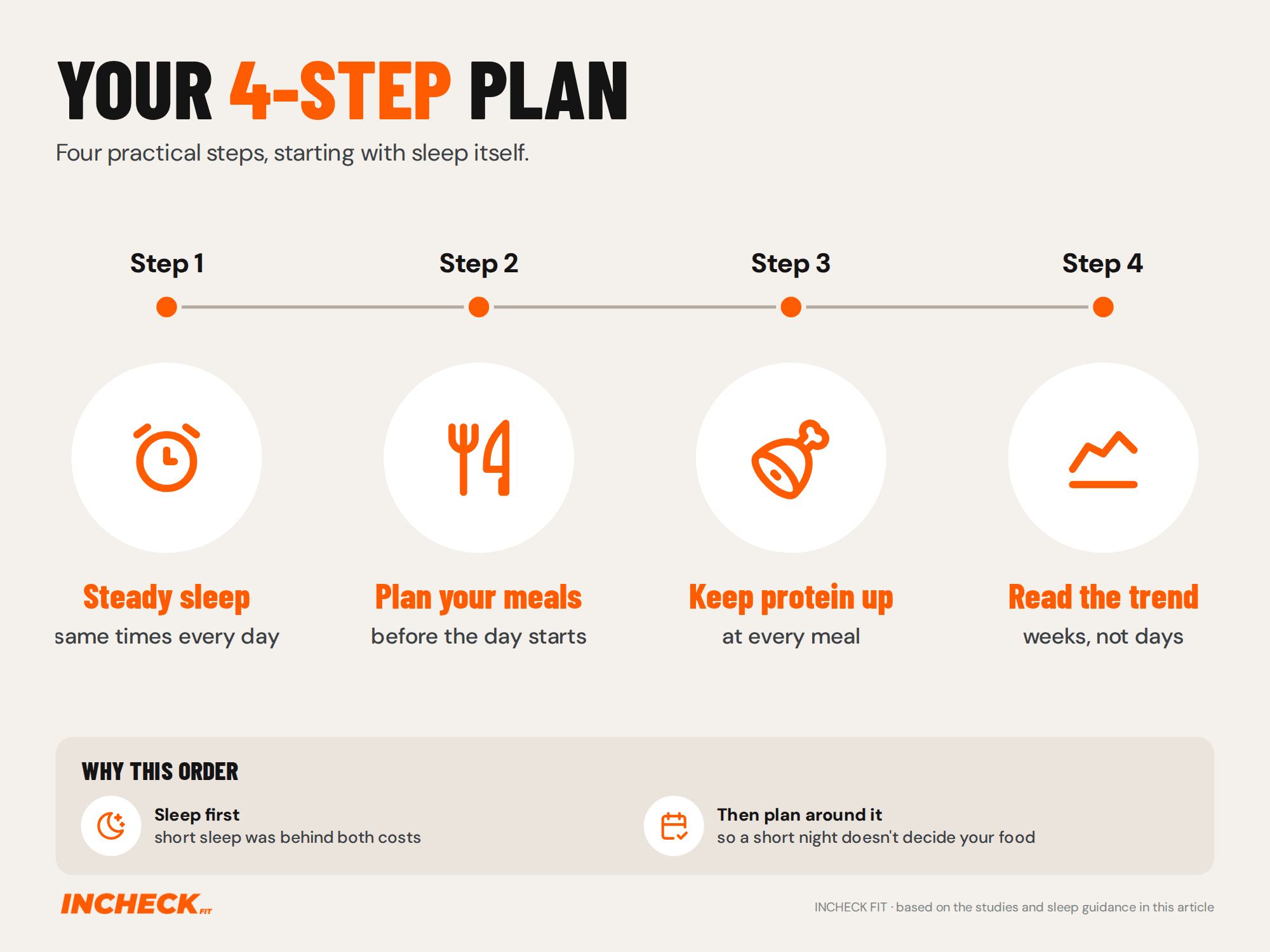
1. Keep your bed and wake times steady
According to sleep scientist Dr Dean Miller, the most important thing for better sleep is consistency: going to bed and waking at roughly the same time every day, weekends included. He walks through the full routine in everything you need to know about sleep.
2. Plan your meals before you’re tired
If tired decisions are worse decisions, take the decisions out of the tired part of your day. Know what you’re eating before the day starts: meals that fill you up, at the times you’ll actually eat them, with any snacks already counted. When your food is decided in advance, a bad night has much less room to change it.
3. Keep your protein up
Protein helps you hold on to lean tissue while you’re losing weight. Across 24 calorie-restricted diet trials in about 1,000 people, higher-protein diets kept roughly 0.4kg more lean tissue than standard-protein ones. Those trials didn’t test sleep, so nobody knows yet whether protein makes up for short nights, but it’s a sensible move either way. Our guide to how much protein per meal shows how to spread it across your day. Lifting weights is the other standard coaching advice for keeping lean tissue while you diet.
4. Judge progress over weeks, not days
If your weight is dropping during a rough patch of sleep, more of it may be lean tissue than you’d like. Look at the trend over a few weeks, and check your measurements as well as the scale. A calorie deficit gets the weight moving. In the study above, sleep changed what that weight was made of.
INCHECK FIT plans your week to your calorie and protein targets in advance, with the quantities set out, so a short night doesn’t also mean making every food decision from scratch.
The bottom line
Short sleep tends to make you eat more, and it can change what you lose. If your food looks right but your results have stalled, check your sleep before you cut more. It can quietly add snacks, and it can change what the scale is actually showing you.
Frequently Asked Questions
-
Does sleep affect weight loss? Yes, in two ways. Across 8 lab trials in healthy adults, people whose sleep was cut ate about 250 more calories a day. And in one small study of 10 dieters on the same diet, short sleep barely changed how much weight they lost: about 3kg either way. But much less of it was fat, about 0.6kg instead of 1.4kg.
-
Can lack of sleep make you gain weight? It can push you that way, because you tend to eat more. Across 8 lab trials, healthy adults with their sleep cut ate about 250 more calories a day. That figure is about eating, not weight gain, and the trials used big, short-term sleep cuts, so it isn’t known exactly how much everyday late nights change things. But extra calories day after day are how weight creeps on.
-
Why do I snack more when I’m tired? In a study of 11 adults, two weeks at 5.5 hours in bed (compared with 8.5) left their meals about the same. But it added roughly 220 calories a day of snacks. Their hunger hormones showed no clear difference. Our take is that tiredness makes in-the-moment food decisions harder, though the study didn’t measure that.
-
Does bad sleep make you lose muscle on a diet? Not exactly muscle. In a two-week study of 10 dieters, short sleep meant more of their weight loss came from lean tissue: about 2.4kg with 5.5 hours in bed versus 1.5kg with 8.5 hours. Lean tissue is everything that isn’t fat, including muscle, water and stored carbs, and it was a small study.
-
How much sleep do I need to lose fat? There’s no proven fat-loss number. In the study of 10 dieters, people kept more lean tissue with 8.5 hours in bed (about 7.4 hours of actual sleep) than with 5.5 hours in bed. For general health, most adults are advised to get 7 to 9 hours a night.
-
Is it true bad sleep messes with your hunger hormones? Partly. A 2020 review of 21 studies and 2,250 people found ghrelin, often called the hunger hormone, slightly higher with short sleep. But a 2019 review of controlled lab trials in healthy adults found no strong sign of a change in either hormone. And in people kept awake or very short of sleep, the 2020 review found leptin, the fullness hormone, went up rather than down. The clearer effect is behaviour: across 8 lab trials in healthy adults, people with their sleep cut ate about 250 more calories a day.
-
Can I make up for bad sleep with diet? Not proven, but you can stack the odds. Planning your meals ahead takes food decisions out of your tired hours. And across 24 calorie-restricted diet trials in about 1,000 people, higher-protein diets kept about 0.4kg more lean tissue. Those trials didn’t look at sleep, so nobody knows yet whether protein makes up for short nights.
References
-
Zhu B, Shi C, Park CG, Zhao X, Reutrakul S. “Effects of sleep restriction on metabolism-related parameters in healthy adults: a comprehensive review and meta-analysis of randomized controlled trials.” Sleep Medicine Reviews. 2019;45:18-30. PMID: 30870662. DOI: 10.1016/j.smrv.2019.02.002 [Meta-analysis, human, healthy adults, lab-based partial sleep restriction. The daily intake estimate (+252.8 kcal, 95% CI 59.1 to 446.5) pools 8 trials; 41 is the whole review across outcomes. Full text verified 15 Sep 2026 (reel claims record); citation and abstract re-checked 6 Oct 2026 via Europe PMC, no corrections.]
-
Nedeltcheva AV, Kilkus JM, Imperial J, Kasza K, Schoeller DA, Penev PD. “Sleep curtailment is accompanied by increased intake of calories from snacks.” American Journal of Clinical Nutrition. 2009;89(1):126-133. PMID: 19056602. DOI: 10.3945/ajcn.2008.26574 [Crossover, human, n=11 adults, 14 days per condition at 5.5 vs 8.5 hours in bed, food freely available. Participants were screened to exclude regular exercisers. Abstract verified 15 Sep 2026 (reel claims record); citation re-checked 6 Oct 2026 via Crossref, no update or retraction notices in Crossref.]
-
Nedeltcheva AV, Kilkus JM, Imperial J, Schoeller DA, Penev PD. “Insufficient sleep undermines dietary efforts to reduce adiposity.” Annals of Internal Medicine. 2010;153(7):435-441. PMID: 20921542. DOI: 10.7326/0003-4819-153-7-201010050-00006 [Randomised crossover, human, n=10 overweight adults, 14 days per condition on the same diet at 90% of resting metabolic rate, body composition by DXA. Figures taken from the results table, not the abstract. Full text verified 15 Sep 2026 (reel claims record); citation re-checked 6 Oct 2026 via Crossref, no update or retraction notices in Crossref.]
-
Lin J, Jiang Y, Wang G, Meng M, Zhu Q, Mei H, Liu S, Jiang F. “Associations of short sleep duration with appetite-regulating hormones and adipokines: a systematic review and meta-analysis.” Obesity Reviews. 2020:e13051. PMID: 32537891. DOI: 10.1111/obr.13051 [Systematic review and meta-analysis, human, 21 studies, 2,250 participants. Abstract verified 6 Oct 2026 via Europe PMC.]
-
Wycherley TP, Moran LJ, Clifton PM, Noakes M, Brinkworth GD. “Effects of energy-restricted high-protein, low-fat compared with standard-protein, low-fat diets: a meta-analysis of randomized controlled trials.” American Journal of Clinical Nutrition. 2012;96(6):1281-1298. PMID: 23097268. DOI: 10.3945/ajcn.112.044321 [Meta-analysis, human, 24 trials, n=1,063 participants on energy-restricted diets. Did not test sleep. Abstract verified 6 Oct 2026 via Europe PMC.]
-
Dr Dean Miller, sleep and exercise scientist, interviewed for Everything You Need to Know About Sleep (INCHECK FIT, 2026). Practitioner guidance on sleep consistency.
This article is general information, not medical advice. If you have ongoing trouble sleeping, talk to your GP.
Last reviewed: October 2026 by the INCHECK FIT nutrition team.
Last reviewed: October 2026