
No, not in the way people usually mean it. The idea that eating too little for too long makes your body cling to fat and stops a calorie deficit working is not supported by controlled research. What is real is a smaller effect called metabolic adaptation, and in randomised trials it measures in the tens of calories a day, not hundreds.
That distinction matters, because the myth and the mechanism get treated as the same thing. This article covers what metabolic adaptation actually is, how large it measures when researchers isolate it properly, why the study most often cited as proof of starvation mode is the one that undermines it, and what a genuine months-long stall usually turns out to be.
What people mean by starvation mode
The claim runs roughly like this. You have eaten too little for too long. Your body has responded by holding onto fat. The deficit no longer works, and eating more is the way out.
The answer is half yes and half no, and the half that is yes is much smaller than most people have been told.
What is actually real
When you lose weight, you spend less energy. Some of that is obvious. You are a smaller person, and smaller people burn less at rest and in motion.
There is also a bit on top of that. You burn slightly less than even your new body size would predict. That part is real, measurable, and has a name: metabolic adaptation, sometimes called adaptive thermogenesis.
So the myth is not that the effect exists. The myth is its size, and what it is claimed to do.
How big is metabolic adaptation?
This is the only question that matters, and controlled trials answer it fairly consistently.
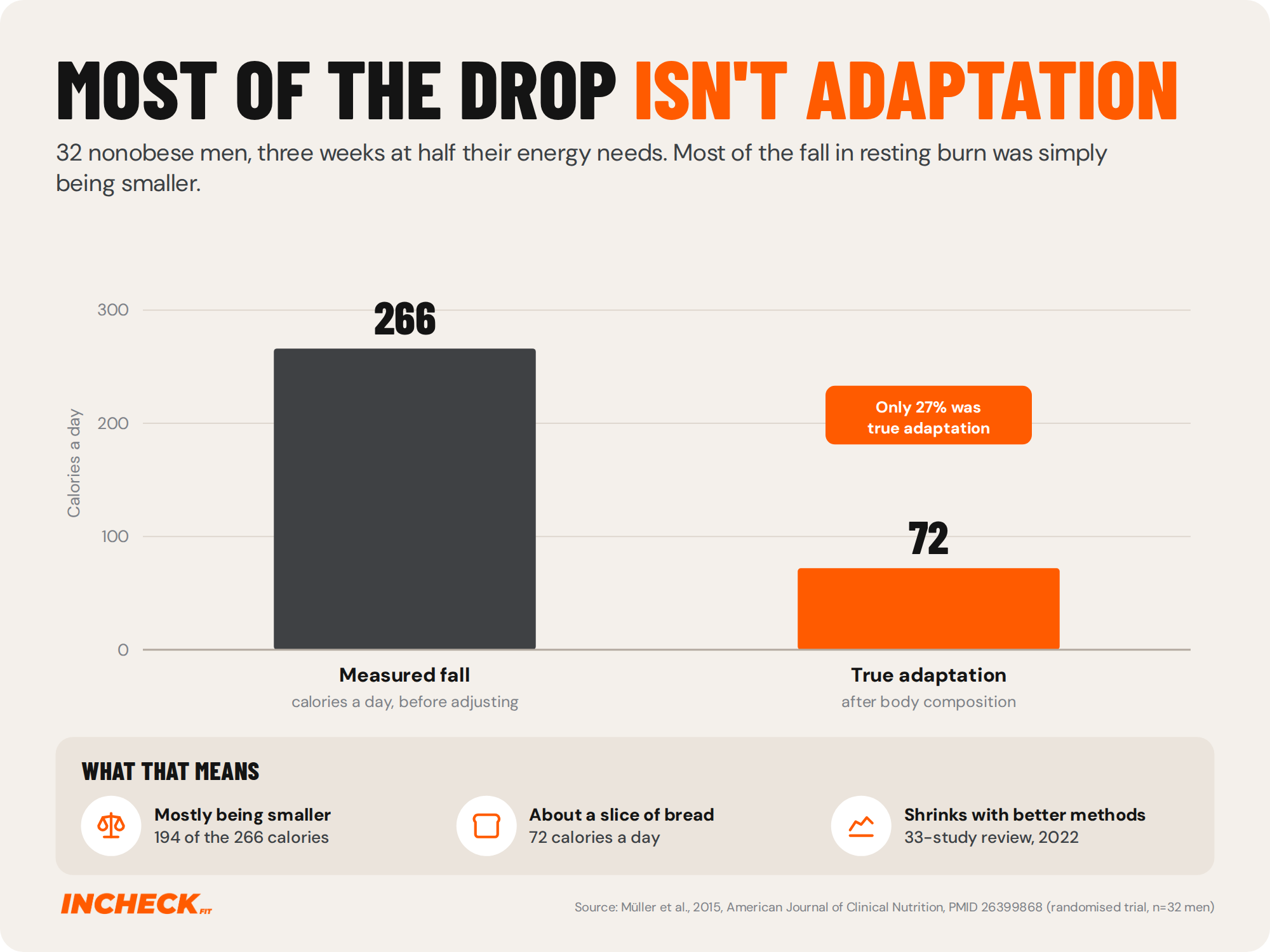
In a randomised trial of 32 nonobese men placed on three weeks at roughly half their energy needs, resting energy expenditure fell by 266 calories a day. Of that fall, 108 calories a day was adaptation rather than body size. When the researchers accounted for changes in the composition of fat-free mass, 72 calories a day remained as true adaptation (Müller et al., 2015).
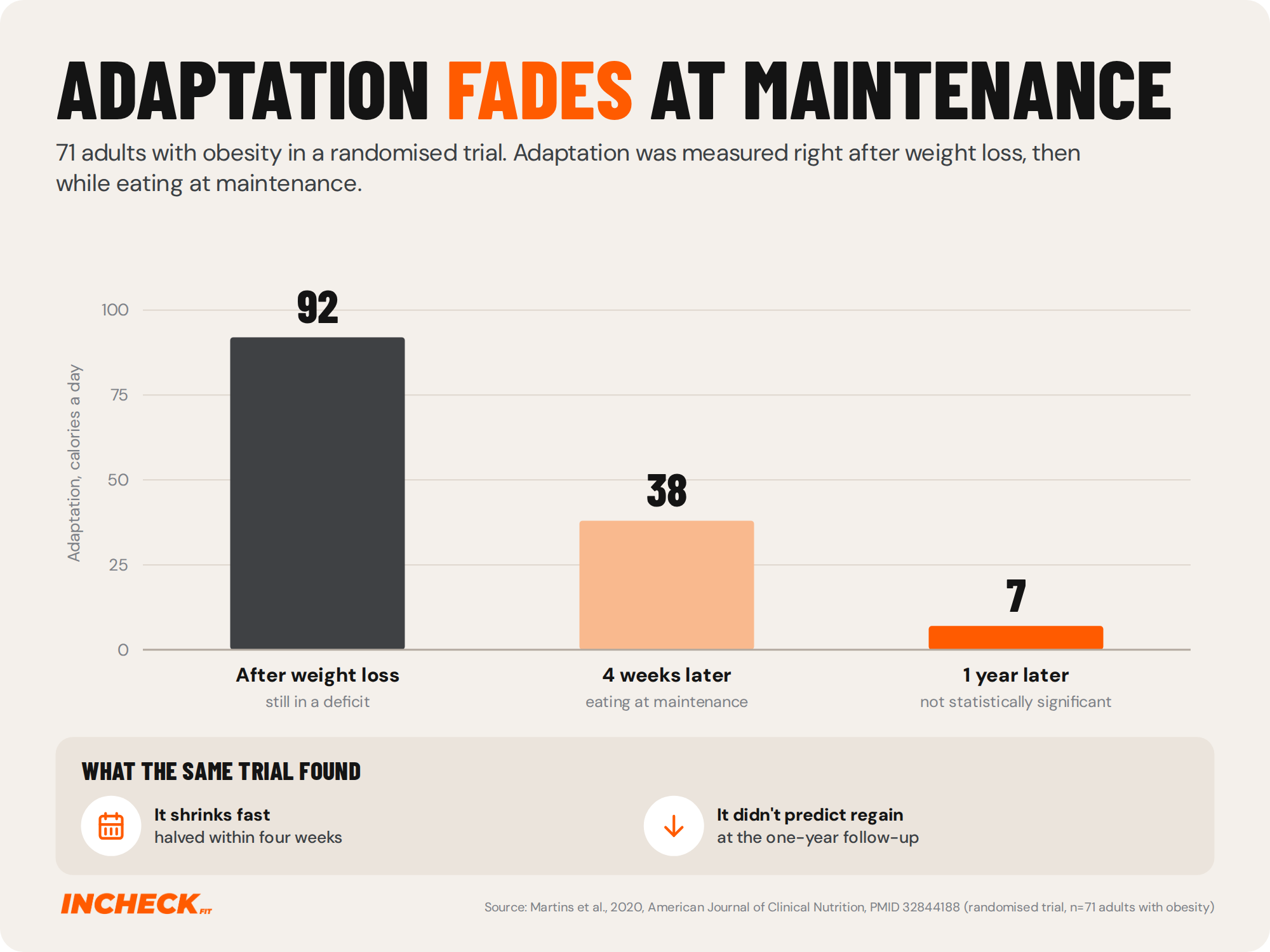
A separate randomised trial of 71 adults with obesity found adaptation of about 92 calories a day immediately after weight loss. After four weeks of eating at maintenance, that halved to roughly 38 calories a day, and at one year it was around 7 calories a day and no longer statistically significant. The same trial found adaptation did not predict who regained weight (Martins et al., 2020).
To put 72 to 92 calories in context, that is roughly a slice of bread. It is a real quantity. It is not a wall.
The pattern in the wider literature
A 2022 systematic review examined 33 studies covering 2,528 adults. Adaptation was observed in most of them, but the review reported large variation driven mainly by how each study measured it, and its authors concluded that well-designed studies reported lower or non-significant values for adaptation (Nunes et al., 2022).
That is the tell. The tighter the method, the smaller the effect. Findings that shrink under better measurement are usually findings that were partly measurement error to begin with.
The Minnesota study: the evidence against, not for
The study most often cited as proof of starvation mode is the one that most clearly contradicts it.
In 1944, researchers at the University of Minnesota placed volunteers on a severe deficit for six months. It should be said plainly that the experience did real damage to those men. It is not a protocol and was never intended as one. It is a warning.
Their metabolic rate fell by roughly 40%, and that is the figure quoted in almost every article arguing that dieting breaks your metabolism. But most of that 40% was simply the consequence of being a far smaller person: they had lost about a quarter of their bodyweight. Once body size is accounted for, the adaptation itself was in the region of 15% (Keys et al., 1950).
And here is the part that rarely gets mentioned. They never stopped losing weight. Not at any point across six straight months of severe restriction.
Bodies do not have an override that halts weight loss when intake falls. If they did, starvation would not be fatal.
So what does this mean in practice?
The version of starvation mode people mean, where the deficit simply stops working, does not exist.
What does exist is a slightly smaller deficit than the one you planned. If you set up a 500 calorie deficit and adaptation trims 70 to 90 of it, you have a 410 to 430 calorie deficit. That is not a wall. It is a rounding error you can account for.
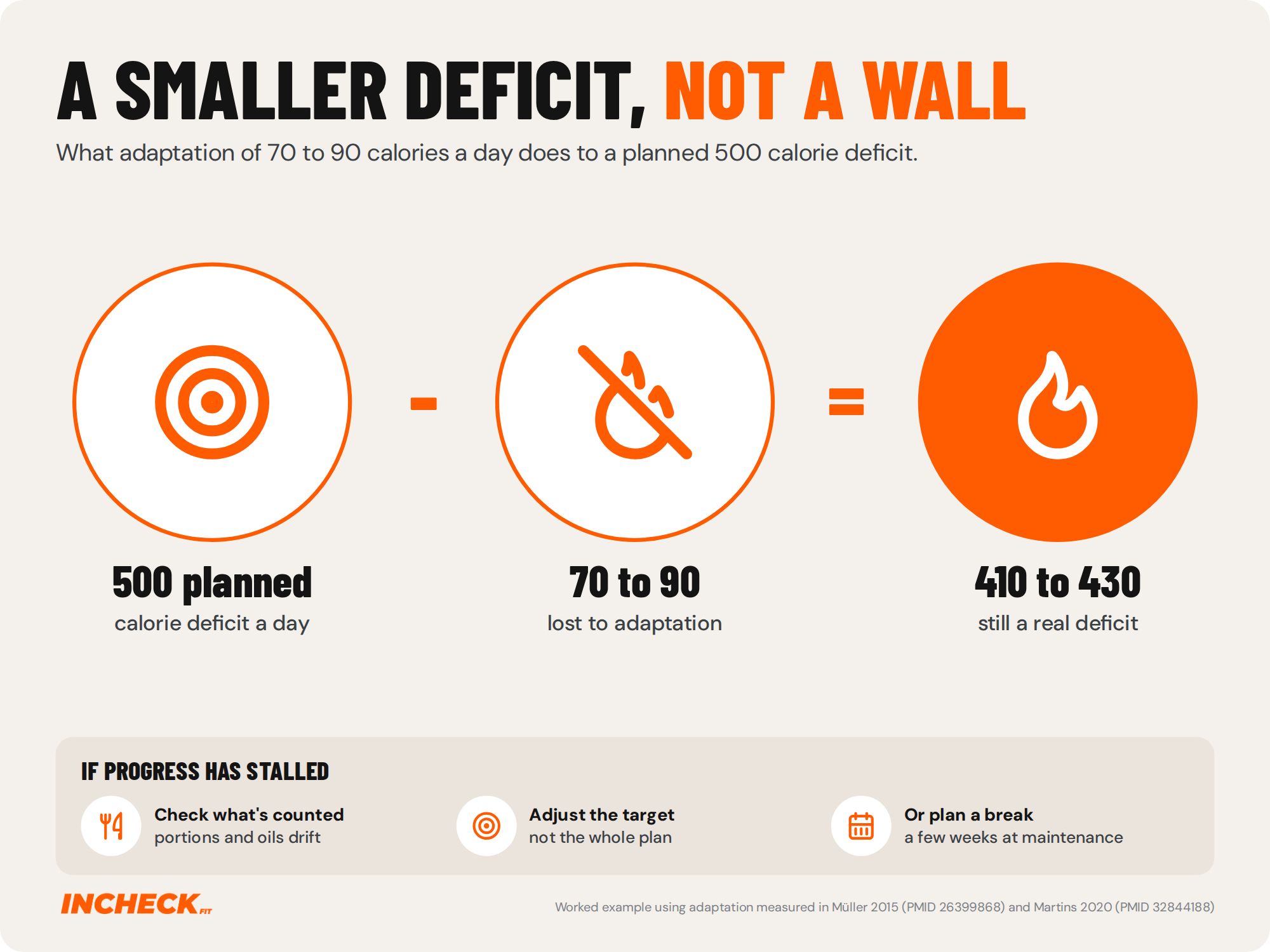
Importantly, none of this is an argument for eating less. A smaller-than-planned deficit is corrected by adjusting the target or by taking a period at maintenance, which is a well-established approach and a different claim entirely from “eat more to lose weight”. If a stall does turn out to be adaptation, the fix is a small target change, which INCHECK FIT’s weekly progress review makes based on your actual results.
What a real stall usually is
When someone has been genuinely stuck for months, it is almost never their metabolism.
Far more often, what is being eaten and what is being counted have drifted apart. Portions creep, cooking oil goes uncounted, and the estimate quietly stops matching the plate. Short nights can add to the gap too: combining 8 lab trials, healthy adults whose sleep was cut ate about 250 more calories a day.
And that is not people lying. Nobody on earth can eyeball this accurately. It is a measurement problem, not a character problem, and it is the single most common explanation for a plateau that feels inexplicable.
This is the problem we built INCHECK FIT to solve. Your weekly meal plan gives you the amounts up front, built to your calorie and macro targets, so what you eat and what you planned stay close together, with no logging after the fact.
If food has started to feel like something you are fighting rather than something you are managing, that is worth raising with a GP or an accredited practising dietitian. It is not something to solve by eating less.
Frequently Asked Questions
-
Does starvation mode actually exist? Not as commonly described. The idea that a calorie deficit stops working because intake has been too low for too long is not supported by controlled research. What exists is metabolic adaptation, which in randomised trials measures roughly 72 to 92 calories a day and shrinks further once weight stabilises.
-
Will eating more help me start losing weight again? Eating more does not cause weight loss. A period at maintenance can reduce metabolic adaptation, which in one trial of 71 adults with obesity halved it in four weeks, but that is an argument for a planned diet break rather than for eating more to lose weight.
-
Did the Minnesota study prove starvation mode? The opposite. Participants on a severe deficit for six months never stopped losing weight. Their metabolic rate fell about 40%, but most of that reflected a quarter of their bodyweight being gone; the adaptation beyond body size was around 15%.
-
Can you permanently damage your metabolism by dieting? There is no good evidence for permanent metabolic damage in otherwise healthy adults from a sensible deficit. In a trial of 71 adults with obesity, measured adaptation had fallen to about 7 calories a day at one year and was no longer statistically significant.
-
Why have I stopped losing weight even though nothing has changed? The most common explanation is drift between what is eaten and what is counted, rather than metabolism. Portion creep and uncounted cooking fats are usual culprits. If you have been genuinely consistent for three or more weeks with no change, it is worth a conversation with a GP or dietitian.
-
How many calories does metabolic adaptation actually cost me? In a randomised trial of 32 nonobese men it was 72 calories a day once body composition change was accounted for. In a trial of 71 adults with obesity it was about 92 calories a day, falling to 38 after four weeks at maintenance.
-
Does metabolic adaptation mean I will regain the weight? Not according to the trial that tested it directly. In 71 adults with obesity, the size of a person’s metabolic adaptation did not predict how much weight they regained at one year.
References
- Müller MJ, Enderle J, Pourhassan M, Braun W, Eggeling B, Lagerpusch M, Glüer CC, Kehayias JJ, Kiosz D, Bosy-Westphal A. “Metabolic adaptation to caloric restriction and subsequent refeeding: the Minnesota Starvation Experiment revisited.” American Journal of Clinical Nutrition. 2015;102(4):807-819. PMID: 26399868. DOI: 10.3945/ajcn.115.109173 [Randomised controlled trial, human, n=32 nonobese men, 3 weeks at -50% of energy needs. Despite its title this is a new trial, not a reanalysis of the 1945 Minnesota data. Abstract verified 17 Sep 2026; two published comments exist (PMIDs 26933128, 26933129), on framing rather than findings.]
- Martins C, Roekenes J, Salamati S, Gower BA, Hunter GR. “Metabolic adaptation is an illusion, only present when participants are in negative energy balance.” American Journal of Clinical Nutrition. 2020;112(5):1212-1218. PMID: 32844188. DOI: 10.1093/ajcn/nqaa220 [Randomised controlled trial, human, n=71 adults with obesity. Abstract verified 17 Sep 2026; three published comments exist (PMIDs 32936882, 33301006, 33301007), on framing rather than direction.]
- Nunes CL, Casanova N, Francisco R, Bosy-Westphal A, Hopkins M, Sardinha LB, Silva AM. “Does adaptive thermogenesis occur after weight loss in adults? A systematic review.” British Journal of Nutrition. 2022;127(3):451-469. PMID: 33762040. DOI: 10.1017/S0007114521001094 [Systematic review, human, 33 studies / 2,528 adults. Verified 17 Sep 2026; corrections checked, none found. Note: this review deliberately pools no single figure and reports large heterogeneity in measurement method.]
- Keys A, Brozek J, Henschel A, Mickelsen O, Taylor HL. The Biology of Human Starvation. University of Minnesota Press, 1950 (study conducted 1944-1945). [Historical controlled study, human, 36 men, 24 weeks of severe restriction. Not indexed in PubMed and carries no PMID or DOI. Figures are widely reported in secondary literature but were not verified against the primary text for this article.]
Last reviewed: September 2026 by the INCHECK FIT nutrition team.
Last reviewed: September 2026