A calorie deficit means eating fewer calories than your body uses in a day, so your body makes up the gap from stored energy, mostly body fat. To calculate yours, estimate your maintenance calories (the amount that keeps your weight steady) and set your target 10 to 25% below that. Our coaching default is 15%.
The quickest way is our free calorie deficit calculator. Enter your sex, age, height, weight and activity level, choose Lose Fat, then pick how fast you want to go. In about two minutes it gives you your maintenance calories, a daily calorie target and a daily protein target.
The rest of this guide explains what that number means. It covers how to work it out by hand, how big your deficit should be, how fast to expect results, and why a deficit can seem to stop working. It also covers how to stick to one without turning food into a second job.
Calorie Deficit Calculator: Find Your Number in Two Minutes
Our calculator does the two steps a nutrition coach would do by hand. First it estimates your maintenance calories. It uses the Mifflin-St Jeor equation (a formula that estimates the energy your body uses at rest) and multiplies that by your activity level. Then it takes off the deficit you choose.
You choose the deficit with a “How fast?” slider. It has four settings:
- Gentle, 10% below maintenance. Slower progress, but the easiest to live with.
- Steady, 15% below maintenance. Our coaching default, and the best place for most people to start.
- Faster, 20% below maintenance. Quicker results, with more hunger and lower energy at times.
- Aggressive, 25% below maintenance. The fastest and the hardest to sustain. Best kept to short phases, and not a good fit if you have a history of disordered eating.
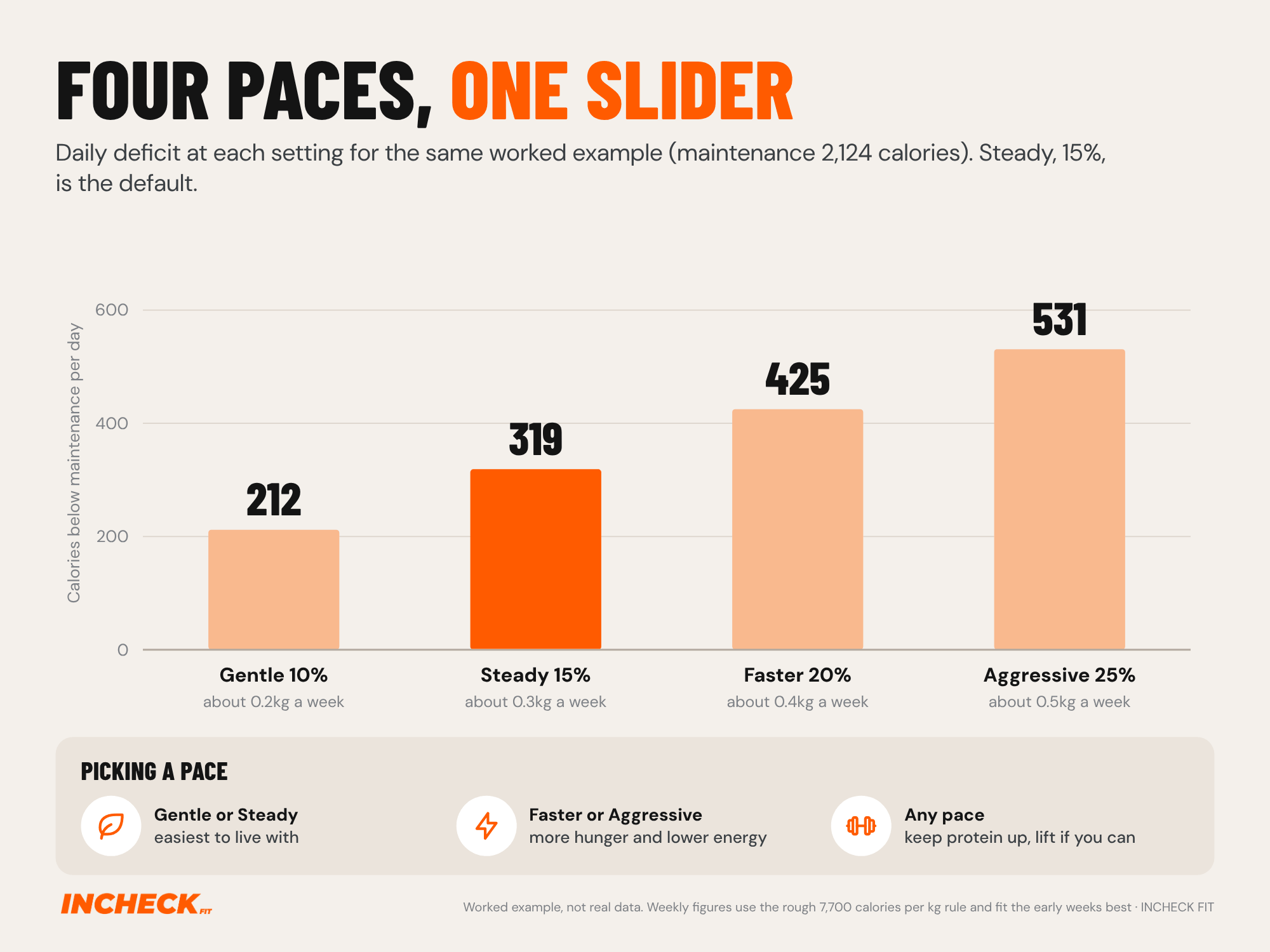
Here’s how that works for one person. A 30-year-old woman who is 165cm, 65kg and moderately active has estimated maintenance of about 2,124 calories a day. At the default Steady pace, her deficit is 319 calories, so her daily target is about 1,805 calories. That’s a worked example of the maths, not a target for anyone else.
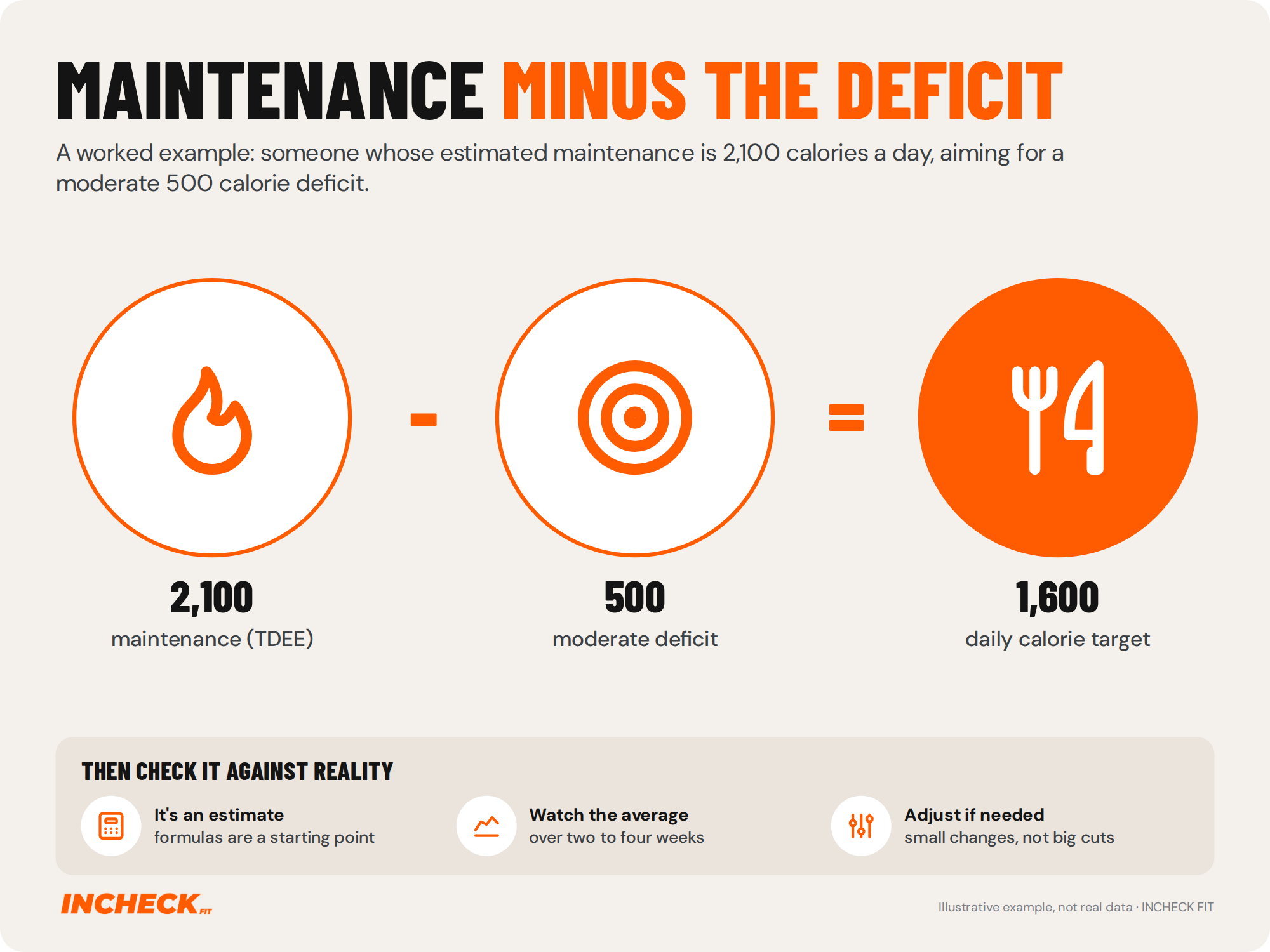
Treat whatever number you get as a starting estimate. Follow it for two to three weeks, judge your weekly average weight, then move the slider up or down one step if you need to. That check against reality matters more than the formula.
What Is a Calorie Deficit?
A calorie deficit is when the energy you take in from food and drink is less than the energy your body uses in a day.
Your body needs energy all the time. Breathing, digesting food, keeping warm and moving all use calories. When food doesn’t cover all of that, your body takes the difference from its stores. Its biggest store is body fat. Repeat that day after day and your body fat goes down, whichever diet you use to get there.
There are three possible states:
- Calorie deficit: you take in less than you use. Your weight trends down over time.
- Maintenance: you take in about what you use. Your weight stays roughly stable.
- Calorie surplus: you take in more than you use. Your weight trends up over time.
How Does a Calorie Deficit Work?
Your body can’t make energy from nothing, so when you eat less than you use, the shortfall has to come from somewhere. Mostly it comes from fat you’ve stored.
Where Body Fat Actually Goes
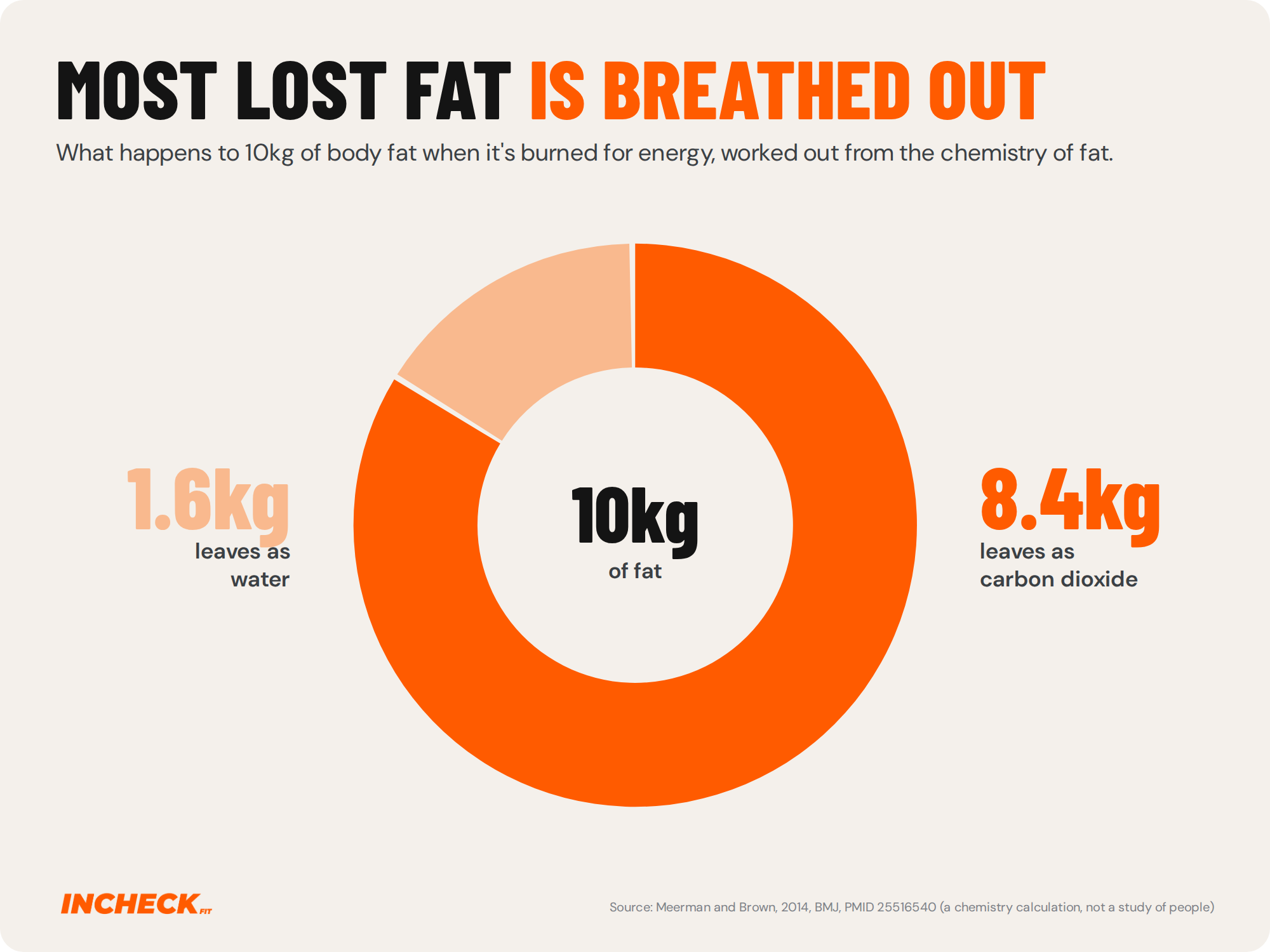
When your body uses stored fat for energy, it breaks the fat down and burns it in your cells. What’s left over is carbon dioxide and water. You breathe out the carbon dioxide, and the water leaves through urine, sweat and breath.
A 2014 calculation in the BMJ worked out the split from the chemistry of fat itself. About 84% of the mass of fat you lose leaves as carbon dioxide you breathe out, and about 16% leaves as water. That figure comes from chemistry, not from measuring people.
The 7,700-Calorie Rule of Thumb
You’ll often read that 1kg of body fat holds about 7,700 calories. By that rule, a 500-calorie daily deficit adds up to about 0.5kg of fat loss a week. (American sources say 3,500 calories per pound.)
It’s a useful planning number, but real bodies don’t follow it exactly. Kevin Hall, then at the US National Institutes of Health, used maths-based models to show that the rule fits best for people starting with more than about 30kg of body fat. Leaner people may need less than 7,700 calories of deficit for each kilogram they lose. His later modelling also shows weight loss slows over time, because a smaller body needs less energy. So treat the rule as a rough guide for the early weeks, not a promise.
How to Calculate Your Calorie Deficit by Hand
If you’d like to see the maths, here’s exactly what the calculator does. You need two numbers: how many calories your body burns each day, and the size of the deficit you choose. (For the next step, here’s how many calories to eat to lose fat.)
Step 1: Estimate the Energy You Use at Rest
For most people, the biggest share of the energy used each day goes on just keeping you alive: your heartbeat, breathing and organs. This is your resting energy use, often called BMR (basal metabolic rate). On top of that you burn energy digesting food, moving around during the day and exercising. Together, all of that is your maintenance calories, sometimes called TDEE (total daily energy expenditure, the total energy you use in a day).
Start with BMR, using the Mifflin-St Jeor equation. It was built in 1990 from lab measurements of 498 healthy adults aged 19 to 78. In that group, the older Harris-Benedict equation overestimated measured resting energy use by about 5%.
For women: BMR = (10 x weight in kg) + (6.25 x height in cm) - (5 x age in years) - 161
For men: BMR = (10 x weight in kg) + (6.25 x height in cm) - (5 x age in years) + 5
Step 2: Multiply by Your Activity Level
Multiply your BMR by the activity factor that best fits your week:
| Activity level | What it looks like | Multiply BMR by |
|---|---|---|
| Sedentary | Little or no exercise, desk job | 1.2 |
| Lightly active | Light exercise 1 to 3 days a week | 1.375 |
| Moderately active | Moderate exercise 3 to 5 days a week | 1.55 |
| Very active | Hard exercise 6 to 7 days a week | 1.725 |
| Extra active | Very hard exercise, a physical job, or training twice a day | 1.9 |
These multipliers are a widely used rule of thumb, not measured values. The result is your estimated maintenance calories: roughly the amount that would keep your weight stable.
Step 3: Take Off Your Deficit
Multiply your maintenance calories by the percentage you choose (10, 15, 20 or 25%) and subtract it. For the 30-year-old woman above, the full sum is:
- BMR: (10 x 65) + (6.25 x 165) - (5 x 30) - 161 = about 1,370 calories
- Maintenance: 1,370 x 1.55 = about 2,124 calories
- Steady 15% deficit: 2,124 x 0.15 = about 319 calories
- Daily target: 2,124 - 319 = about 1,805 calories
Step 4: Check It Against Your Real Progress
Every formula is an estimate. Two people with the same stats can burn quite different amounts. So follow your target for two to three weeks and watch your weekly average weight. If it’s trending down at a pace you’re happy with, keep going. If it isn’t moving, check your portions first, then move down one step if you need to (not past Aggressive, and not below the floor further down this page). If you’re losing faster than planned, or feel flat, tired or hungry most of the time, move up one.
How Big Should Your Calorie Deficit Be?
Our coaching default is about 15% below maintenance, and for most people it’s a good place to start. It’s big enough to see progress and small enough to live with. Bigger deficits get results faster, but they make hunger, energy and training harder, and an approach you drop after three weeks gets you nowhere.
Here’s what each setting means for the same worked example, with maintenance of about 2,124 calories a day.
Slower may also help you hold on to lean mass, which includes muscle. In a 2011 trial, 24 elite athletes doing four strength sessions a week were randomly split into two weight loss speeds. The group aiming to lose about 0.7% of body weight a week (eating about 19% less than usual) gained a little lean mass, measured by a body scan. Lean mass here means muscle, organs, water and other tissue that isn’t fat or bone. The group aiming for about 1.4% a week (eating about 30% less) didn’t. These were elite athletes, so treat it as a guide to pace rather than a rule for everyone.
There’s also a floor. As a coaching rule, we suggest not going below about 1,200 calories a day for women or 1,500 for men without support from a GP or dietitian. Those match the lower ends of the daily intake ranges the 2013 US obesity guideline suggests for adults with overweight or obesity who are losing weight. Eating less than that makes it harder to get all the vitamins and minerals you need from food. Our calculator won’t set a fat loss target below them either. For many people, especially taller or more active people, the right target sits well above those numbers.
If you have a medical condition, are pregnant or breastfeeding, or if food, weight or eating less feels hard to manage, a GP or an Accredited Practising Dietitian is the right person to set your targets with you.
How Fast Will You Lose Weight in a Calorie Deficit?
Expect a slow, bumpy line rather than a smooth one. Using the rough 7,700-calorie rule, the 15% example above (a 319-calorie daily deficit) works out to about 0.3kg a week in the early weeks. People with a bigger maintenance number will see bigger figures at the same percentage, because the same percentage is more calories.
Day to day, the scale also moves with water, stored carbohydrate, salt, your cycle and what’s still in your gut. These swings aren’t fat, but they’re one of the most common reasons people think a deficit has stopped working.
Judge progress on your weekly average weight, not a single weigh-in. If the average is trending down over two to three weeks, it’s working. A typical pattern looks like this, though everyone’s is a little different:
- First week or two: often a bigger drop, partly water and stored carbohydrate rather than fat
- Next month or two: a slower, steadier trend down, with daily ups and downs
- After a few months: progress often slows as your body gets smaller and needs less energy, so it’s worth recalculating your target
Why Your Calorie Deficit Might Not Be Working
Eating in what feels like a deficit and seeing no change is one of the most frustrating parts of fat loss. There are a few common reasons. For the full list, ranked by how much each one matters, see calorie deficit but not losing weight.
You’re Not Eating Quite as Little as It Seems
Studies that compare what adults say they eat with the energy they’re measured to burn keep finding that people under-report their intake. In a 2003 US study of 484 adults aged 40 to 69, men under-reported their calories by about 12 to 14% on detailed food recalls, and women by about 16 to 20%. That isn’t people lying. Portions are hard to judge, cooking oil and sauces are easy to miss, and “healthy” foods are often assumed to be lower in calories than they are. You don’t need to weigh every ingredient forever, but guesses are often less accurate than people expect, especially early on.
Your Watch Is Overestimating What You Burn
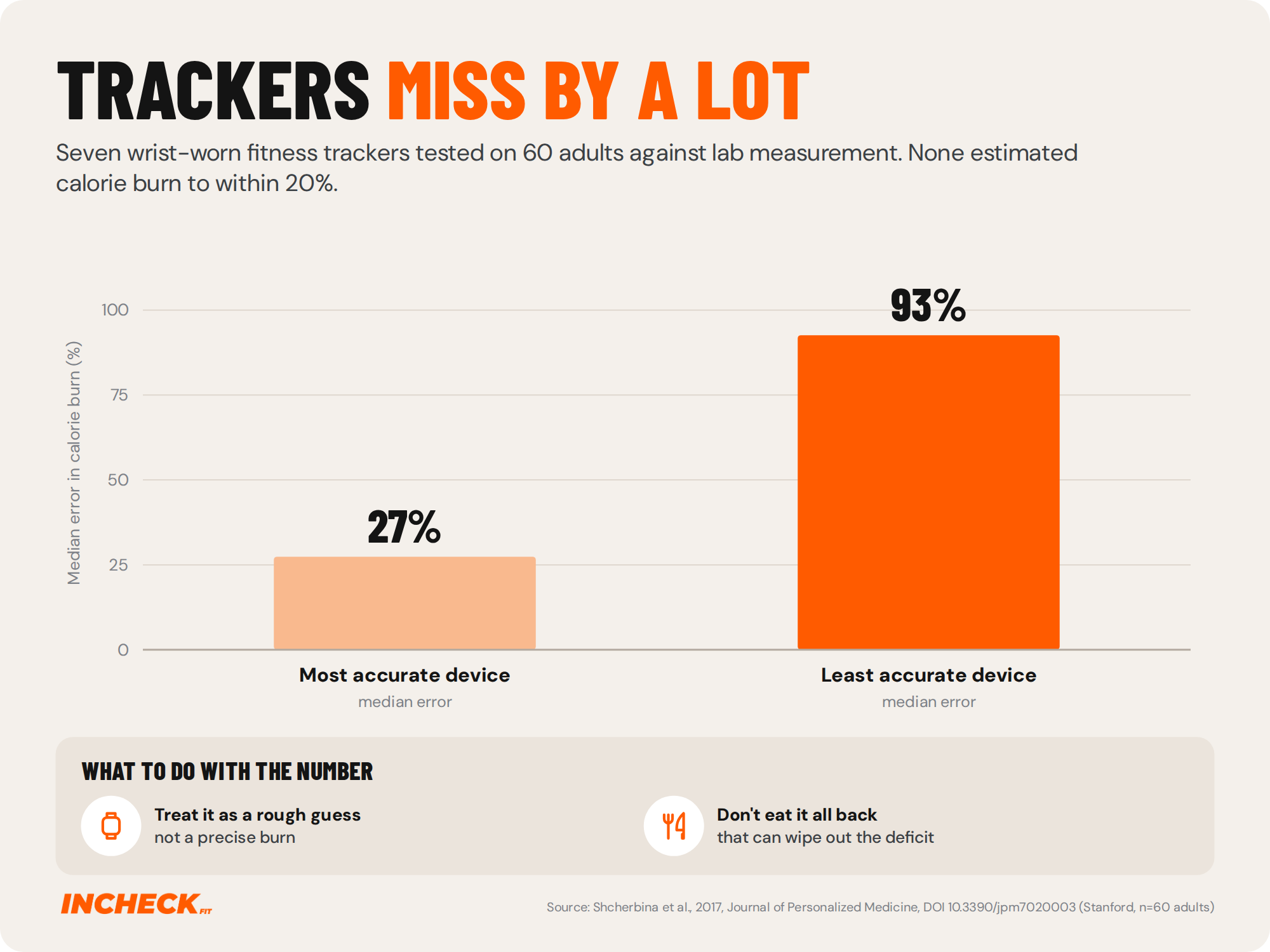
In a 2017 Stanford study of 60 adults testing seven wrist-worn fitness trackers in a lab, none estimated calorie burn to within 20%. The best device at estimating calorie burn had a typical (median) error of about 27%, and the worst about 93%. Eating back those estimated exercise calories can cancel out a deficit without you noticing.
Your Body Is Using a Little Less Energy
When you lose weight, your body burns a little less energy, mostly because there’s less of you to fuel. On top of that, it can cut back slightly more than the weight loss alone would predict. This is called adaptive thermogenesis. In a 2020 study, 71 adults with obesity followed a supervised 1,000-calorie-a-day diet for eight weeks. Straight afterwards, their energy use at rest was about 92 calories a day lower than predicted for their new size. After four more weeks aimed at keeping their weight stable, the gap was about 38 calories a day. That study only measured energy used at rest. It doesn’t stop a deficit from working, but it’s one reason progress slows.
You’re Moving Less Without Realising
Some people move, stand and fidget less when they’re eating less, which shrinks the deficit without any change to their workouts. How much this happens varies a lot between people. Some research suggests people who start exercising may also move a little less the rest of the day, though how much is still debated.
The Role of Protein in a Calorie Deficit
Protein matters more than usual when you’re eating less, for two reasons: it helps you keep muscle, and it keeps you fuller.
When you’re short on energy, your body is more likely to break down muscle if protein is low. Keeping muscle helps your strength and how you look and feel, and it helps a little with how much energy you use. For people who exercise, the International Society of Sports Nutrition recommends 1.4 to 2.0g of protein per kg of body weight a day. The same position stand notes that lean people who lift weights may need more, about 2.3 to 3.1g per kg a day, to hold on to as much lean mass as possible in a deficit. For fat loss we suggest 1.7g per kg for women and 1.8g for men, which is what our calculator gives you.
A 2018 analysis of 49 trials in 1,863 healthy adults doing weight training found little extra gain in lean mass (everything that isn’t fat, including muscle) above about 1.6g of protein per kg a day. That analysis didn’t look specifically at people in a calorie deficit. Here’s more on how much protein to eat to lose fat, and on whether you can build muscle in a calorie deficit. If you train and wonder about creatine too, here’s whether you can get enough creatine from food.
Protein can also make a deficit easier to stick to. Many people find it the most filling of the three macronutrients (protein, carbs and fat), so higher protein meals can mean less hunger between meals.
How to Stay in a Calorie Deficit Without Obsessive Tracking
Logging every meal works, but it’s also a lot of mental effort. For many people, scanning every barcode and adding up every portion is exactly what makes them give up. If you’re weighing up your options, here’s how the main weight loss apps compare on how much of that work they leave to you.
A few things make a deficit easier with less effort:
Get protein into every meal. It helps you keep muscle and keeps hunger down between meals.
Build meals around filling, lower-calorie foods. Vegetables, legumes, lean proteins and whole grains give you more food for the same calories than most ultra-processed foods. A 500-calorie plate that leaves you satisfied is worth far more than one that leaves you hungry.
Make fewer food decisions. Rotating a few reliable meals, knowing what you’re eating before you’re hungry and shopping to a list all take daily load off. Here’s how to make a macro meal plan if you’d like to plan your own week.
Let something else do the maths. INCHECK FIT builds a weekly meal plan around your calorie and protein targets, with recipe portions already set, so you follow the plan instead of logging what you ate. Each week it reviews your progress and adjusts your targets if needed, and any meal can be swapped with portions recalculated so the day still adds up.
Common Calorie Deficit Myths
Myth: Eating Less Will Permanently Damage Your Metabolism
Your body’s small extra drop in energy use during a deficit doesn’t seem to last. In the same 2020 study, 45 of the adults with obesity were followed for a year after their eight-week diet. By then, the extra drop in their energy use at rest had shrunk to about 7 calories a day, too small to be a real effect. There’s no good evidence that a sensible, moderate deficit causes lasting metabolic damage in otherwise healthy adults.
Myth: All Calories Are Equal
For weight change, a calorie is a calorie. But where calories come from changes how hungry you feel, how much muscle you keep and how well you meet your nutrient needs. A 1,800-calorie day built around protein, fibre and whole foods feels very different from the same calories from mostly ultra-processed food.
Myth: A Bigger Deficit Always Means Faster Results
A bigger deficit speeds up early weight loss, but it makes hunger, energy and training harder, and many people can’t keep it up. A moderate deficit you can hold for months will usually get you further than an aggressive one that falls apart after a few weeks.
Myth: You Should Always Eat Back Your Exercise Calories
It depends on how you worked out your maintenance calories. If your activity level already includes your usual training, eating back exercise calories counts them twice and can wipe out the deficit. If you used our calculator, your activity level already includes your training, so we suggest not eating exercise calories back, especially since trackers often overestimate them.
Frequently Asked Questions
-
How do I figure out my calorie deficit? Estimate your maintenance calories, then set your target 10 to 25% below them (our coaching default is 15%). Maintenance comes from the Mifflin-St Jeor equation multiplied by your activity level, which a calorie deficit calculator does for you. At a 15% deficit, someone with estimated maintenance of 2,124 calories a day would aim for about 1,805. Follow it for two to three weeks and adjust based on your weekly average weight.
-
Is 1,200 calories enough for a calorie deficit? For many adults, 1,200 calories a day is a much bigger deficit than they need, and it isn’t a target to aim for. It’s the lower end of the daily intake range the 2013 US obesity guideline suggests for women with overweight or obesity who are losing weight, and we suggest not going below it without support from a GP or dietitian. Taller or more active people usually reach a sensible 10 to 25% deficit well above 1,200 calories.
-
How much of a deficit do I need to lose 1kg a week? Using the rough rule that 1kg of body fat holds about 7,700 calories, losing 1kg a week would take a deficit of about 1,100 calories a day. For a worked example with maintenance of 2,124 calories a day, that’s more than half of maintenance, far beyond the 25% top setting on our calculator. For most people, a slower pace they can hold for months gets them further.
-
Is 1,500 calories a day good for a deficit? It depends on your maintenance calories. For a worked example with maintenance of 2,124 calories a day, 1,500 is about 29% below maintenance, which is steeper than the 25% Aggressive setting. For someone with maintenance near 1,765 calories, 1,500 is about a 15% deficit. For men, 1,500 a day is the lower end of the range the 2013 US obesity guideline suggests for men with overweight or obesity, and we suggest not going lower without support from a GP or dietitian.
-
What is a calorie deficit in simple terms? A calorie deficit means eating fewer calories than your body uses in a day. Your body makes up the difference from stored energy, mostly body fat, so over weeks your body fat and weight trend down.
-
How long does it take to see results from a calorie deficit? Our take: expect a change in your weekly average weight within two to three weeks. The first week often shows a bigger drop, partly from water and stored carbohydrate rather than fat. Judge it on the weekly average, not single weigh-ins.
-
Can you be in a calorie deficit and not lose weight? Yes, for a while. Water retention can hide fat loss for a week or two, especially around the menstrual cycle. If the weekly average still isn’t moving after two to three weeks, there are three usual reasons. You may be eating a little more than you think (that isn’t people lying; portions, oils and sauces are hard to judge), eating back exercise calories that a tracker has overestimated, or have lower maintenance than the formula estimated.
-
Is a 1,000 calorie deficit safe? For many adults, a 1,000-calorie daily deficit is a big share of maintenance (about 47% for someone with maintenance of 2,124 calories a day) and is hard to sustain. The 2013 US obesity guideline, written for adults with overweight or obesity, suggests a deficit of about 500 to 750 calories a day. Australia’s NHMRC guideline for adults with overweight or obesity suggests about 2,500 kilojoules, roughly 600 calories, a day. Bigger deficits are sometimes used, but under medical supervision rather than as a do-it-yourself plan.
-
Do I need to count calories to stay in a calorie deficit? Not necessarily. Counting is one method that works. Structured meal plans, filling higher-protein meals and tools that work out portions for you are others. Our take: for many people, not having to log every meal is what makes a deficit last.
References
- Mifflin MD, St Jeor ST, Hill LA, Scott BJ, Daugherty SA, Koh YO. “A new predictive equation for resting energy expenditure in healthy individuals.” American Journal of Clinical Nutrition. 1990;51(2):241-247. PMID: 2305711. DOI: 10.1093/ajcn/51.2.241 [Equation development study, human, n=498 healthy adults aged 19-78, resting energy measured by indirect calorimetry. Record verified 25 Sep 2026 and re-read 27 Oct 2026 via Europe PMC; coefficients match; Harris-Benedict overestimated measured REE by 5%.]
- Hall KD. “What is the required energy deficit per unit weight loss?” International Journal of Obesity. 2008;32(3):573-576. PMID: 17848938. DOI: 10.1038/sj.ijo.0803720 [Mathematical modelling, human data. Record verified 25 Sep 2026 via Europe PMC; abstract read on nature.com.]
- Hall KD, Sacks G, Chandramohan D, Chow CC, Wang YC, Gortmaker SL, Swinburn BA. “Quantification of the effect of energy imbalance on bodyweight.” Lancet. 2011;378(9793):826-837. PMID: 21872751. DOI: 10.1016/S0140-6736(11)60812-X [Mathematical modelling, human data. Record verified 25 Sep 2026 via Europe PMC.]
- Meerman R, Brown AJ. “When somebody loses weight, where does the fat go?” BMJ. 2014;349:g7257. PMID: 25516540. DOI: 10.1136/bmj.g7257 [Stoichiometric calculation, not a study of people. Record verified 25 Sep 2026 via Europe PMC; 84% and 16% figures read on bmj.com.]
- Martins C, Roekenes J, Salamati S, Gower BA, Hunter GR. “Metabolic adaptation is an illusion, only present when participants are in negative energy balance.” American Journal of Clinical Nutrition. 2020;112(5):1212-1218. PMID: 32844188. DOI: 10.1093/ajcn/nqaa220 [Secondary analysis of a randomised weight loss trial (ASKED), human, n=71 adults with obesity; 1,000 kcal/day diet for 8 weeks then 4 weeks weight stabilisation; resting metabolic rate only; 1-year subset n=45 (-7 kcal/day, not significant). Re-read 27 Oct 2026 via the PMC full text (PMC7657334); at least one published comment (PMID 33301006).]
- Shcherbina A, Mattsson CM, Waggott D, Salisbury H, Christle JW, Hastie T, Wheeler MT, Ashley EA. “Accuracy in wrist-worn, sensor-based measurements of heart rate and energy expenditure in a diverse cohort.” Journal of Personalized Medicine. 2017;7(2):3. PMID: 28538708. DOI: 10.3390/jpm7020003 [Validation study, human, n=60 adults, 7 devices. Verified 25 Sep 2026 on the publisher page (MDPI).]
- Morton RW, Murphy KT, McKellar SR, Schoenfeld BJ, Henselmans M, Helms E, et al. “A systematic review, meta-analysis and meta-regression of the effect of protein supplementation on resistance training-induced gains in muscle mass and strength in healthy adults.” British Journal of Sports Medicine. 2018;52(6):376-384. PMID: 28698222 [Meta-analysis, human, 49 trials, n=1,863 healthy adults doing resistance training; outcome fat-free mass; not a study of people in a deficit. Verified 25 Sep 2026 and re-read 27 Oct 2026 via Europe PMC; a 2020 erratum exists (PMID 32943392).]
- Jensen MD, Ryan DH, Apovian CM, et al. “2013 AHA/ACC/TOS guideline for the management of overweight and obesity in adults.” Circulation. 2014;129(25 Suppl 2):S102-S138. DOI: 10.1161/01.cir.0000437739.71477.ee [Clinical practice guideline, US. Deficit and intake ranges read 25 Sep 2026 via a published summary; recommendation 3a (1,200-1,500 kcal/day women, 1,500-1,800 men; 500 or 750 kcal/day deficit, for adults with overweight or obesity) read in a full-text copy 27 Oct 2026.]
- National Health and Medical Research Council. Clinical Practice Guidelines for the Management of Overweight and Obesity in Adults, Adolescents and Children in Australia. NHMRC, 2013. nhmrc.gov.au [Clinical practice guideline, Australia. Summary guide read 25 Sep 2026 on nhmrc.gov.au.]
- Jäger R, Kerksick CM, Campbell BI, et al. “International Society of Sports Nutrition Position Stand: protein and exercise.” Journal of the International Society of Sports Nutrition. 2017;14:20. PMID: 28642676. DOI: 10.1186/s12970-017-0177-8. [Position stand. Abstract and full text verified 12 Oct 2026 and re-read 27 Oct 2026 via Europe PMC: 1.4 to 2.0g per kg body weight a day for most exercising people; 2.3 to 3.1g/kg/d may be needed to maximise lean mass retention in resistance-trained people in a deficit; no corrections found.]
- Garthe I, Raastad T, Refsnes PE, Koivisto A, Sundgot-Borgen J. “Effect of two different weight-loss rates on body composition and strength and power-related performance in elite athletes.” International Journal of Sport Nutrition and Exercise Metabolism. 2011;21(2):97-104. PMID: 21558571. DOI: 10.1123/ijsnem.21.2.97 [Randomised controlled trial, human, n=24 elite athletes doing resistance training (13 slow, 11 fast). Abstract verified 27 Oct 2026 via Europe PMC: energy intake cut 19% vs 30%, lean body mass by DXA +2.1% vs -0.2% (unchanged); target weekly loss 0.7% vs 1.4%; no corrections listed.]
- Subar AF, Kipnis V, Troiano RP, et al. “Using intake biomarkers to evaluate the extent of dietary misreporting in a large sample of adults: the OPEN study.” American Journal of Epidemiology. 2003;158(1):1-13. PMID: 12835280. DOI: 10.1093/aje/kwg092 [Biomarker study, human, n=484 adults aged 40-69, Maryland, US. Abstract verified 27 Oct 2026 via Europe PMC: energy under-reported against total energy expenditure by 12-14% (men) and 16-20% (women) on 24-hour recalls; no corrections listed.]
Last reviewed: October 2026