The short answer:
- The best weight loss app is the one you’ll still be using in three months.
- Most apps are trackers: you decide what to eat, then log it. A few build the plan for you.
- If you like data and control, a tracker such as MyFitnessPal, MacroFactor or Cronometer suits you.
- If logging is what makes you quit, pick an app that plans your meals for you.
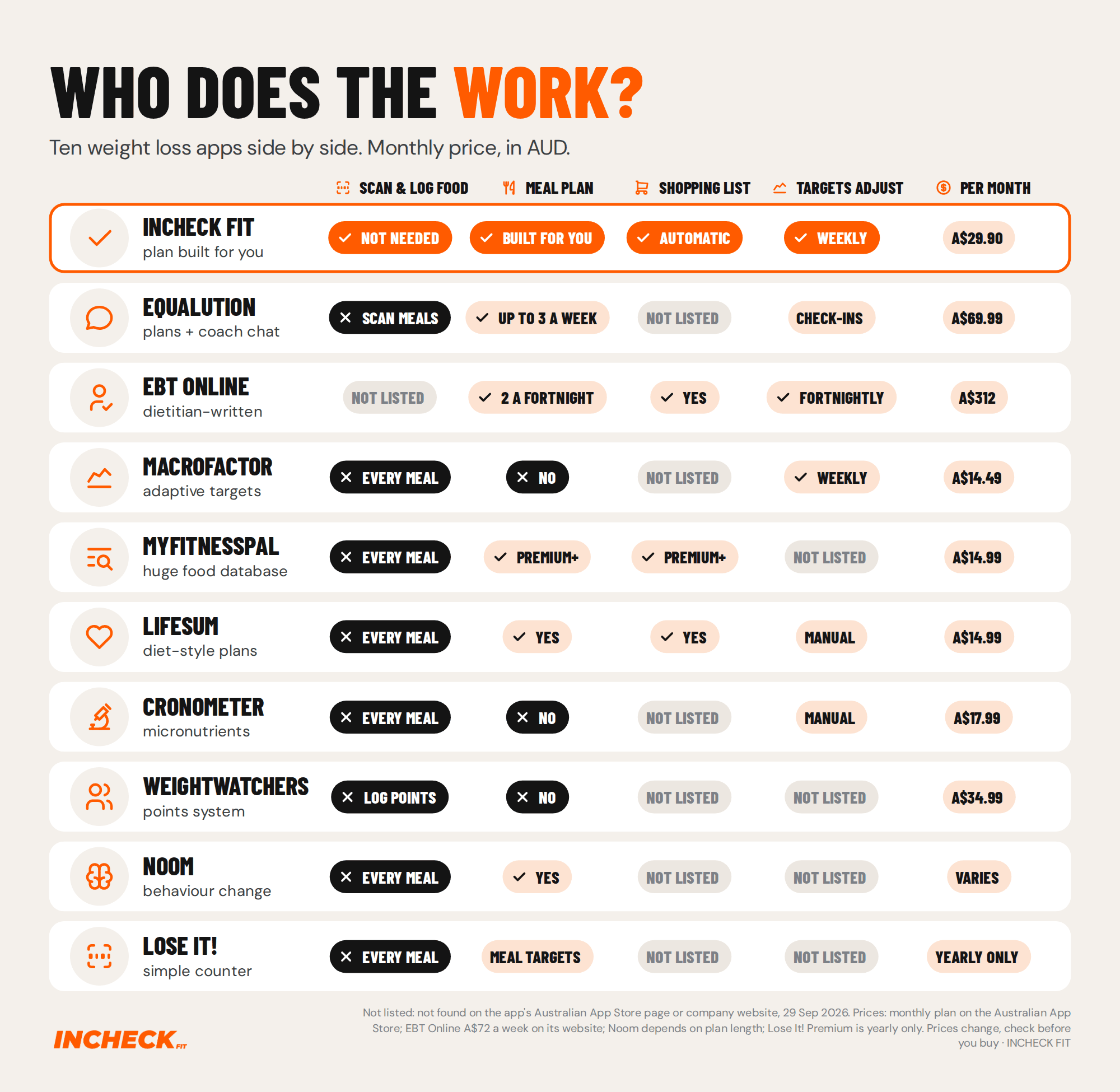
- Of the ten apps here, INCHECK FIT is the only one whose listing covers all four: no food logging, a meal plan built for you, an automatic shopping list and targets that adjust every week, for A$29.90 a month.
- Equalution and EBT Online also give you meal plans, with more coaching support, at more than twice the price: about A$2.30 and A$10 a day, against about A$1 a day for INCHECK FIT.
- Prices below are in AUD, mostly from the Australian App Store, and change often, so check before you buy.
A note before you read: INCHECK FIT is our app, and it’s one of the ten below. We’ve tried to describe every app, including ours, by what it actually does, using each app’s Australian App Store page and each company’s own website, checked on 29 September 2026. Prices shown are the monthly price; most apps are cheaper per month on a longer plan, noted below.
There are two broad kinds of weight loss app. Trackers give you a calorie target and a food database, and you log what you eat. Planners decide what you eat and how much, and you follow the plan. INCHECK FIT builds your plan in the app; at EBT Online, dietitians write it; Equalution sits in between, with meal plans and an in-app coach. Both can work. Which one works for you depends mostly on how much daily effort you’ll realistically keep putting in.
What makes a weight loss app worth using?
Tracking what you eat helps. A systematic review of 22 weight loss studies found a consistent link between self-monitoring (writing down food, exercise or weight) and losing weight, although the authors rated the evidence as weak because most studies relied on self-report and mainly included white women (Burke et al., 2011).
The catch is that tracking only helps while you keep doing it, and logging every meal is the part many people drop. So the useful question isn’t which app has the most features. It’s which app asks for an amount of daily effort you’ll actually keep up.
Beyond that, the things worth looking for are:
- Personal targets based on your body and goal, not a generic number.
- Targets that change as you do, because the calories that start your weight loss won’t keep it going forever. There’s more on why in what a calorie deficit is.
- Help with the decisions, not just the maths: what to eat, and how much of it.
The best weight loss apps compared
App-by-app breakdown
INCHECK FIT
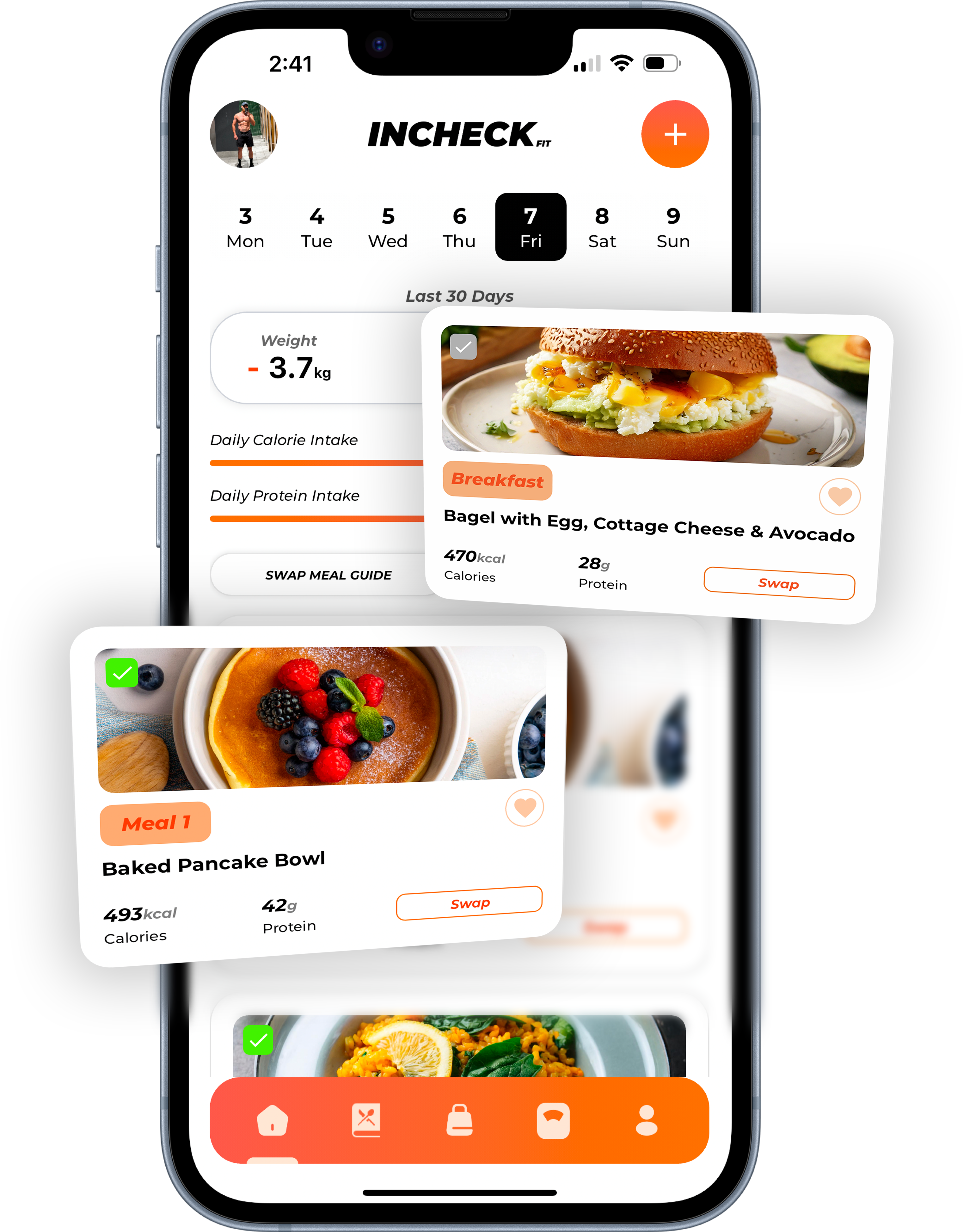
What it does: INCHECK FIT does the planning for you, so you don’t have to count, log or decide what to eat each day. It builds you a weekly meal plan to your calorie and macro targets, designed to hit your protein target, based on your goal, body stats and food preferences, with the quantities for each meal set out. It pulls from more than 500 recipes, lets you swap any meal you don’t like, and builds your shopping list automatically. Each week it reviews your progress and adjusts your targets, and that review isn’t based on a single weigh-in, so one heavy morning doesn’t throw your plan out. You don’t log your meals, because you’re following a plan rather than recording what you ate. You do still weigh or measure your food to the amounts the plan gives you.
How a week works:
- Your plan and shopping list are ready for the week, built to your targets.
- You shop, cook and eat to the plan, swapping any meal you don’t feel like.
- At the end of the week it reviews your progress and adjusts next week’s targets for you.
Price: A$29.90 a month on the Australian App Store, with a 7-day free trial. That works out at about A$1 a day for your meal plan, shopping list and weekly target updates. It’s more than most trackers, which leave the planning and logging to you, and less than half the price of the two other meal plan services below, Equalution (A$69.99 a month) and EBT Online (A$72 a week, about A$312 a month).
Good for:
- People who’ve tried tracking and dropped it
- Busy people who’d rather not decide what to eat every day
- Anyone who wants the shopping list done for them
- Anyone who wants their targets adjusted each week without doing the maths
Less good for:
- People who want to pick every meal themselves from a big food database
- It’s newer, with far fewer reviews than the established apps
- It costs more each month than most trackers
- There’s no human coach
Best for: anyone who knows roughly what to do but finds the daily decisions and logging are what make them stop. You can start with a 7-day free trial.
Equalution (equ app)
What it does: Equalution’s equ app is the most similar to INCHECK FIT of the apps here. According to its website, equ calculates personalised calorie and macro targets and gives you up to three personalised meal plans each week, with unlimited meal swaps and a library of more than 9,000 recipes, with meal plans and recipes it says are built by qualified nutritionists. You track what you eat with a food photo scanner or by logging planned meals to your food diary, and you complete a quick weekly check-in. A 24/7 in-app Coach answers questions about food choices and progress, and the website says you can connect with a real equ nutrition coach when you need more.
Price: A$69.99 a month on the Australian App Store, after a 7-day free trial. Its website lists A$69 a month, or from A$49 a month on a six-month plan.
Good for:
- Meal plans plus an in-app coach and weekly check-ins
- A large recipe library and a big community
Less good for:
- You still track what you eat, even if the photo scanner makes it quick
- More than double our monthly price
Best for: people who want planned meals and more support, and don’t mind tracking.
EBT Online (Evidence Based Training)
What it does: EBT Online is an Australian coaching service where real people write your meal plans. According to its website and FAQs, a team including dietitians creates two personalised single-day meal plans each fortnight, based on a detailed questionnaire about what you eat, enjoy and avoid, and updated each fortnight with your preferences and budget, and you can alternate between them and swap each recipe out twice. You check in every fortnight, and your calories and macros are reassessed at each check-in. A training and nutrition package adds a weekly training program for home or the gym.
Price: A$72 a week for nutrition only (about A$312 a month), or A$95 a week with training (about A$412 a month), according to EBT’s website. There’s an 8-week minimum, no cooling-off period and two weeks’ notice to cancel. The app itself is a free download; coaching is bought through the website.
Good for:
- Meal plans written by qualified people, not software
- Coaching for training as well as nutrition
Less good for:
- By far the most expensive option here, and you can’t cancel in the first 8 weeks
- Two meal plans a fortnight, with check-ins and target changes fortnightly rather than weekly
Best for: people who want nutrition, and possibly training, planned by a person and have the budget for it.
MacroFactor
What it does: MacroFactor is a macro tracker built around an algorithm that, in its own words, adapts “to changes in your metabolism” and personalises your macro plan as you go. You log your food and your weight, and it recalculates your targets from how your body is actually responding. It’s one of the few trackers that adjusts targets for you.
Price: from A$14.49 a month, or A$103.99 a year.
Good for:
- Adaptive targets that update from your real data
- People who like numbers and don’t mind logging
Less good for:
- You still log everything you eat
- No meal plan: it tells you the target, not what to eat
Best for: committed trackers who want their targets to adjust automatically.
MyFitnessPal
What it does: MyFitnessPal is one of the best-known calorie trackers. Its App Store listing describes one of the largest food databases, with over 20.5 million foods, and connections to more than 40 apps and devices. Premium adds barcode scanning, meal scanning, voice logging, custom macro goals and ad-free logging. Premium+ adds customised weekly meal plans, more than 1,500 recipes and shopping lists generated from your plan.
Price: Premium and Premium+ subscriptions run from A$14.99 to A$29.99 a month, or A$79.99 to A$129.99 a year, on the Australian App Store. Its website lists Premium at A$29.99 a month or A$129.99 a year.
Good for:
- A very large food database, and a useful free version
- Connects with 40+ apps and devices
Less good for:
- You log every meal, every day
- The meal planner is only in Premium+
Best for: people who enjoy tracking and want a huge database.
Lifesum
What it does: Lifesum is a calorie and macro tracker with photo, voice and barcode logging. Its App Store listing includes nutrition plans and meal plans with grocery lists, in diet styles such as keto, high protein and Mediterranean. The free version has limited features, and Premium unlocks the full app.
Price: A$14.99 a month, A$34.99 to A$39.99 for three months or A$69.99 to A$99.99 a year on the Australian App Store.
Good for:
- A polished, Editors’ Choice app on the App Store
- Diet-style meal plans with grocery lists
Less good for:
- You still log your food
- Plans are organised by diet style rather than built around your weekly progress
Best for: people who want some structure and a polished app.
Cronometer
What it does: Cronometer is the detail app. Its App Store listing says it tracks more than 95 vitamins and minerals, uses a curated database of more than 1.1 million verified foods and has tools trusted by dietitians and healthcare professionals.
Price: Gold from A$17.99 a month, or A$79.99 to A$99.99 a year.
Good for:
- Very detailed nutrient tracking
- Checking whether you’re short on particular nutrients
Less good for:
- You log everything you eat
- No meal plan, and it can feel like a lot for simple weight loss
Best for: people who want the full nutritional picture, or who’ve been asked to watch specific nutrients.
WeightWatchers
What it does: WeightWatchers (WW) gives foods a points value and gives you a points budget, which you track in the app. There’s no set meal plan: its website says what you eat is up to you. The app includes more than 7,000 recipes, community features, workshops in some areas and, more recently, tracking for people on GLP-1 weight loss medications.
Price: monthly plans from A$34.99 on the Australian App Store. Its website lists plans from A$21 a month on a 12-month commitment.
Good for:
- A long-running programme with a big community
- A points system if you’d rather not count calories directly
Less good for:
- You still log what you eat, as points
- One of the pricier options
Best for: people who stay consistent through community and group accountability.
Noom
What it does: Noom is a behaviour change programme. Alongside AI food logging, its App Store listing lists meal plans and dietitian-backed recipes, daily lessons on the psychology behind eating habits, and optional one-to-one coaching.
Price: sold as programmes of different lengths rather than a simple monthly fee, so there’s no single monthly price to compare. Noom’s own help centre lists a one-month plan at US$70, and purchases on the Australian App Store range from A$64.99 to A$309.99 depending on the plan.
Good for:
- Working on the habits and mindset side of eating
- Coaching options
Less good for:
- Built around logging your food
- Harder to compare on price, and among the more expensive options
Best for: people whose biggest obstacle is habits and emotional eating rather than knowing what to eat. If that’s you, our guide to emotional eating and weight loss covers the research.
Lose It!
What it does: Lose It! is a simple, beginner-friendly calorie counter with a food database of more than 56 million items and recipes, according to its App Store listing. Premium adds barcode scanning, photo and voice logging, macro tracking and what it calls meal planning: targets for each meal that suggest how many calories and macros to aim for, rather than a menu.
Price: a free version, and Premium is a yearly subscription, according to its App Store listing and help centre; we couldn’t find a monthly option. Premium purchases on the Australian App Store are listed from A$7.99 to A$124.99.
Good for:
- Easy to pick up
- Useful free version
Less good for:
- Manual logging for every meal
- Its meal planning is per-meal targets, not a plan built for you
Best for: beginners who want a straightforward counter.
Tracker or plan: which suits you?
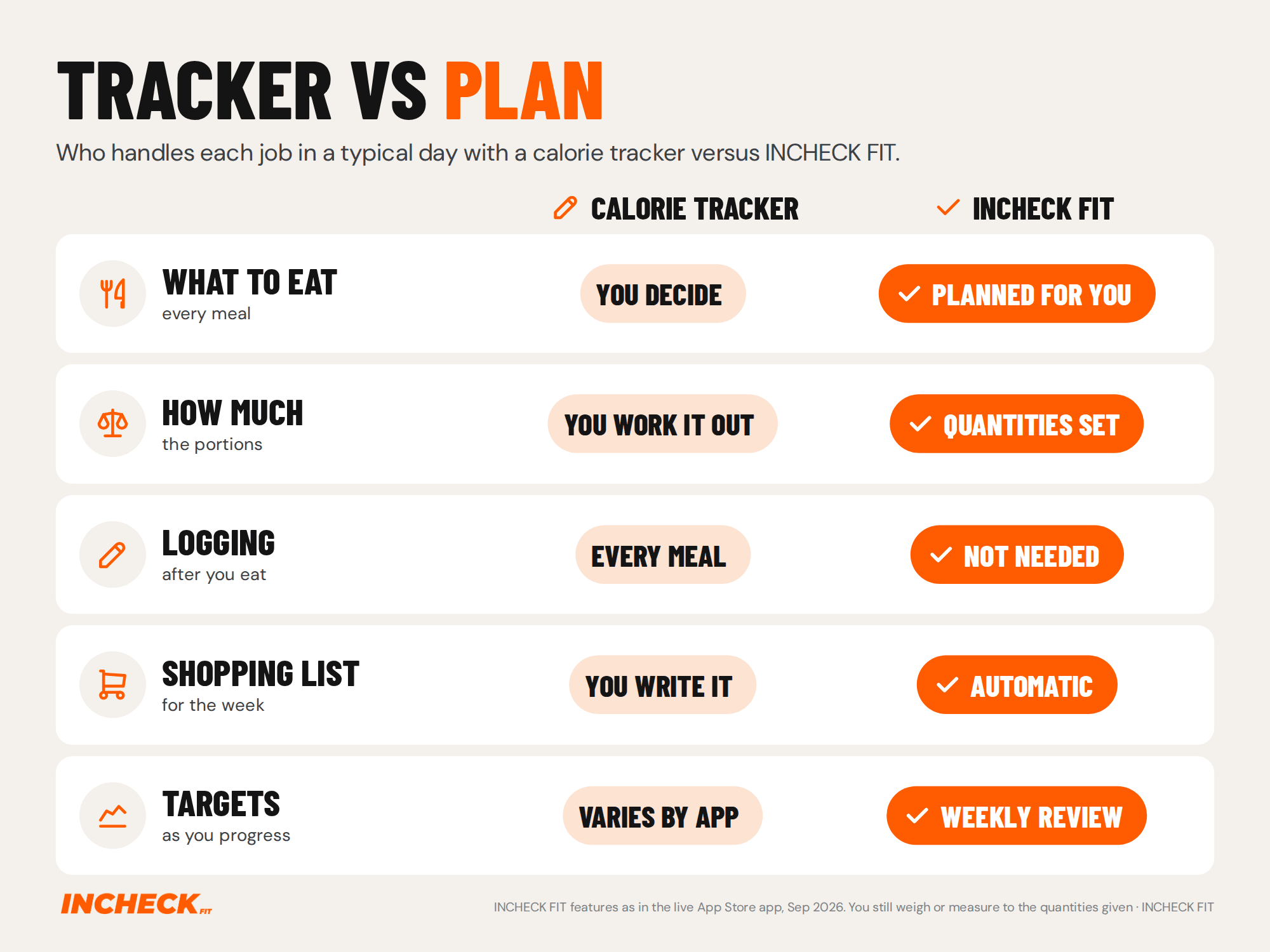
A tracker gives you a number and leaves the decisions to you. That suits people who like control and don’t mind the daily admin. A plan makes those decisions up front: what to eat, how much and what to buy. That suits people who know what they should be doing but keep running out of energy for the decisions in between. It’s the approach we built INCHECK FIT around: the plan, the shopping list and the weekly adjustments are done for you, and your job is to follow it.
Either way, the calorie target underneath still matters most. Here’s how many calories to eat to lose fat if you want to understand the number any of these apps gives you.
Which app should you choose?
- You want it done for you: INCHECK FIT plans your meals and shopping and adjusts your targets each week.
- You want planned meals with more human support: Equalution (with tracking), or EBT Online for plans written by dietitians, plus training.
- You like tracking and want adaptive targets: MacroFactor.
- You want a huge database and a free option: MyFitnessPal.
- You want diet-style plans and a polished app: Lifesum.
- You want the deepest nutrition detail: Cronometer.
- Community keeps you going: WeightWatchers.
- Habits and mindset are the problem: Noom.
- You want the simplest starting point: Lose It!.
Frequently asked questions
-
What is the best app to lose weight in Australia? It depends on how much daily effort you want to put in. If you like tracking, MacroFactor, MyFitnessPal and Cronometer are strong options. If logging is what makes you quit, an app that plans your meals, such as INCHECK FIT, removes that step. For the apps compared here, monthly plans range from about A$15 a month for a tracker to about A$312 a month (A$72 a week) for dietitian-written plans.
-
What is the best free app to lose weight? MyFitnessPal, Lose It! and Cronometer all have free versions that cover basic calorie tracking. Free versions generally mean full manual logging, with meal plans and extra features kept for paid tiers.
-
Do weight loss apps actually work? They can. A systematic review of 22 studies found a consistent link between self-monitoring and weight loss, although the evidence was rated weak because most studies relied on self-report and mainly included white women (Burke et al., 2011). An app only helps while you keep using it, so how much effort it asks of you matters.
-
What’s the difference between a calorie tracker and a meal planning app? A calorie tracker records what you’ve eaten after you log it. A meal planning app decides what you’ll eat in advance, with quantities set. Trackers suit people who want control; planners suit people who find the daily decisions and logging hard to keep up. If you used Mealime as your planner, see the best Mealime alternatives. For a full roundup of meal planning apps, see the best meal planner apps in 2026.
-
Which weight loss apps adjust your calories automatically? MacroFactor adjusts your targets weekly from the food and weight you log. INCHECK FIT reviews your progress each week and adjusts your targets without you logging meals. EBT Online’s dietitians reassess your targets at each fortnightly check-in. For the other apps here, we couldn’t find automatic target changes listed on their App Store pages or websites; Lifesum and Cronometer let you change targets yourself.
-
Do I still need to weigh my food with a meal planning app? Usually, yes. INCHECK FIT gives you the quantities for each meal, so you weigh or measure to the plan rather than logging afterwards. What it removes is the deciding and the logging, not the kitchen scale.
-
Which weight loss app is the best value? It depends on how much of the work you want the app to do. If you only want to count calories, the free versions of MyFitnessPal, Lose It! and Cronometer cost nothing. If you want your meals planned for you, INCHECK FIT is the lowest-priced of the three apps here built around following a meal plan: about A$1 a day (A$29.90 a month), against about A$2.30 a day for Equalution (A$69.99 a month) and about A$10 a day for EBT Online (A$72 a week). Prices are from each app’s Australian App Store page or website, September 2026.
-
Is paying more for human support worth it? It depends on whether accountability to a person is what keeps you going. EBT Online (A$72 a week, or about A$312 a month, according to its website, September 2026) has dietitians write your meal plans and review them fortnightly, and Equalution (A$69.99 a month on the Australian App Store) adds an in-app coach and weekly check-ins. If you mainly need the planning and decisions taken off your plate, a planning app does that for less.
-
Are weight loss apps safe? If you have a medical condition, are pregnant, or have a history of disordered eating, talk to your GP or an accredited practising dietitian before starting any calorie-focused programme. This article is general information, not medical advice.
References
- Burke LE, Wang J, Sevick MA. “Self-monitoring in weight loss: a systematic review of the literature.” Journal of the American Dietetic Association. 2011;111(1):92-102. PMID: 21185970. DOI: 10.1016/j.jada.2010.10.008. [Systematic review, human, 22 studies published 1993 to 2009. Abstract verified 29 Sep 2026 via PubMed: consistent association between self-monitoring and weight loss, level of evidence weak.]
- App prices: in-app purchase lists on each app’s Australian App Store page (apps.apple.com/au), checked 29 September 2026. Equalution’s website (joinequ.com/programs) and EBT Online’s website (ebtonline.au), checked the same day; EBT coaching is not sold in the app. Lose It! and Noom plan terms from their help centres (loseit.zendesk.com, noom.com support FAQs), checked the same day. Prices change and can differ on Google Play and on each company’s website.
- App features: each app’s Australian App Store description, checked 29 September 2026, and each company’s website: joinequ.com (home, Coach and Programs pages), ebtonline.au (home and FAQs), macrofactor.com, myfitnesspal.com (Premium and Premium+ pages), lifesum.com, cronometer.com/gold, weightwatchers.com/au/plans and loseit.com. Noom’s Australian features are taken from its App Store listing.
Last reviewed: September 2026 by the INCHECK FIT nutrition team.
Last reviewed: September 2026