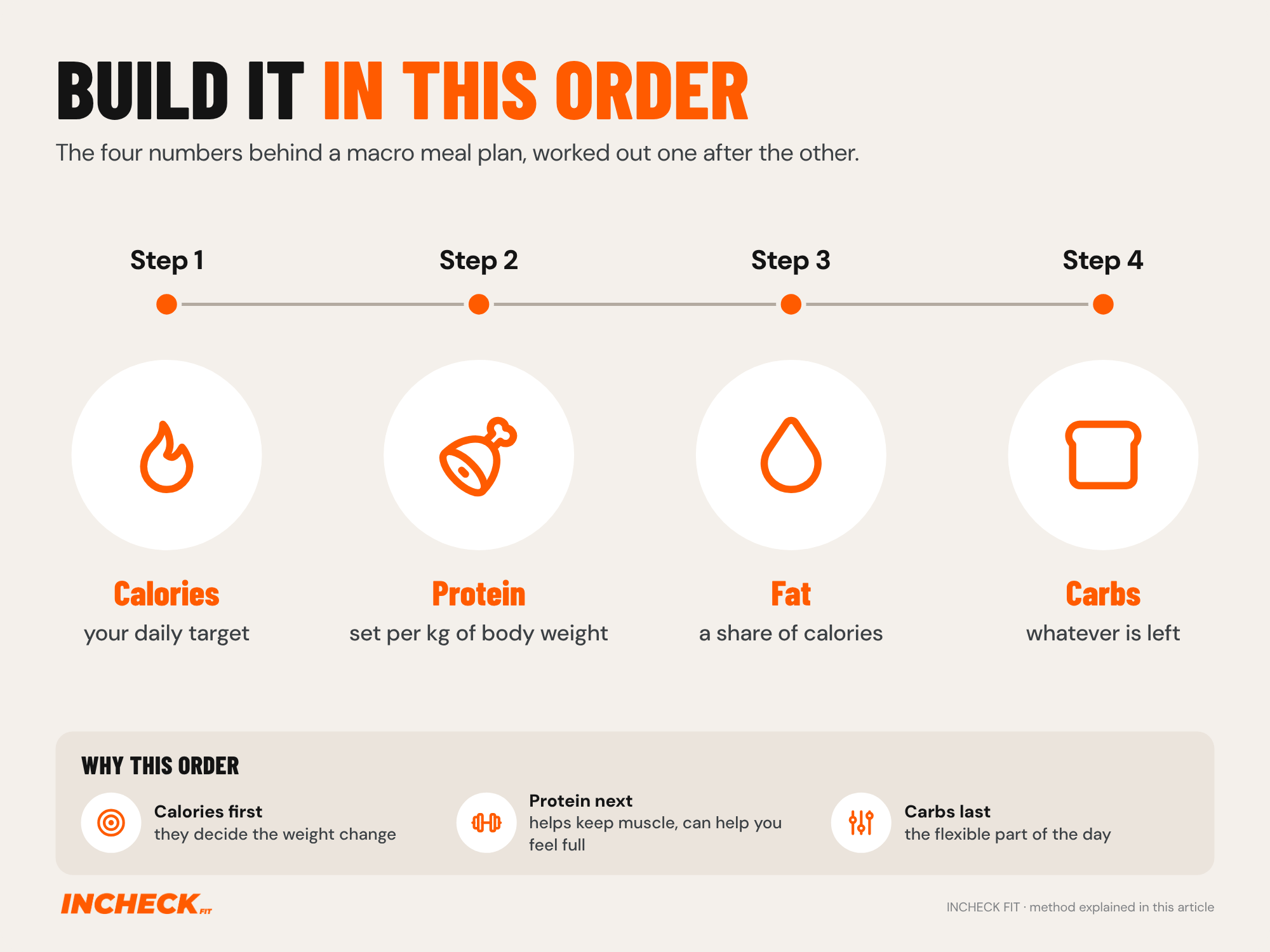
To make a macro meal plan, set your daily calories first, then your protein, then your fat, and fill the rest with carbohydrates. Then split those numbers across your meals and choose foods and portions that add up to them for the week.
A macro meal plan is simply a week of meals built to hit daily targets for the three macronutrients (“macros”): protein, fat and carbohydrate. Almost all your calories come from the macros (alcohol is the main other source), so a plan that hits them also hits your calorie target.
Below is the whole process in six steps, with one worked example carried all the way through. Turning numbers into actual meals is the hardest part, so that’s where most of the practical detail is.
What Is a Macro Meal Plan?
A macro meal plan sets how many grams of protein, fat and carbohydrate you eat each day, then plans meals that land on those numbers. It’s more specific than a calorie target alone. Two days with the same calories can look very different if one is mostly protein and vegetables and the other is mostly biscuits.
Each macro carries a set amount of energy. Protein and carbs have about 4 calories per gram, and fat has about 9. (Australia and New Zealand’s food standards use 17, 17 and 37 kilojoules per gram.) Those three numbers are all the maths you need.
Step 1: Set Your Daily Calories
Calories come first because, over time, they decide whether your weight goes down, stays steady or goes up. Your macros then share out those calories.
The quickest way is our free calorie calculator. It estimates your maintenance calories (the amount that keeps your weight steady), then adjusts for your goal and gives you a daily protein target too. If your goal is fat loss, here’s how to choose the right calorie deficit and how big it should be.
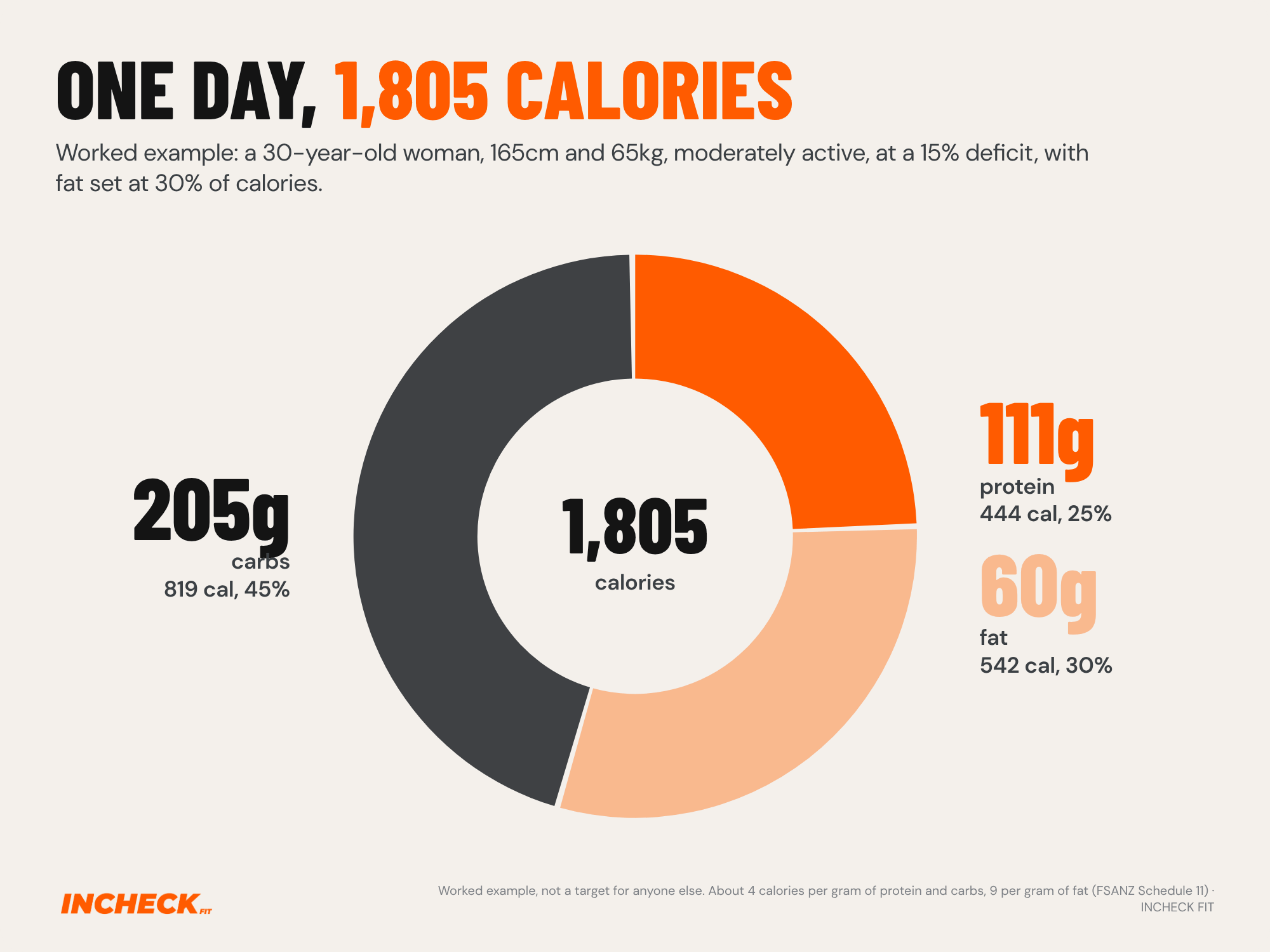
Here’s the worked example we’ll use all the way through. A 30-year-old woman who is 165cm, 65kg and moderately active has estimated maintenance of about 2,124 calories a day. She wants to lose fat at a steady pace, 15% below maintenance, so her daily target is about 1,805 calories. That’s an example of the maths, not a target for anyone else.
Step 2: Set Your Protein
Protein comes next because it does the most work. It helps you keep or build muscle, and many people find it more filling than the same calories from carbs or fat.
Set it from your body weight, not as a percentage of calories. For most people who exercise, the International Society of Sports Nutrition recommends 1.4 to 2.0g of protein per kg of body weight a day. Our standard is 1.7g per kg for women and 1.8g per kg for men, which is what our calculator gives you.
For the worked example, 65kg x 1.7g = about 111g of protein a day. At 4 calories per gram, that’s 444 calories.
If you want more detail, here’s how much protein to eat to lose fat.
Step 3: Set Your Fat
Fat is essential, so it gets a floor before carbs fill the rest. Australia and New Zealand’s Nutrient Reference Values (the official nutrition reference figures) suggest fat makes up 20 to 35% of your calories for healthy adults. Those ranges are for general health, not specifically for weight loss, so they’re a guide rather than a rule.
Our take: 25 to 30% of calories from fat is a comfortable place for most people to start. It leaves room for cooking oil, dairy, nuts and the foods that make meals enjoyable, without crowding out carbs.
For the worked example, 30% of 1,805 calories is about 542 calories. At 9 calories per gram, that’s about 60g of fat a day.
Step 4: Fill the Rest With Carbohydrates
Whatever calories are left after protein and fat come from carbohydrates. Carbs fuel training and everyday energy. Carb foods like grains, fruit, legumes and starchy vegetables, along with other vegetables, are where your fibre comes from.
For the worked example: 1,805 - 444 - 542 = 819 calories from carbs. At 4 calories per gram, that’s about 205g of carbohydrate a day.
So her full daily macros are about 111g protein, 60g fat and 205g carbs. That works out to roughly 25% of calories from protein, 30% from fat and 45% from carbs. All three sit inside the ranges the Nutrient Reference Values use for healthy adults: 15 to 25% protein and 20 to 35% fat, with carbohydrate up to 65%. (For carbs, the Nutrient Reference Values cite a 45 to 65% range from a US and Canadian review.)
Does the Exact Split Matter?
When calories are cut by the same amount, the split between carbs, fat and protein seems to matter much less than people think. In a two-year trial, 811 overweight adults were randomly assigned to one of four diets that cut calories by the same amount but had different amounts of fat, protein and carbohydrate. Weight loss at two years was similar whichever way the diets were compared, about 3 to 3.5kg on average (2.9 to 3.6kg across the comparisons). The researchers concluded that reduced-calorie diets lead to meaningful weight loss whichever macros they emphasise.
What that means for you: get protein right, keep fat in a sensible range, and let carbs fill the rest in a way you enjoy. A split you can stick to beats a “perfect” one you can’t.
Step 5: Split Your Macros Across Your Meals
Now turn daily numbers into meal-sized ones. Start with protein, because it’s the one that matters most per meal.
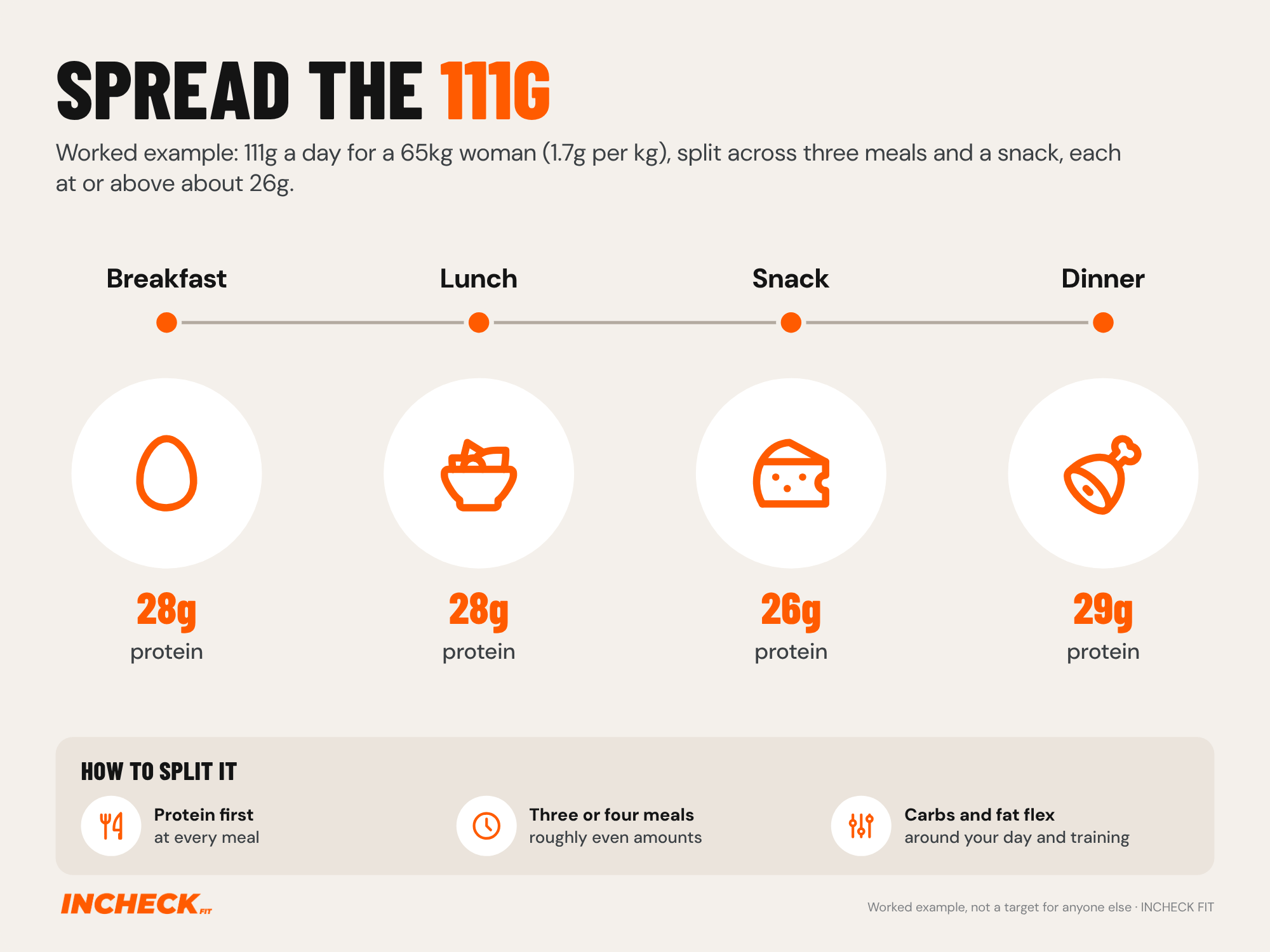
For people who lift weights, a 2018 review of the research on protein for muscle building suggested about 0.4g of protein per kg of body weight per meal (about 26g for someone who weighs 65kg). It suggested spreading that across at least four meals, to reach at least 1.6g per kg a day, and up to about 0.55g per kg per meal for higher daily intakes. In practice, roughly even amounts across three meals and a snack works well. Here’s more on how much protein per meal you need.
Carbs and fat are more flexible. A simple approach is to split them roughly evenly across your main meals, with a little less at snacks. Our take: if you train, putting a bit more of your carbs in the meal before or after training is a sensible tweak, but it isn’t essential.
For the worked example, three meals and a snack might look like this:
- Breakfast: about 28g protein, 55g carbs, 15g fat
- Lunch: about 28g protein, 60g carbs, 15g fat
- Snack: about 26g protein, 25g carbs, 10g fat
- Dinner: about 29g protein, 65g carbs, 20g fat
Those add up to 111g protein, 205g carbs and 60g fat. These are planning targets, not rules. Being within a few grams at each meal is fine as long as the day roughly adds up.
Step 6: Build Meals That Hit the Numbers
This is the step people most often find hard, so keep it simple. Build each meal in the same order you set your macros:
- Pick a protein source first. Chicken, fish, lean beef, eggs, tofu, Greek yoghurt, cottage cheese or a protein powder. Size the portion to your protein number for that meal.
- Add a carb source. Rice, pasta, potatoes, bread, oats, fruit or legumes. Size it to the carbs left for that meal.
- Add vegetables. They add volume, fibre and nutrients for very few calories, so be generous.
- Let the fat come mostly from cooking and extras. Oil, cheese, avocado, nuts or a dressing. Measure these, because they add up fastest.
To size portions, use the nutrition panel on the pack. Most packaged foods in Australia show protein, fat and carbohydrate per serve and per 100g (or 100mL for drinks), so a quick sum tells you how much you need. For example, if a food has 25g of protein per 100g, about 120g of it gives you about 30g of protein.
A few things make the week easier:
- Repeat meals. Two or three breakfasts and lunches on rotation is plenty. Variety can live at dinner.
- Write the shopping list from the plan, not the other way around, so you buy exactly what the week needs.
- Batch-cook the base ingredients. Cook protein and carbs in bulk on one or two days, then build meals from them.
- Use a scale while you learn. Our take: after a few weeks, you’ll likely find you can judge your usual portions.
Check Your Progress and Adjust
Your plan is an estimate, so once it’s running, check it against what actually happens. Follow it for two to three weeks and watch your weekly average weight, not single weigh-ins. If the average is moving the way you want, keep going. If it isn’t, trim (or add) about 100 to 200 calories a day and keep your protein the same. Usually that means adjusting carbs or fat.
Also check how you feel. If you’re always hungry, try moving some calories from fat to carbs and vegetables for more food volume, or adding protein at the meal where you’re hungriest. Our take: if training feels flat, try moving more of your carbs to the meals around training.
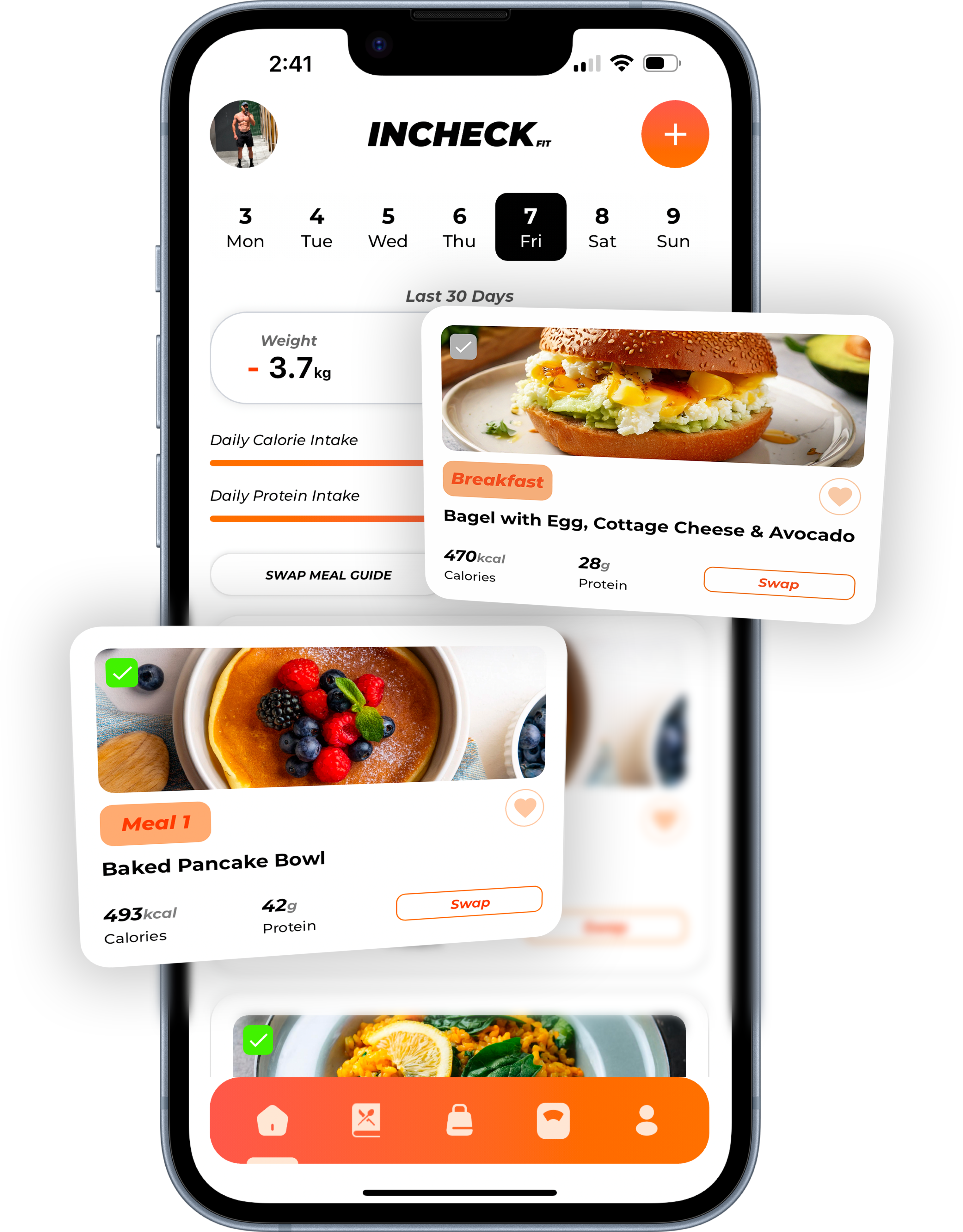
Doing step six by hand takes time every week. If you’d rather not build meals by hand, INCHECK FIT builds a weekly meal plan with recipe portions already set to your calorie and protein targets. It also writes your shopping list and lets you swap meals, with portions recalculated. Each week it reviews your progress and adjusts your targets if needed. You still follow the portions in each recipe, but the calorie and protein maths and the planning are done for you.
Frequently Asked Questions
-
How do I create a meal plan for my macros? Set your daily calories, then protein (based on body weight), then fat (a share of calories), and fill the rest with carbs. Split those numbers across three or four meals, starting with protein. Then build each meal from a protein source, a carb source, vegetables and a measured amount of fat, sized to hit the numbers. Repeating meals keeps the week simple.
-
How do I calculate my macros per meal? Divide your daily macros across the number of times you eat, starting with protein. For people who lift weights and want to build muscle, a 2018 review suggested about 0.4g of protein per kg of body weight per meal, across at least four meals. For someone who weighs 65kg, that’s about 26g per meal. Carbs and fat can be split roughly evenly across meals, or shifted toward the meals around training.
-
What is the 30/30/40 rule for macros? It’s an informal split, not an official guideline: 30% of calories from protein, 30% from fat and 40% from carbohydrate. Its 30% protein sits above the 15 to 25% range in Australia and New Zealand’s Nutrient Reference Values for healthy adults. Its 40% carbs sits below the 45% lower figure those reference values cite, though the ranges aren’t designed for weight-loss diets. Our take: setting protein from body weight, rather than as a percentage, is usually more useful.
-
What is the 3-3-3 rule for meal prep? It’s an informal meal prep tip, not a nutrition guideline, and people use it in different ways. A common version is to prep three proteins, three carbs and three vegetables at the start of the week, then mix and match them into meals. It pairs well with a macro plan, because you can size each portion to your numbers.
-
Do I need to hit my macros exactly every day? No. Our take: aim to be close on calories and protein most days, and let carbs and fat vary a bit. In a two-year trial of 811 overweight adults, four diets that cut calories by the same amount, with different fat, protein and carb levels, produced similar weight loss. That suggests that once calories are set, the exact split matters less than sticking with it.
-
Is a macro meal plan good for weight loss? It can be, because a macro plan is also a calorie plan. If your calories are truly below maintenance, you should lose weight over time whichever split you choose, as long as you stick to it. A good protein target also helps you keep muscle while eating less, and many people find it keeps them fuller.
-
Should I count macros or calories? Calories decide how your weight changes. Macros add detail on top, mainly making sure you get enough protein. Our take: for most people, a calorie target plus a protein target covers most of the benefit, with carbs and fat left flexible.
-
Is there an app that makes a macro meal plan for me? Yes, several apps build meal plans to targets. INCHECK FIT builds a weekly plan with recipe portions set to your calorie and protein targets (it doesn’t set carb and fat targets), with an automatic shopping list, meal swaps with portions recalculated, and weekly target adjustments based on your progress. Other apps let you enter custom macro targets or log your own meals instead.
References
- Jäger R, Kerksick CM, Campbell BI, et al. “International Society of Sports Nutrition Position Stand: protein and exercise.” Journal of the International Society of Sports Nutrition. 2017;14:20. PMID: 28642676. DOI: 10.1186/s12970-017-0177-8. [Position stand. Abstract and full text verified 12 Oct 2026 via Europe PMC: 1.4 to 2.0g per kg body weight a day for most exercising people; no corrections found.]
- Schoenfeld BJ, Aragon AA. “How much protein can the body use in a single meal for muscle-building? Implications for daily protein distribution.” Journal of the International Society of Sports Nutrition. 2018;15:10. PMID: 29497353. DOI: 10.1186/s12970-018-0215-1. [Narrative review. Abstract verified 27 Oct 2026 via Europe PMC: 0.4g/kg/meal across a minimum of four meals to reach a minimum of 1.6g/kg/day; no corrections listed.]
- Sacks FM, Bray GA, Carey VJ, et al. “Comparison of weight-loss diets with different compositions of fat, protein, and carbohydrates.” New England Journal of Medicine. 2009;360(9):859-873. PMID: 19246357. DOI: 10.1056/NEJMoa0804748. [Randomised controlled trial, human, n=811 overweight adults, 4 reduced-calorie diets, 2 years. Abstract verified 27 Oct 2026 via Europe PMC: weight loss at 2 years 2.9 to 3.6kg across comparisons, all P>0.20; about 4kg among the 80% who completed; seven published comments, no corrections listed.]
- National Health and Medical Research Council and New Zealand Ministry of Health. Nutrient Reference Values for Australia and New Zealand: Macronutrient balance. eatforhealth.gov.au. [Guideline, Australia and New Zealand. Read 27 Oct 2026 on eatforhealth.gov.au: protein 15 to 25% and fat 20 to 35% of energy; for carbohydrate the page cites the US/Canadian FNB:IOM range of 45 to 65% (upper bound 65%, notes 45% may be too low); for otherwise healthy adults; page notes the ranges are not necessarily suited to weight-loss diets.]
- Food Standards Australia New Zealand. Australia New Zealand Food Standards Code, Schedule 11: Calculation of values for nutrition information panel, section S11-2(2). legislation.gov.au F2015L00481. [Regulation. Read 27 Oct 2026 on legislation.gov.au: energy factors protein 17, carbohydrate (excluding unavailable) 17, fat 37 kJ/g.]
- Food Standards Australia New Zealand. Australia New Zealand Food Standards Code, Standard 1.2.8: Nutrition information requirements, sections 1.2.8-4 to 1.2.8-6. legislation.gov.au F2015L00395. [Regulation. Read 27 Oct 2026 on legislation.gov.au (2021 compilation): the nutrition information panel gives energy, protein, fat and carbohydrate per serving and per 100g (100mL for liquids); some foods are exempt.]
Last reviewed: October 2026