If you’re in a calorie deficit but not losing weight, you’re probably focusing on the wrong things. A real deficit always shows up on the scale in time. When it doesn’t, the effort usually went into the small stuff, like supplements or meal timing, while the big stuff slipped.
As a coach, this is the pattern I see most. Someone is buying fat burners, cutting carbs after 6pm and stressing over brown rice versus white. Meanwhile their weekends quietly wipe out the deficit, their protein is low and they’re sleeping five hours a night.
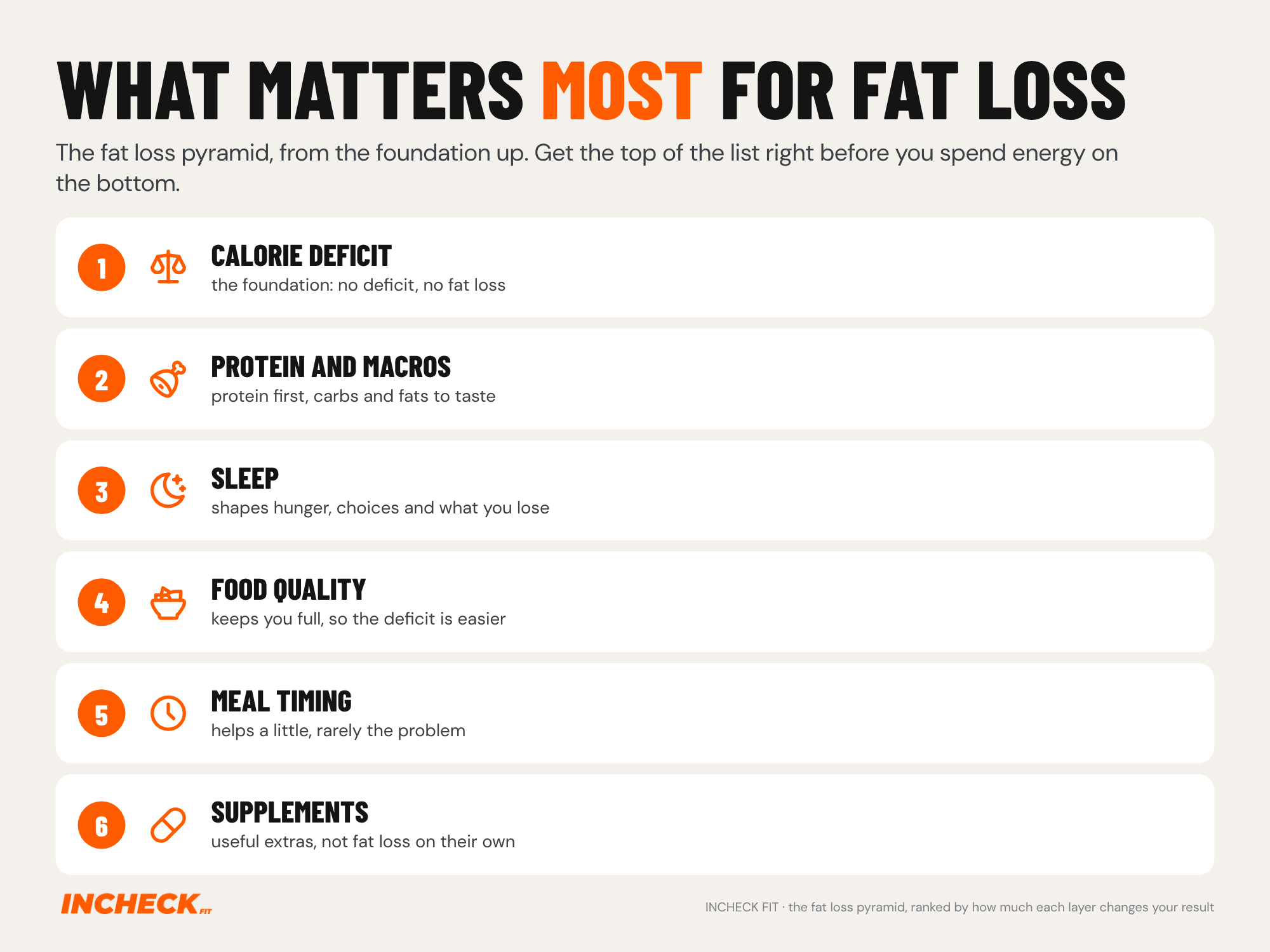
Fat loss works like a pyramid. The base does most of the work and the top does very little. This article walks through each layer, from the foundation up, so you know where your effort actually pays off.
First, is your deficit actually real?
Let’s start with the hard truth. If you’re truly eating less energy than you burn, you will lose weight over time. Your body has no way around that. So when the scale won’t move for weeks, the most likely explanation is that the deficit isn’t really there.
That isn’t people lying. It’s that eating is very hard to judge by eye. In one well-known study, 10 adults with obesity who said they couldn’t lose weight on very little food had their intake measured precisely. On average, they under-reported what they ate by about 47%. The researchers found nothing wrong with their metabolism. In everyday life, our take is that the gap usually hides in oil poured rather than measured, bites while cooking, and weekends that never make it into the count.
Two other things can hide a deficit that is working:
- Water. Your weight bounces from day to day with salt, carbs, training and hormones. A real loss of fat can sit underneath that noise for a week or two. Our guide to weight gain vs fat gain shows how to read the trend instead of single mornings.
- Time. Judge it over three to four weeks, using your weekly average, not three days.
What about “starvation mode”? Your body does burn a little less as you lose weight, but it doesn’t stop fat loss in a real deficit. We break that down in does starvation mode exist.
The first fix is the simplest. Work out what your body actually needs with our free calorie calculator, then check what you’re really eating against it for a couple of weeks. If you want the basics of how a deficit works, start with what a calorie deficit is.
Layer 1: the calorie deficit is the foundation
Everything else in this article sits on top of this. Without a deficit, no amount of protein, sleep or clean eating will create fat loss. With one, you’ll lose weight even if the rest is imperfect.
That’s why it’s the base of the pyramid. Nail this layer before you spend any energy on the ones above it. In practice that means a target that suits your body, and eating close to it on most days, weekends included.
Layer 2: protein first, then carbs and fats to taste
Once the deficit is in place, the next biggest lever is what that deficit is made of. And here, protein matters far more than the carbs versus fats debate.
Protein does two jobs
Protein helps you hold on to lean tissue, including muscle, while you lose weight, and it tends to keep you fuller for longer. Researchers pooled 24 trials of about 1,000 people on reduced-calorie diets. Compared with normal-protein diets, higher-protein diets kept about 0.4kg more lean tissue. Lean tissue is everything in your body that isn’t fat, like muscle, water and stored carbs. People on higher protein also lost a little more fat. In 3 of the 5 trials that measured it, people felt more satisfied too.
That’s why I tell clients to lock in their protein number first and build the rest of the day around it. For how much you need, see how much protein to lose fat, and for how to spread it out, how much protein per meal.
Carbs versus fats is mostly preference
Once your calories and protein are set, the split between carbs and fats makes surprisingly little difference to weight loss. In one large trial, 811 overweight adults were put on four reduced-calorie diets with different amounts of protein, fat and carbs. After two years, weight loss was similar on all of them, between about 2.9 and 3.6kg on average. Between 35% and 65% of calories from carbs, and 20% and 40% from fat, there was no clear difference.
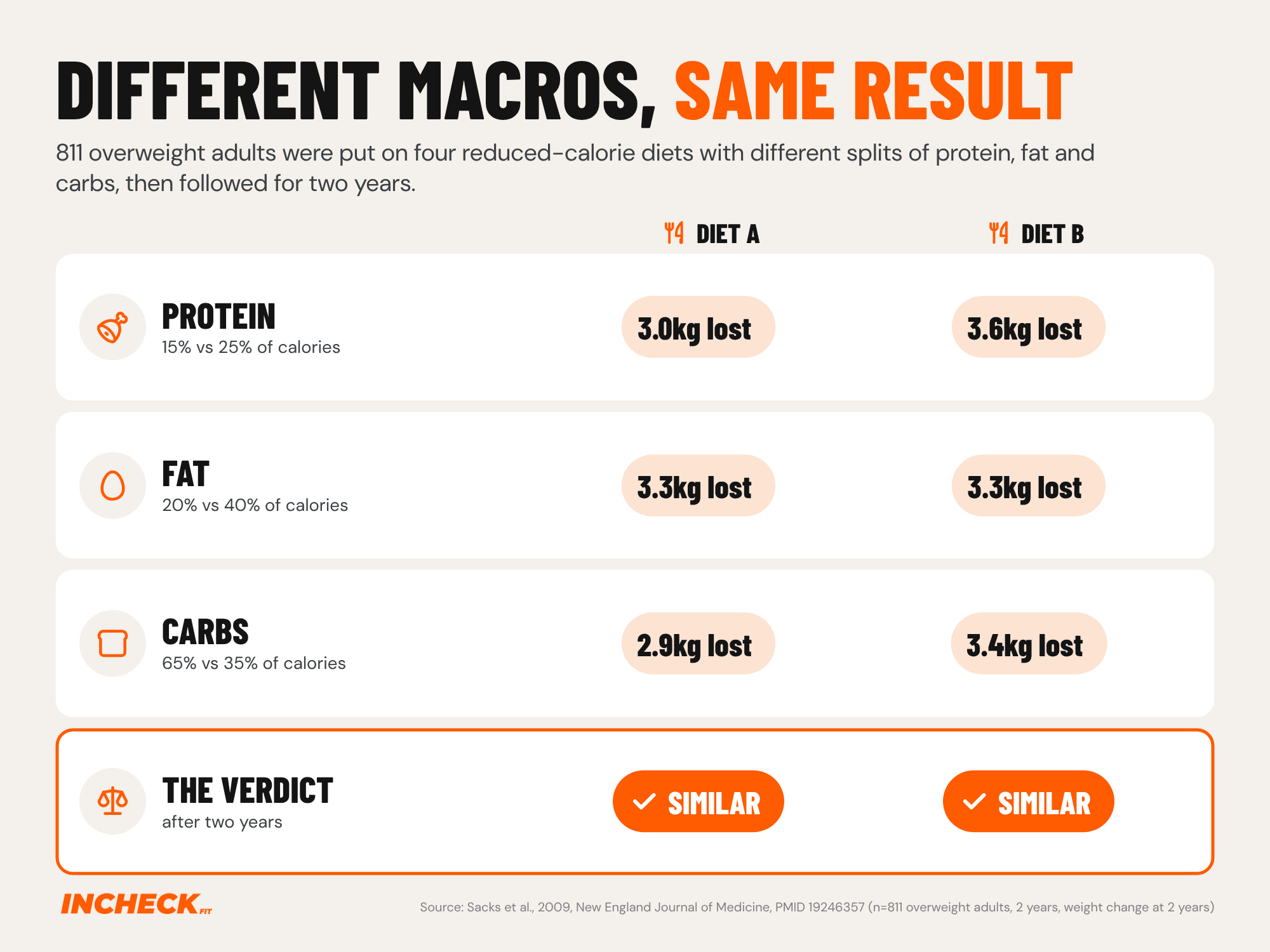
The same study found that the more group sessions people attended, the more weight they lost, about 0.2kg per session. Showing up mattered more than the split. So pick the split you can stick with. If you love bread and pasta, keep them. If you feel better with more fats, that works too.
Layer 3: sleep changes how you eat and what you lose
Sleep sits higher up the pyramid than most people expect, because it affects the layers below it.
First, short sleep tends to make you eat more. Across 8 lab trials in healthy adults, people whose sleep was cut ate about 250 more calories a day. That’s a big chunk of a typical deficit. In a separate study of 11 adults, the extra came from snacks, not meals. Our take: tired decisions are worse decisions, and the in-between choices are the first to slip.
Second, sleep can change what you lose. In one small, tightly controlled study, 10 overweight adults did the same reduced-calorie diet for two weeks, twice. They lost about 3kg either way. But with 8.5 hours in bed, about 1.4kg of it was fat. With 5.5 hours in bed, only about 0.6kg was fat, and the rest was lean tissue. It was a small, short study, so treat it as an early signal rather than the final word.
The full story is in does sleep affect weight loss. The short version: if your nights are short, fix that before you change your food.
Layer 4: food quality makes the deficit easier
Food quality doesn’t burn fat on its own. Healthy food still has calories, which is why so many people end up eating healthy but not losing weight. But quality affects how full you feel, your energy through the day, and your next food decision. So it matters, just not in the way most people think.
The clearest example comes from a study run on a hospital research ward. 20 adults lived there for four weeks. For two weeks they ate ultra-processed meals (think packaged snacks, sugary cereals and ready meals), and for two weeks unprocessed meals. Both diets offered the same calories, sugar, fat, fibre and protein, and people could eat as much or as little as they liked.
On the ultra-processed diet, they ate about 508 more calories a day and gained about 0.9kg. On the unprocessed diet, they lost about 0.9kg. Their weight followed how much they ate.
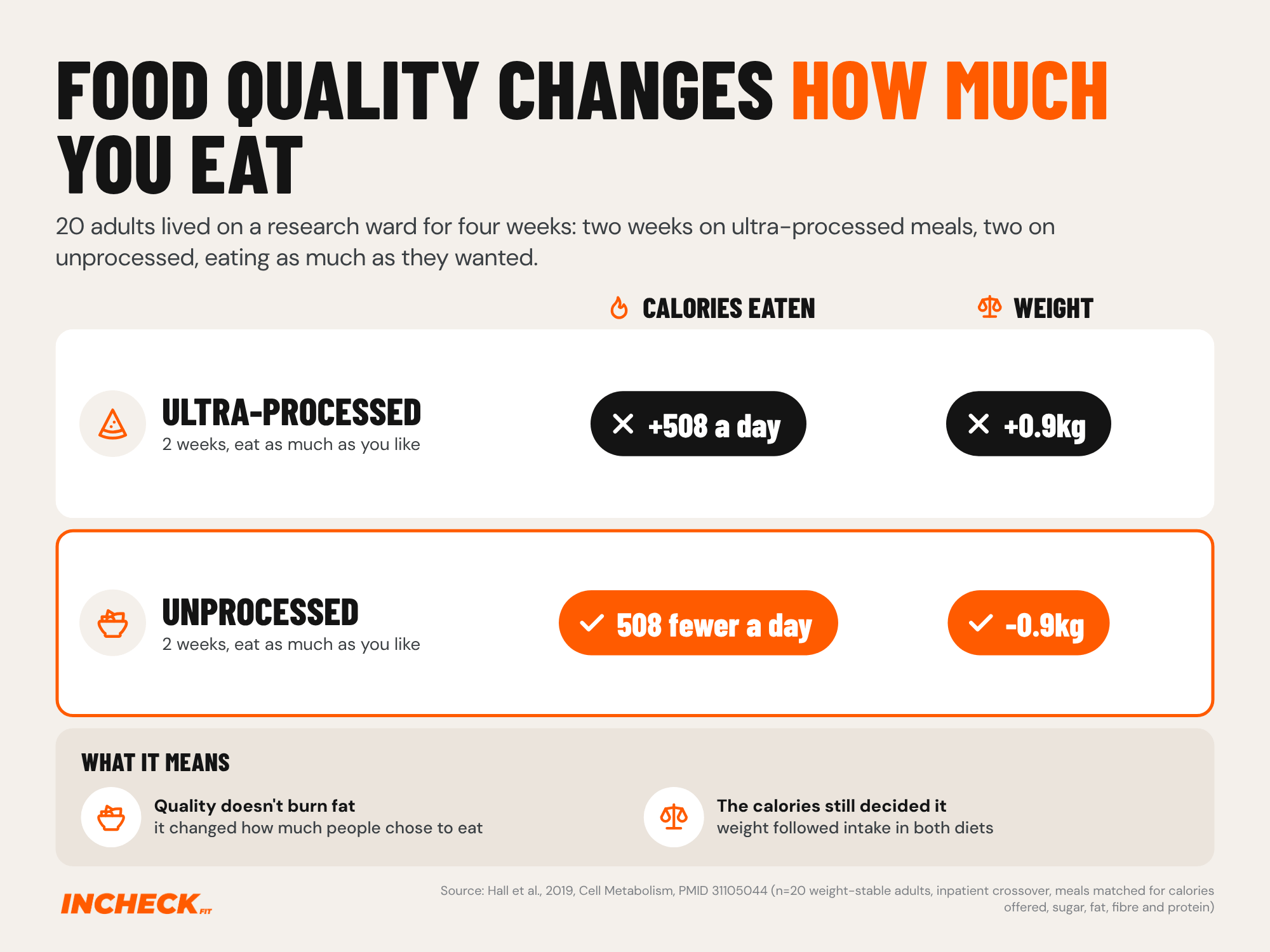
So the food didn’t change the rules. It changed how easy it was to eat too much. Mostly whole foods, plenty of protein and fibre, and treats you actually enjoy make a deficit feel liveable. That’s what keeps you in it for months, not weeks.
Layer 5: meal timing helps a little, but it’s rarely the problem
As a coach, I like spacing protein across the day and having some carbs around training, because most people feel and train better that way. But when it comes to fat loss, whether your biggest meal is breakfast or dinner makes very little difference.
One trial tested this. 30 adults with overweight or obesity did two 4-week diets with the same calories. One put the biggest share of the day’s food (45%) at breakfast, the other at dinner. Weight loss was no different, and neither was how many calories they burned. The one difference: people felt less hungry on the big-breakfast diet.
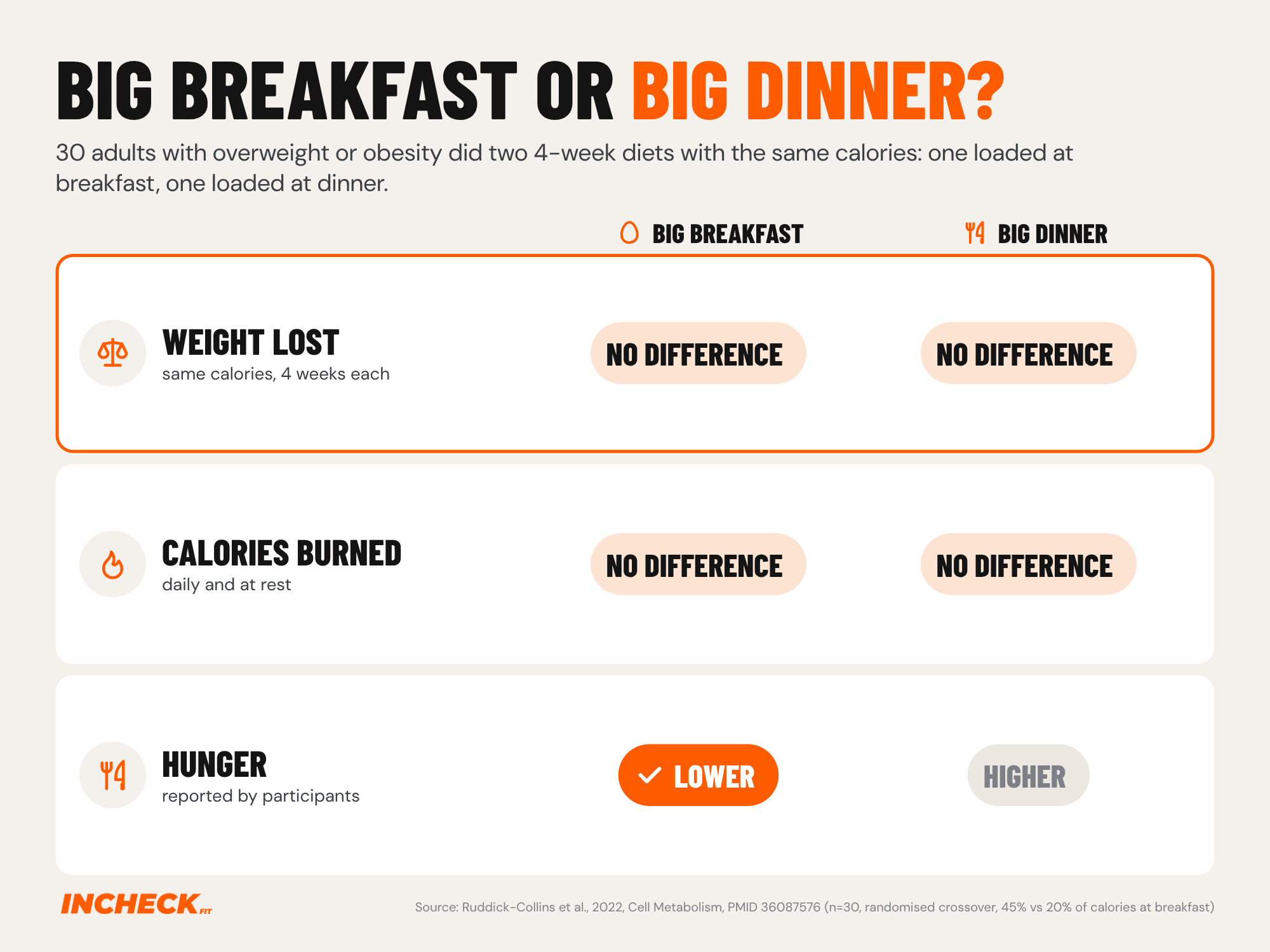
That’s the pattern with timing. It’s a tool for managing hunger and fitting food into your day, not a fat loss lever in itself. The same goes for protein timing around workouts: a review of 23 studies found that, for building muscle, getting enough protein in total mattered more than when you had it. If a big breakfast keeps you full, use it. If you’d rather save calories for dinner with your family, that works too.
Layer 6: supplements are the smallest piece
Supplements sit at the top of the pyramid because they do the least. That doesn’t make them useless. In my experience as a coach, protein powder is a handy way to hit your protein, creatine is worth it if you train, and a multivitamin can fill gaps.
But none of them creates fat loss on its own. The US National Institutes of Health puts it plainly: there’s little scientific evidence that weight-loss supplements work. Eating well, cutting calories and moving more are what’s proven. If a product promises to “burn fat” without a deficit, it can’t deliver. Spend that money on food you enjoy that helps you hit your protein.
How to fix a calorie deficit that isn’t working
Work from the bottom of the pyramid up, and only move up once the layer below is solid.
- Check the deficit is real. Get a target from the calorie calculator, then compare it with what you actually eat for two weeks, weekends included. Weighing your oils, spreads and snacks for a while is eye-opening.
- Judge the trend, not the day. Use your weekly average over three to four weeks.
- Lock in protein. Hit your number every day, then fill the rest with carbs and fats you enjoy.
- Protect your sleep. Steady bed and wake times make the rest easier.
- Build around whole foods. Mostly minimally processed meals, so the deficit feels less like a fight.
- Then, and only then, fine-tune. Timing and supplements are the finishing touches, not the starting point.
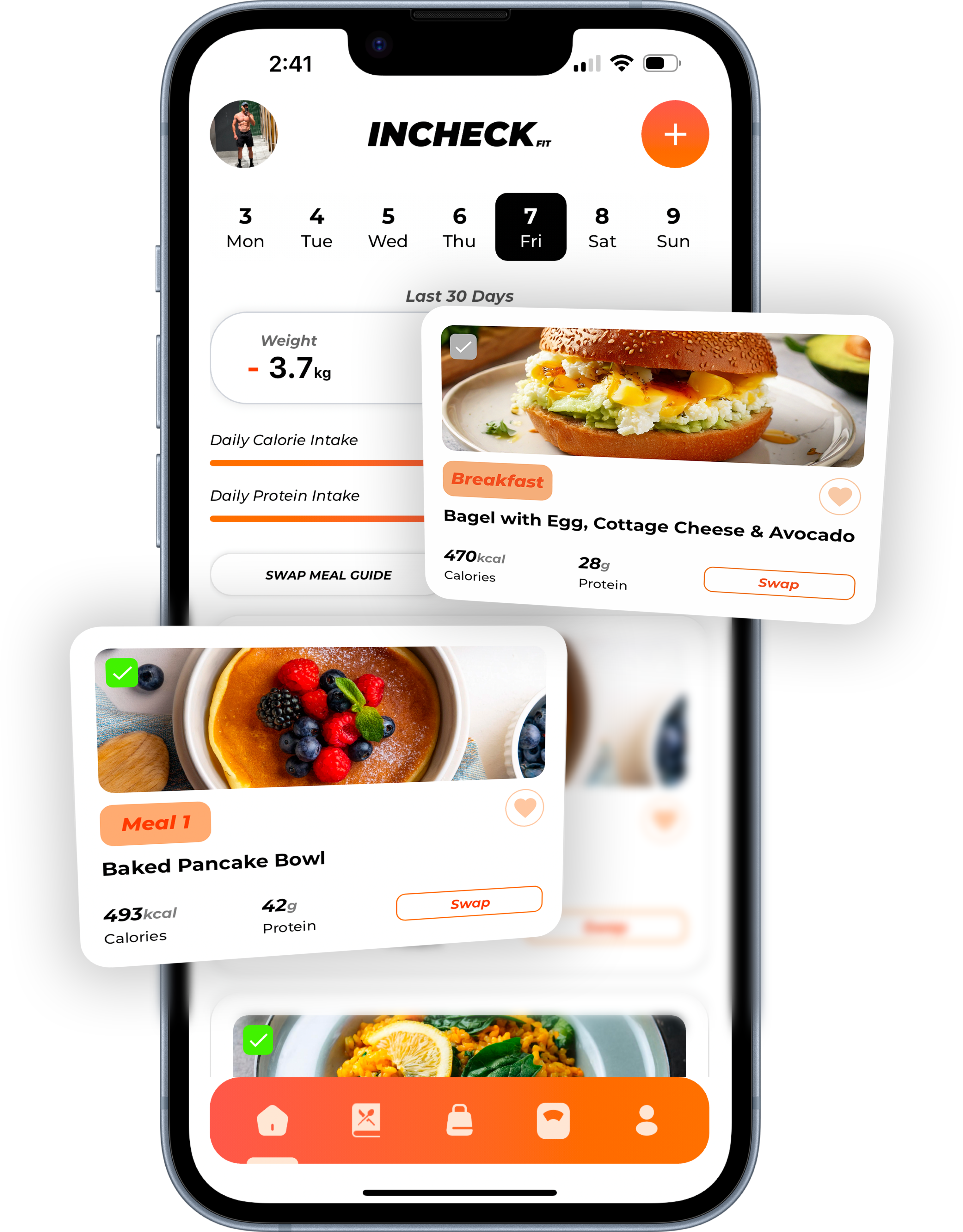
A lot of people get stuck at steps 1 and 3 because doing the maths every day is tiring. That’s the part INCHECK FIT takes off your plate. It builds your week of meals to your calorie and protein targets, with the quantities set out, so the foundation is already in place before you start cooking.
If food has started to feel stressful, or you’ve been cutting for a long time with no change, it’s worth talking to your GP or an accredited practising dietitian. A stall isn’t a reason to eat less and less.
The bottom line
Nothing in the pyramid is useless. But the layers aren’t equal. A calorie deficit does most of the work, protein and sleep protect what you lose, and food quality makes the whole thing easier to stick to. Timing and supplements are the finishing touches.
If your calorie deficit isn’t working, don’t add more to the top. Go back and get the foundation right.
Frequently Asked Questions
-
Can you be in a calorie deficit and not lose weight? Not for long. If you’re truly eating less energy than you burn, you’ll lose weight over time. When your weekly average hasn’t moved for two to three weeks, the deficit usually isn’t as big as it looks. In one study of 10 adults with obesity who said they couldn’t lose weight, people under-reported what they ate by about 47%. Day-to-day water changes can also hide a real loss for a week or two.
-
Why am I not losing weight in a calorie deficit? Usually because effort has gone into the small things while the big ones slipped. Supplements and meal timing make little difference. A deficit that holds on weekends, enough protein and decent sleep make a big one. Check those first, and judge your progress by your weekly average over several weeks.
-
Does meal timing matter for fat loss? Not much. In a trial of 30 adults on two 4-week diets with the same calories, putting the biggest share of food at breakfast or at dinner made no difference to weight loss or calories burned. People did feel less hungry with a big breakfast. So use timing to manage hunger, not to burn more fat.
-
Do supplements help you lose fat? Not on their own. The US National Institutes of Health says there’s little scientific evidence that weight-loss supplements work. Protein powder can help you hit your protein, and creatine supports training, but neither creates a calorie deficit. The deficit is what drives fat loss.
-
Does sleep affect weight loss? Yes. Across 8 lab trials in healthy adults, people whose sleep was cut ate about 250 more calories a day. And in one small study of 10 dieters on the same diet, short sleep meant about 0.6kg of the weight lost was fat instead of about 1.4kg. Both studies used big sleep cuts, but the direction is clear.
-
Is it better to eat low carb or low fat to lose weight? Whichever you can stick with. In a two-year trial of 811 overweight adults on reduced-calorie diets, weight loss was similar whether the diet was moderate or high in carbs, and lower or higher in fat. Set your calories and protein first, then split the rest the way you enjoy.
-
Does eating healthy food help you lose weight? It helps, but it can’t do it alone. In a ward study of 20 adults eating as much as they liked, people ate about 508 more calories a day on ultra-processed meals than on unprocessed ones. Food quality changes how much you tend to eat. It doesn’t replace the deficit.
References
-
Lichtman SW, Pisarska K, Berman ER, et al. “Discrepancy between self-reported and actual caloric intake and exercise in obese subjects.” New England Journal of Medicine. 1992;327(27):1893-1898. PMID: 1454084. DOI: 10.1056/NEJM199212313272701 [Human study, n=10 adults with obesity describing themselves as diet resistant. Abstract: intake under-reported by 47%; the body says “under-reported by about 47%”, never “ate 47% more”. Inherited from eating-healthy-not-losing-weight (verified Sep 2026).]
-
Wycherley TP, Moran LJ, Clifton PM, Noakes M, Brinkworth GD. “Effects of energy-restricted high-protein, low-fat compared with standard-protein, low-fat diets: a meta-analysis of randomized controlled trials.” American Journal of Clinical Nutrition. 2012;96(6):1281-1298. PMID: 23097268. DOI: 10.3945/ajcn.112.044321 [Meta-analysis of RCTs, human, 24 trials, n=1,063 adults on energy-restricted diets. Fat-free mass +0.43kg, fat mass -0.87kg versus standard protein; greater satiety in 3 of 5 studies. Inherited from how-much-protein-to-lose-fat (abstract verified 12 Oct 2026 via Europe PMC).]
-
Sacks FM, Bray GA, Carey VJ, et al. “Comparison of weight-loss diets with different compositions of fat, protein, and carbohydrates.” New England Journal of Medicine. 2009;360(9):859-873. PMID: 19246357. DOI: 10.1056/NEJMoa0804748 [Randomised trial, human, n=811 overweight adults, four reduced-calorie diets, 2 years. Weight loss at 2 years: 15% vs 25% protein 3.0 vs 3.6kg; 20% vs 40% fat 3.3 vs 3.3kg; 65% vs 35% carbohydrate 2.9 vs 3.4kg (P>0.20 for all). Attendance strongly associated with weight loss. Abstract verified 27 Oct 2026 via Europe PMC; published comments, no corrections.]
-
Zhu B, Shi C, Park CG, Zhao X, Reutrakul S. “Effects of sleep restriction on metabolism-related parameters in healthy adults: a comprehensive review and meta-analysis of randomized controlled trials.” Sleep Medicine Reviews. 2019;45:18-30. PMID: 30870662. DOI: 10.1016/j.smrv.2019.02.002 [Meta-analysis, human, healthy adults, lab sleep restriction. +252.8 kcal/day pools 8 trials. Inherited from does-sleep-affect-weight-loss (full text verified 15 Sep 2026).]
-
Nedeltcheva AV, Kilkus JM, Imperial J, Kasza K, Schoeller DA, Penev PD. “Sleep curtailment is accompanied by increased intake of calories from snacks.” American Journal of Clinical Nutrition. 2009;89(1):126-133. PMID: 19056602. DOI: 10.3945/ajcn.2008.26574 [Crossover, human, n=11 adults, 14 days per condition at 5.5 vs 8.5 hours in bed. Inherited from does-sleep-affect-weight-loss.]
-
Nedeltcheva AV, Kilkus JM, Imperial J, Schoeller DA, Penev PD. “Insufficient sleep undermines dietary efforts to reduce adiposity.” Annals of Internal Medicine. 2010;153(7):435-441. PMID: 20921542. DOI: 10.7326/0003-4819-153-7-201010050-00006 [Randomised crossover, human, n=10 overweight adults, 14 days per condition on the same diet, body composition by DXA. Weight 2.9 vs 3.0kg, fat 1.4 vs 0.6kg. Inherited from does-sleep-affect-weight-loss (results table verified 15 Sep 2026). Hard rule carried over: kilograms only, say lean tissue not muscle.]
-
Hall KD, Ayuketah A, Brychta R, et al. “Ultra-processed diets cause excess calorie intake and weight gain: an inpatient randomized controlled trial of ad libitum food intake.” Cell Metabolism. 2019;30(1):67-77.e3. PMID: 31105044. DOI: 10.1016/j.cmet.2019.05.008 [Randomised crossover, human, n=20 weight-stable adults, inpatient at the NIH Clinical Center, 2 weeks per diet, meals matched for presented calories, energy density, macronutrients, sugar, sodium and fibre. Intake +508 kcal/day on ultra-processed; +0.9kg vs -0.9kg. Abstract verified 27 Oct 2026 via Europe PMC. Two errata exist (PMIDs 31269427, 33027677); the abstract figures used here were read from the current record. Kevin Hall was then at the NIH.]
-
Ruddick-Collins LC, Morgan PJ, Fyfe CL, et al. “Timing of daily calorie loading affects appetite and hunger responses without changes in energy metabolism in healthy subjects with obesity.” Cell Metabolism. 2022;34(10):1472-1485.e6. PMID: 36087576. DOI: 10.1016/j.cmet.2022.08.001 [Randomised crossover, human, n=30 adults with overweight or obesity, two 4-week isoenergetic calorie-restricted diets, 45%:35%:20% vs 20%:35%:45% of calories at breakfast, lunch and dinner. No difference in weight loss, total energy expenditure or resting metabolic rate; lower reported hunger with the morning-loaded diet. Abstract verified 27 Oct 2026 via Europe PMC; one published comment, no corrections.]
-
Schoenfeld BJ, Aragon AA, Krieger JW. “The effect of protein timing on muscle strength and hypertrophy: a meta-analysis.” Journal of the International Society of Sports Nutrition. 2013;10:53. PMID: 24299050. DOI: 10.1186/1550-2783-10-53 [Meta-regression of randomised trials, human, 23 studies (n=525) for hypertrophy. No significant effect of timing after controlling for covariates; total protein intake was the strongest predictor. Abstract verified 27 Oct 2026 via Europe PMC; one published comment, no corrections. Muscle outcomes, not fat loss.]
-
National Institutes of Health, Office of Dietary Supplements. “Dietary Supplements for Weight Loss: Fact Sheet for Consumers.” Updated 22 March 2021. https://ods.od.nih.gov/factsheets/WeightLoss-Consumer/ [Government consumer fact sheet. Quote “there’s little scientific evidence that weight-loss supplements work” read 27 Oct 2026.]
This article is general information, not medical advice.
Last reviewed: October 2026 by the INCHECK FIT nutrition team.
Last reviewed: October 2026