The short answer:
- Some people can gain lean mass in a calorie deficit, but it isn’t the usual result.
- In our experience, it’s most likely with a small deficit, plenty of protein and hard strength training.
- When trials were combined, people lifting in a deficit lost a little lean mass on average, while their strength went up about as much as in people not in a deficit.
- Our take: for most people, keeping the muscle you have while you lose fat is the realistic win, and it’s a good one.
Can you build muscle in a calorie deficit? Some people can, but it’s the exception rather than the rule. When researchers combined trials of people lifting weights, those in a calorie deficit lost a little lean mass (muscle plus water and other non-fat tissue) on average, while those not in a deficit gained some.
That doesn’t mean lifting while you diet is wasted. Strength still went up in a deficit. In my experience coaching, lifting is also the best tool we have for holding on to muscle while you diet. I’d rather you hold your muscle while the fat comes off than chase a small gain and burn out.
This article covers who is most likely to build muscle in a deficit, what the research shows, and how to give yourself the best chance.
First, what “building muscle in a deficit” means
A calorie deficit means eating less than your body uses, so it draws on stored energy. Building muscle takes energy and protein. So in a deficit, your body is being asked to do two jobs at once with less fuel than usual.
Losing fat and gaining muscle at the same time is often called a body recomposition, or “recomp”. It’s why some people’s weight barely moves while their waist gets smaller and their lifts go up.
One thing to know about the research: most studies measure lean mass (everything in your body that isn’t fat, like muscle, water and stored carbs), not muscle on its own. Lean mass going up usually includes some muscle, but it isn’t the same thing.
What the research shows
Combining the trials: a deficit held back lean mass, not strength
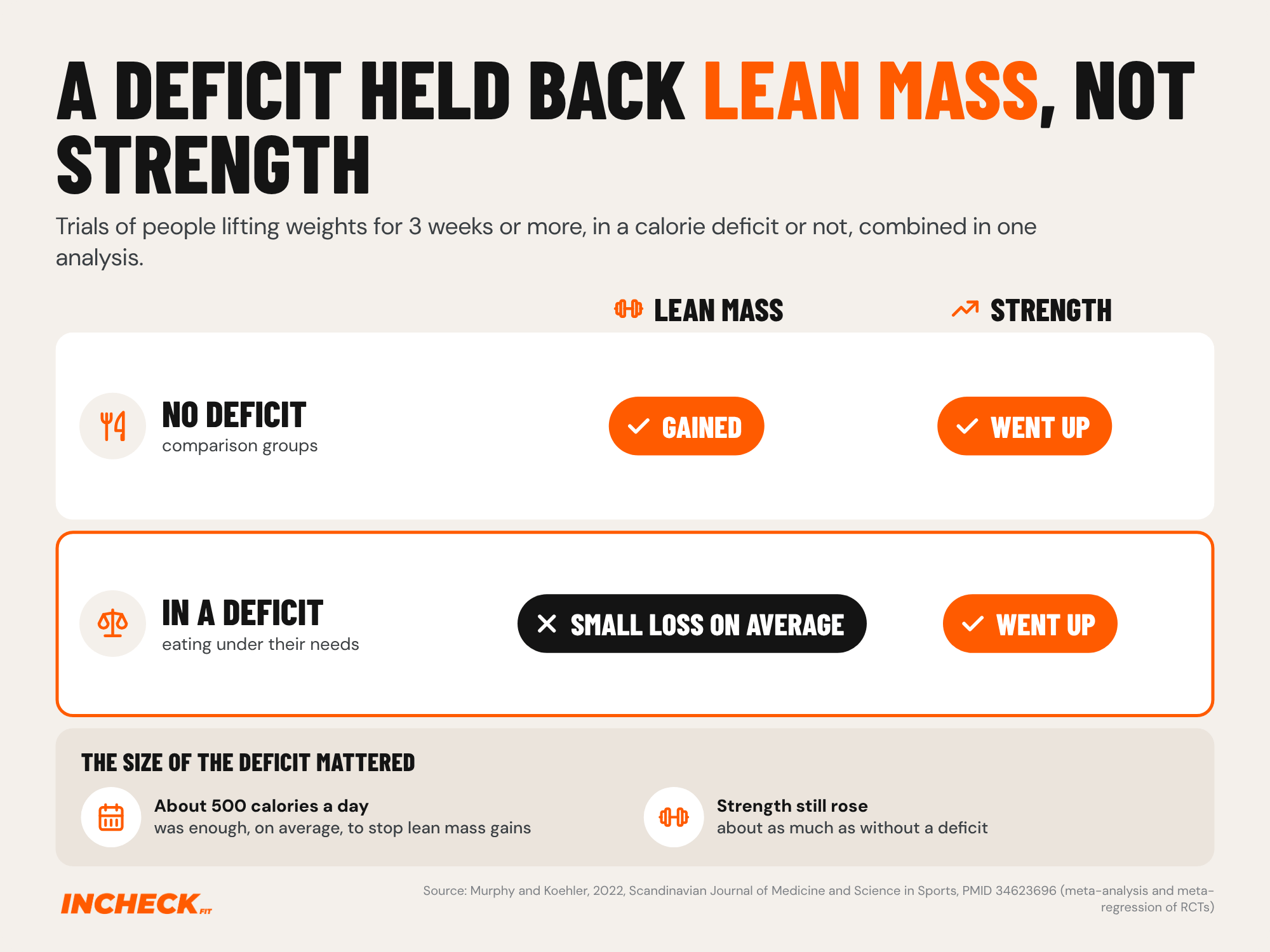
The clearest answer comes from a 2022 analysis that combined controlled trials of people doing strength training for at least 3 weeks, some in a calorie deficit and some not. In those trials, people in a deficit gained less lean mass than people who weren’t, and on average their lean mass dipped slightly. Their strength, though, went up by about the same amount.
The size of the deficit mattered. On average, a deficit of about 500 calories a day was enough to stop lean mass going up. The authors suggest keeping a deficit under about 500 calories a day to protect lean mass while losing weight.
What this means for you: if your main goal is building muscle, a deficit works against you. If your main goal is losing fat, lifting still pays off, because you get stronger, and in my experience coaching, it’s what helps people hold on to their muscle.
One trial where lean mass did go up
Averages hide exceptions, and one 2016 trial shows what’s possible under extreme conditions. Researchers put 40 young men on a diet about 40% below their energy needs for 4 weeks. All of them did weight training and interval sessions (short bursts of hard effort with rests) 6 days a week. Half ate 1.2g of protein per kg of body weight a day, and half ate 2.4g.
In those 40 young men, the higher-protein group gained 1.2kg of lean mass while losing 4.8kg of fat. The lower-protein group gained 0.1kg of lean mass and lost 3.5kg of fat.
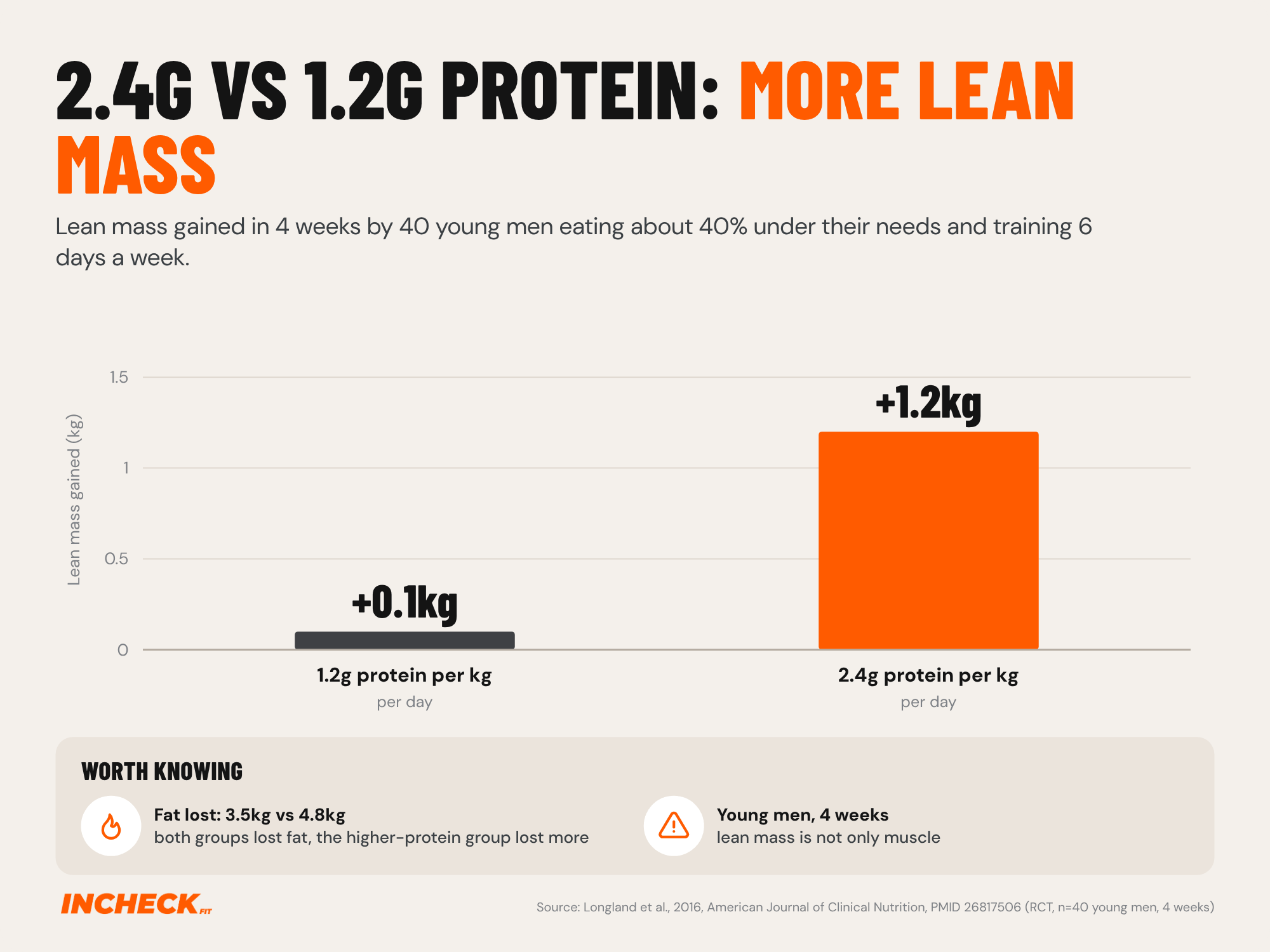
That’s a striking result, but read it carefully. It was a short trial, in young men only, with a very large deficit, very high protein and 6 training days a week. It shows that gaining lean mass in a deficit is possible, at least in young men under these conditions. It doesn’t show that most people will, and it isn’t a deficit we’d ever set for a client. We cover what it means for protein targets in how much protein to lose fat.
Who is most likely to build muscle in a deficit
This part is our take as coaches rather than a single study result. In my experience coaching people through fat loss, a recomp is most likely if you’re:
- New to lifting. Muscle responds fastest when the training is new to it.
- Coming back after a break. People returning to training often regain muscle quicker than they first built it.
- Carrying more body fat. We think more stored energy may give your body more to work with while you eat under your needs.
It’s least likely if you’re already lean and have been training seriously for years. For you, a deficit is usually a time to hold muscle, and a separate phase of eating a bit more is where the building happens.
Does this apply to women? The 2016 trial above was in young men only, so it can’t tell us what women would gain. A separate trial of 39 men and women ate 0.8g, 1.6g or 2.4g of protein per kg a day during a 21-day deficit. Each group lost about 3.2kg on average, but the two higher-protein groups lost a smaller share of it as fat-free mass (the same thing as lean mass). That trial measured how much lean mass was lost, not gained, and didn’t report women separately. Our take: the same three levers (a small deficit, enough protein and hard training) are what we’d set up for women and men alike.
How to give yourself the best chance
1. Keep the deficit small
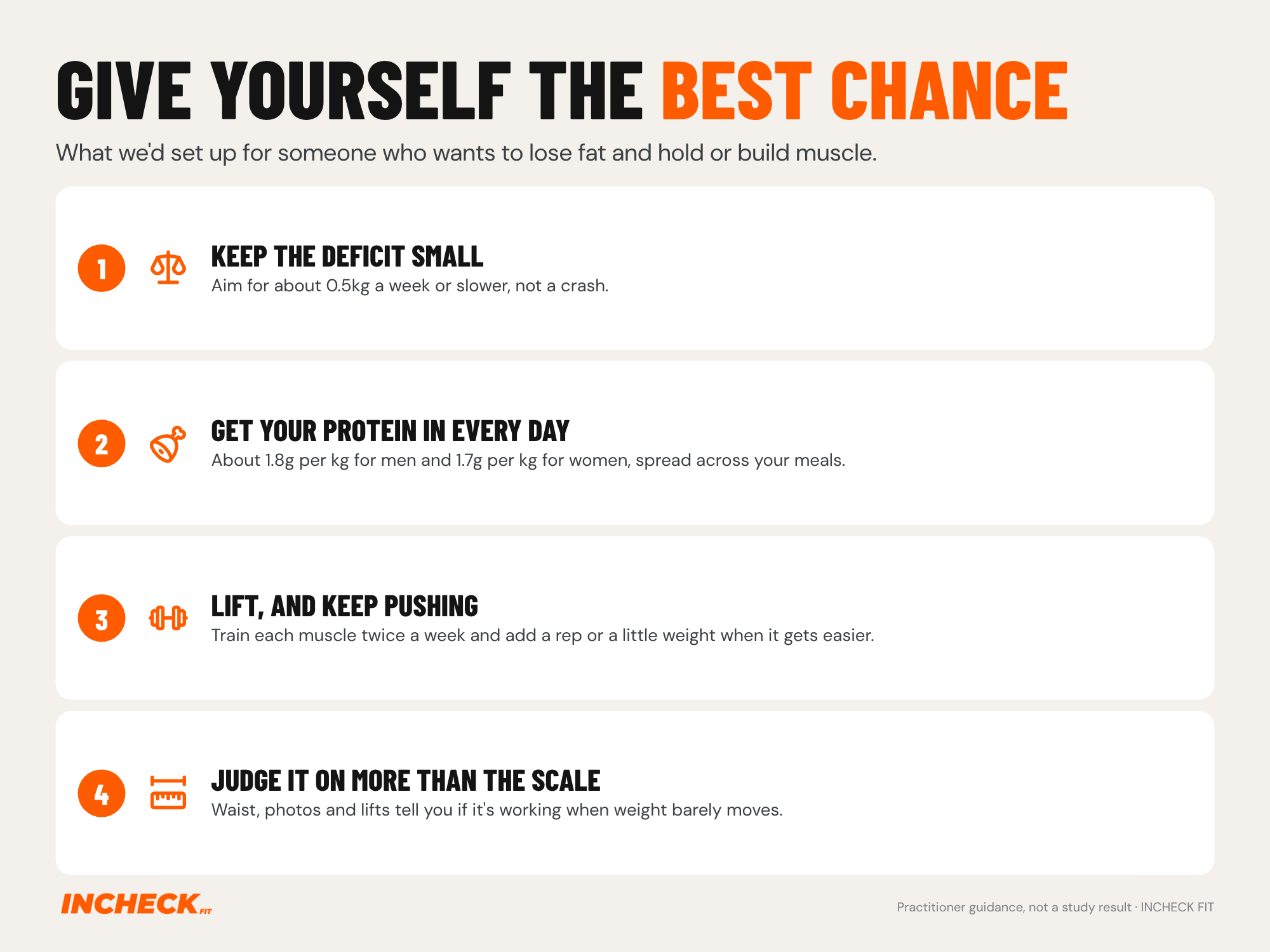
A smaller deficit leaves more energy for training and recovery. Our standard coaching advice for keeping muscle is to lose about 0.5kg a week or slower, judged on the weekly average of your morning weigh-ins. If building muscle is your priority, go slower still. You can work out your starting calories with our calorie calculator, which lets you set a steady pace.
2. Eat enough protein, every day
Protein gives your body the building blocks to repair and build muscle. We recommend about 1.8g per kg of body weight a day for men and 1.7g per kg for women. For a 70kg man, that’s about 125g of protein a day.
A 2018 analysis looked at 49 trials in healthy adults doing strength training while not dieting. The extra benefit of protein for lean mass levelled off at around 1.6g per kg a day (more than that made little extra difference), with a likely range of about 1.0 to 2.2g. That analysis wasn’t in people in a deficit. Our take: most people don’t need the 2.4g used in the trial above, and our targets sit a little above 1.6g to allow for eating less. Spreading protein across your meals helps too, as we explain in how much protein per meal.
3. Lift, and keep pushing
Your muscles need a reason to stay, and a reason to grow. Our standard coaching advice is to train each muscle group about twice a week. Take most sets close to the point where you can’t do another rep, and add a rep or a little weight when it gets easier. Cardio is fine on top, and walking counts. We compare the two in weights or cardio for fat loss.
4. Judge it on more than the scale
If you’re building some muscle while losing fat, your weight may barely move. That can feel like nothing is happening when the opposite is true. Track your waist, take photos every few weeks and watch your lifts. If your weight is steady, your waist is coming down and your lifts are going up, that’s a good sign the recomp is working.
Keeping muscle is the realistic win
In my experience, for most people in a deficit, holding onto muscle is the goal that matters. Muscle is a big part of what makes the result look and feel like progress rather than just a smaller version of where you started.
Our take: if you finish a fat loss phase stronger, with your waist down and your muscle kept, that’s a great result, even if you didn’t add a kilo of new muscle.
The food side is often what makes it hard: hitting your calories and protein every day without thinking about it. That’s the part INCHECK FIT plans for you, with your quantities set in every recipe. The lifting is still on you.
Frequently asked questions
-
Can you build muscle in a calorie deficit? Sometimes, but it isn’t the usual result. A 2022 analysis combining controlled trials of people doing strength training for 3 weeks or more found that people in a calorie deficit lost a little lean mass on average, while their strength improved about as much as in people not in a deficit. From that research and our coaching experience, gaining lean mass in a deficit is most likely with a small deficit, plenty of protein and hard training, and in people who are new to lifting or carrying more body fat.
-
Is a 500 calorie deficit too much to build muscle? It can be. In a 2022 analysis of controlled strength training trials, a deficit of about 500 calories a day was enough, on average, to stop lean mass going up. If building muscle is your priority, our coaching advice is a smaller deficit than that, alongside enough protein and hard training.
-
Will I lose muscle on a 1,000 calorie deficit? Our take: probably more lean mass than on a smaller deficit. The 2022 analysis of controlled strength training trials didn’t test a 1,000 calorie deficit, but it found about 500 calories a day was already enough, on average, to stop lean mass going up. The authors suggest keeping a deficit under about 500 calories a day to protect lean mass while losing weight. A large deficit is also hard to keep up and leaves less energy for training. If eating has become stressful or very restricted, talk to your GP or a dietitian.
-
Can you build muscle on 1,500 calories a day? It depends on your own needs, not the number. 1,500 calories could be a small deficit for one person and a large one for someone bigger or more active. Work out your maintenance first, for example with our calorie calculator, then aim for a small deficit below it.
-
Do you need more protein to build muscle in a deficit? Protein looks especially important when you’re eating less. In one 4-week trial of 40 young men on a large deficit, those eating 2.4g of protein per kg a day gained 1.2kg of lean mass, against 0.1kg at 1.2g per kg. We recommend about 1.8g per kg a day for men and 1.7g per kg for women, which is our target rather than a figure any single study tested.
-
Can women build muscle in a calorie deficit? We’d use the same principles, though the 2016 trial above was in young men only. A trial of 39 men and women in a 21-day deficit found that eating 1.6g or 2.4g of protein per kg a day meant a smaller share of the weight lost came from fat-free mass, though it didn’t report women separately. Our take: a small deficit, enough protein and hard training are what we’d set up for women and men alike.
-
How do I know if I’m building muscle while losing fat? Look at more than the scale. If your weight is steady, your waist is getting smaller and your lifts are going up, you’re likely losing fat and holding or building muscle. Measure your waist and take photos every few weeks.
-
Should I eat at maintenance instead to build muscle? Our coaching advice: if building muscle is your main goal and you’re already lean, eating at maintenance or slightly above gives you the best chance. If losing fat is your main goal, a small deficit with hard training and enough protein can help you keep muscle, and sometimes build a little.
References
- Murphy C, Koehler K. “Energy deficiency impairs resistance training gains in lean mass but not strength: A meta-analysis and meta-regression.” Scandinavian Journal of Medicine and Science in Sports. 2022;32(1):125-137. PMID: 34623696. DOI: 10.1111/sms.14075. [Meta-analysis and meta-regression of randomised controlled trials, human, resistance training in an energy deficit for at least 3 weeks versus controls. Lean mass gains impaired in deficit groups vs controls (ES -0.57, p=0.02); within groups, lean mass ES -0.11 (p=0.03) in deficit groups vs 0.20 (p<0.001) in controls. Strength gains similar (ES -0.31, p=0.28). “An energy deficit of ~500 kcal · day-1 prevented gains in LM.” Number of studies, participants and sex not given in the abstract. Abstract read 20 Oct 2026 via Europe PMC; no corrections listed.]
- Longland TM, Oikawa SY, Mitchell CJ, Devries MC, Phillips SM. “Higher compared with lower dietary protein during an energy deficit combined with intense exercise promotes greater lean mass gain and fat mass loss: a randomized trial.” American Journal of Clinical Nutrition. 2016;103(3):738-746. PMID: 26817506. DOI: 10.3945/ajcn.115.119339. [Randomised trial, single-blind, human, n=40 young men (20 per group), 4 weeks, about 40% energy deficit, resistance training plus high-intensity interval training 6 days a week. Lean body mass +1.2 ± 1.0kg (2.4g/kg) vs +0.1 ± 1.0kg (1.2g/kg); fat mass -4.8 ± 1.6kg vs -3.5 ± 1.4kg; 4-compartment model. Abstract read 20 Oct 2026 via Europe PMC; no corrections listed.]
- Pasiakos SM, Cao JJ, Margolis LM, et al. “Effects of high-protein diets on fat-free mass and muscle protein synthesis following weight loss: a randomized controlled trial.” FASEB Journal. 2013;27(9):3837-3847. PMID: 23739654. DOI: 10.1096/fj.13-230227. [Randomised trial, human, n=39 adults (men and women), 31 days (10 days maintenance, 21 days deficit), 0.8, 1.6 or 2.4g/kg/day. About 3.2kg lost regardless of protein; lower proportion of fat-free mass lost at 1.6 and 2.4g/kg. Abstract only. Carried from the record verified 12 Oct 2026 via Europe PMC; no corrections found.]
- Morton RW, Murphy KT, McKellar SR, et al. “A systematic review, meta-analysis and meta-regression of the effect of protein supplementation on resistance training-induced gains in muscle mass and strength in healthy adults.” British Journal of Sports Medicine. 2018;52(6):376-384. PMID: 28698222. DOI: 10.1136/bjsports-2017-097608. [Meta-analysis and meta-regression, human, 49 trials, n=1,863 healthy adults doing resistance training, not energy-restricted. Breakpoint 1.62g/kg/day (95% CI 1.03 to 2.20). Carried from the record verified 12 Oct 2026 via Europe PMC (abstract and full text). One correction (2020, PMID 32943392) adds a competing-interest statement and does not change these figures.]
Last reviewed: October 2026