A lean bulk is a way of building muscle by eating a small calorie surplus and gaining weight slowly, so less of what you gain ends up as fat. A 2019 review of nutrition for bodybuilders in the off-season suggested that beginner and intermediate lifters eat about 10 to 20% above maintenance and aim to gain about 0.25 to 0.5% of body weight a week, with advanced lifters going more conservatively.
As a personal trainer, the mistake I see most is people treating “bulk” as permission to eat everything in sight. The scale climbs fast, it feels like progress, and three months later a lot of that gain is fat they then have to diet off. A lean bulk isn’t eating less. It’s gaining slower.
Below is what a lean bulk is, how to set your surplus, what the trials comparing bigger and smaller surpluses found, what to eat, and what holds muscle gain back.
What is a lean bulk?
A lean bulk is a muscle-building phase where you eat a little more than you burn and gain weight slowly. Expert recommendations range from about 5 to 20% above maintenance calories (the calories that keep your weight steady), aiming for about 0.25 to 0.5% of body weight a week. The goal is steady muscle gain with as little fat gain as you can manage.
Our take: training is what tells your body to build muscle, and food supplies the material and energy to do it. In the trials below, eating well beyond what training could use mostly showed up as extra fat.
A quick note on terms, because studies measure muscle in different ways. “Lean mass” or “fat-free mass” means everything that isn’t fat: muscle, but also water, bone and organs. “Muscle thickness” is the size of a muscle measured on a scan. We use each study’s own term below.
For a 75kg person, 0.25 to 0.5% of body weight a week is about 0.19 to 0.38kg a week, or roughly 0.8 to 1.6kg a month. That is slow on purpose. The 2019 review suggested advanced bodybuilders go even more conservatively, and the authors of a 2023 trial recommended a surplus of 5 to 20%, scaled to training experience, with experienced lifters gaining more slowly. That scaling is expert reasoning: in a search of Europe PMC on 10 November 2026, we found no trial that tested different surplus sizes in beginners.
How big should your surplus be?
Start from your maintenance calories, then add a small surplus. Our calorie calculator does both: choose “Build Muscle” and pick your pace on the slider, from 5% to 20% above maintenance, with 10% as our default.
Here is how it works for an example person, a 28-year-old man who is 180cm and 75kg and moderately active:
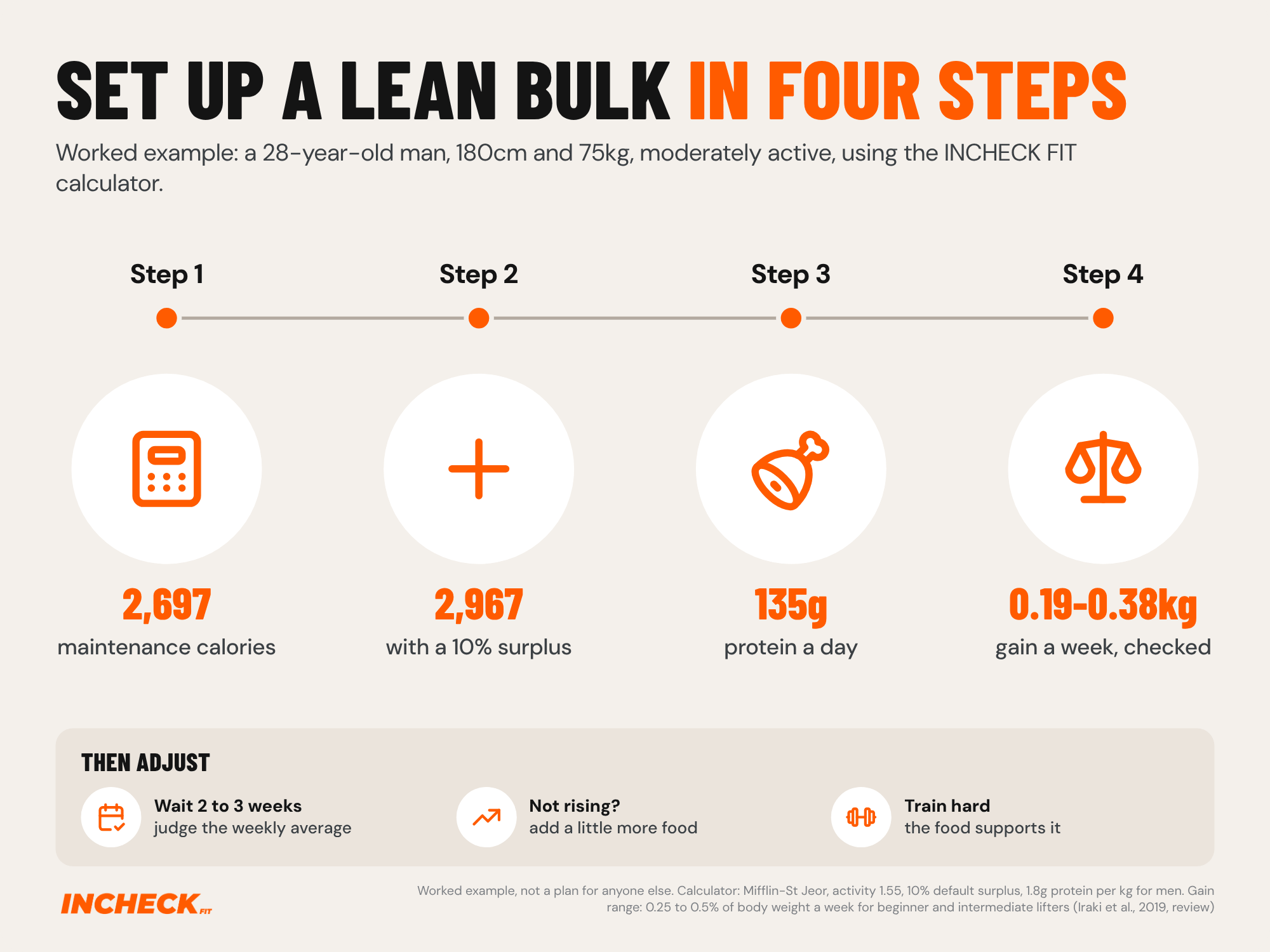
- Maintenance: about 2,697 calories a day.
- Lean bulk target: about 2,967 calories a day at the 10% default, which is about 270 calories more than maintenance. At 5% it would be about 2,832.
- Protein: about 135g a day, from our coaching standard of 1.8g per kg for men (1.7g for women).
That is a worked example, not a target for anyone else. Any calculator gives an estimate, so the scale has the final say. Weigh yourself most mornings and look at the weekly average. In our experience, day-to-day readings can jump around with water, salt and food, which is why a jump on the scale is rarely fat.
Our take on adjusting: if your weekly average weight isn’t rising after two to three weeks, add a little more food. If it’s climbing much faster than about 0.5% of your body weight a week, pull back a little. These are coaching rules of thumb, not tested rules. If you choose the smallest 5% setting, that two-to-three-week check matters even more, because a very small surplus is easy to miss (more on that below).
Is lean bulking better than bulking?
For most people who lift, a slower gain looks like the better trade. In the small trials that compared eating more with eating less, the bigger surplus consistently added more fat. Whether it also added more muscle was mixed: two found no clear difference and two found more lean mass or muscle. The trials are small and short, so this leans one way rather than settling it.
The most direct test is a 2023 trial of 21 resistance-trained lifters (17 finished) who trained 3 days a week for 8 weeks. They were assigned to eat at maintenance, a 5% surplus or a 15% surplus. Both surplus groups gained about 3.3kg of body weight on average, against about 0.4kg at maintenance. The researchers found no clear difference between groups in muscle thickness or squat strength, although the 15% group did gain more bench press strength. People who gained more weight gained more skinfold thickness (a measure of fat under the skin). The authors concluded that faster weight gain mainly speeds up fat gain rather than building more muscle or strength.
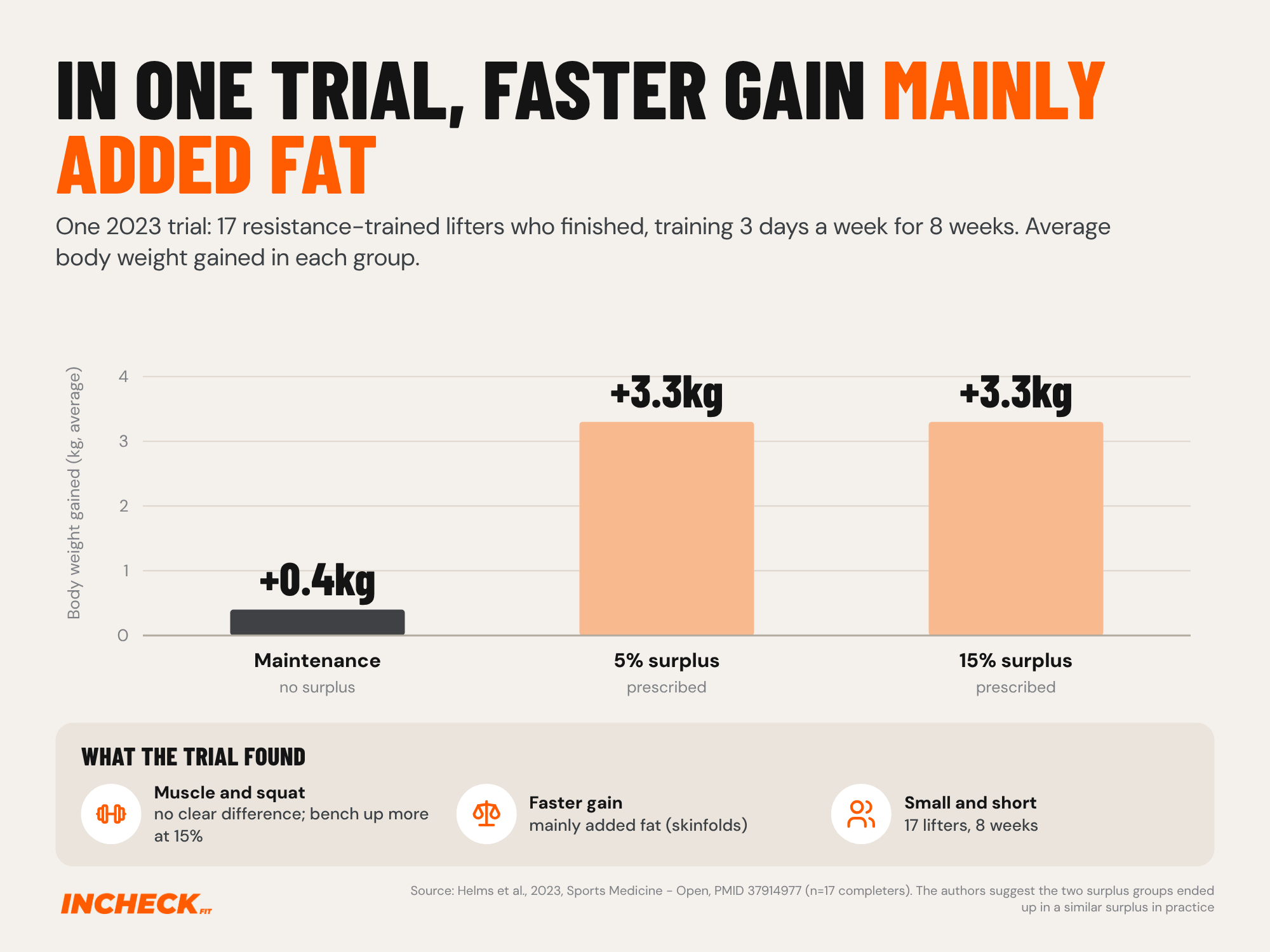
One catch in that trial: the authors’ evidence suggests the 5% and 15% groups ended up in a similar surplus in practice, which fits with their identical weight gain. They suggested a prescribed 5% surplus may be too small for most of their participants to hit reliably.
Two reports from the same research group, both in elite athletes who added extra strength training, came to different answers on muscle:
- In 21 elite athletes, a planned surplus of about 500 calories a day increased lean mass by about 2.8% over 8 to 12 weeks, while the group that ate as they liked had no change in lean mass.
- In 39 elite athletes, the planned surplus group gained more body weight (3.9% against 1.5%) and their fat mass rose by 15% against 3%, but lean mass gains were not clearly different between groups.
The two reports may include some of the same athletes; the abstracts don’t say.
A small 2019 pilot trial (a small, early-stage trial) in 11 competitive bodybuilders found that over 4 weeks, muscle mass rose 2.7% against 1.1% in the higher-calorie group, and body fat rose 7.4% against 0.8%.
Put together: in these small trials, eating more sped up weight gain and consistently added more fat, while extra muscle appeared in some trials and not others. If you’d rather not spend months dieting the fat back off, a slower gain is the safer bet.
What do you eat for a lean bulk?
The same foods you’d eat any other time, in slightly bigger amounts. Get your protein in, spread it across your meals, and fill the rest of the surplus with carbs and fats you enjoy. Our take: total calories and protein matter more than specific foods, and the research on specific bulking foods is thin.
Protein first. A 2018 meta-analysis (a study that pools the results of many trials) of 49 trials in 1,863 healthy adults doing resistance training estimated that protein intakes above about 1.6g per kg of body weight a day added no further gains in fat-free mass. Our coaching standard of 1.7g per kg for women and 1.8g for men sits just above that. If you want help hitting it, our high protein meal plan shows how to build a day around a protein anchor at every meal.
Spread it across the day. A 2018 review suggested about 0.4g of protein per kg of body weight per meal, across at least four meals, for people trying to maximise muscle building. For more detail, see how much protein per meal.
Carbs and fats fill the rest. A 2026 meta-analysis of 11 trials found no clear effect of eating more carbohydrate on muscle growth during resistance training, though the authors rated the certainty of that evidence as low. Our take: carbs still help fuel hard sessions, so most people do well putting a fair share of the surplus there.
Meal frequency seems to matter little. In a small 2021 crossover trial, 10 male rowers gaining weight tried the same food split into three or six meals, and it made no difference to body composition or appetite.
If you struggle to eat enough, a 2022 review of weight gain for athletes says bigger portions, more energy-dense foods and drinks with calories may help. A 2019 review adds that drinks are less filling than solid food. Our examples: nut butters, olive oil and dried fruit.
Is it possible to bulk and be lean?
Yes, if you gain slowly, and some people can gain fat-free mass (which includes muscle) with no surplus at all. That second outcome is called recomposition. In the two trials below where it happened, people ate high protein and trained hard. Our take: for most people chasing steady muscle gain, a small surplus is the more reliable route.
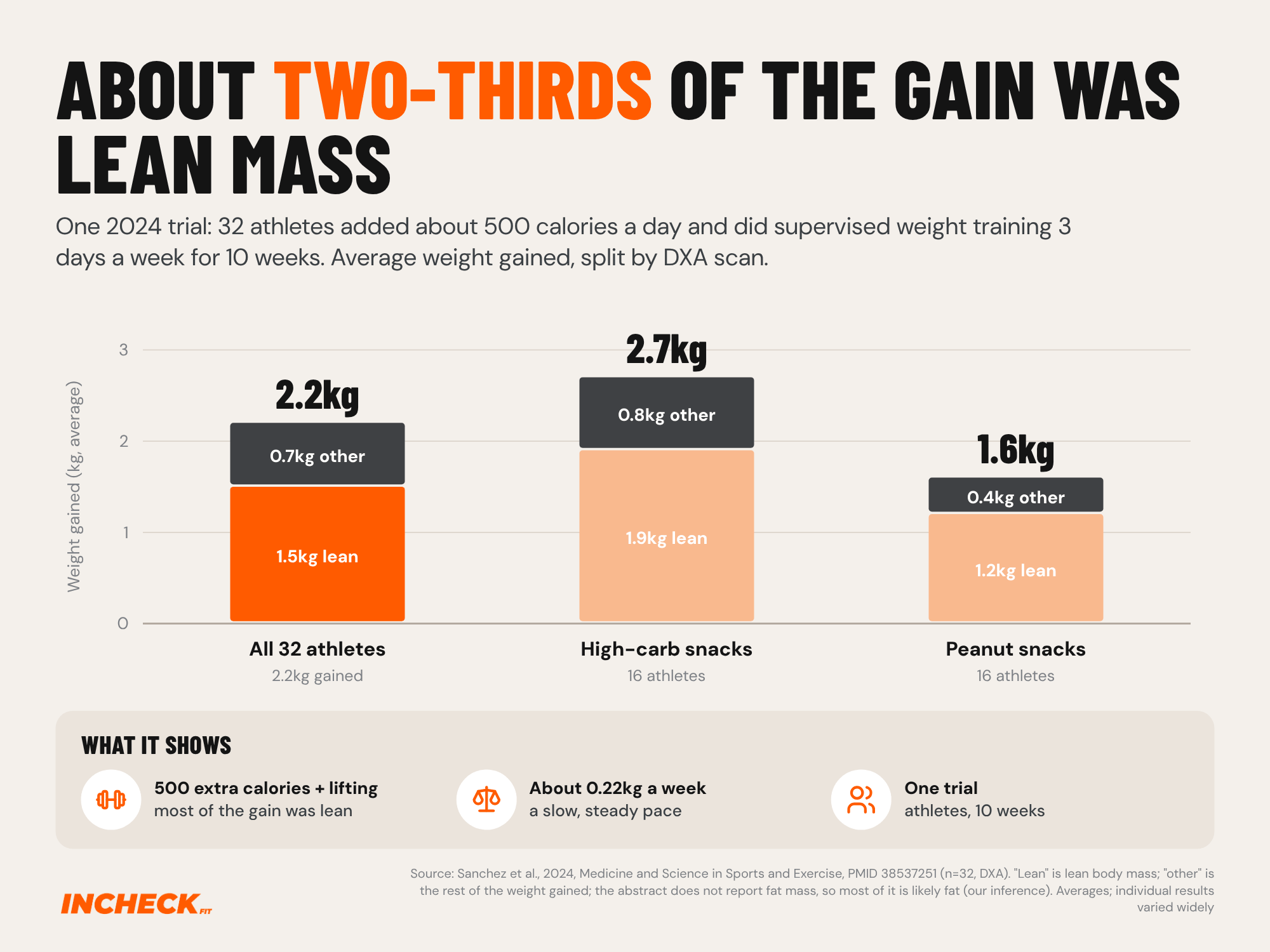
What a slow gain looked like in one trial. In a 2024 trial, 32 athletes added about 500 calories a day and did supervised weight training 3 days a week for 10 weeks. On average they gained 2.2kg, or about 0.22kg a week, and 1.5kg of that was lean body mass measured on a DXA scan. That’s about two-thirds. The study didn’t report fat mass, so we assume most of the other 0.7kg was fat. Results varied widely from person to person.
Gaining without a surplus. In a 2026 trial in resistance-trained young adults (30 in total, including a control group), the two diet groups trained 4 days a week for 10 weeks on 2.5g of protein per kg a day. Fat-free mass rose by about 1kg in both the group eating at maintenance and the group eating a moderate deficit. In a 2016 trial of 40 young men eating about 40% below their needs for 4 weeks, with very hard training 6 days a week, the group on 2.4g of protein per kg gained about 1.2kg of lean mass while losing fat.
Those were demanding programmes in young adults, and the gains were modest. If you’d like to explore that route, here’s more on building muscle in a calorie deficit.
What kills muscle gain the most?
No study ranks these against each other. Three have meta-analysis evidence: not eating enough, not doing enough training, and too little protein. Poor sleep and heavy drinking have only short-term lab evidence. One of the best-studied is an ongoing calorie deficit.
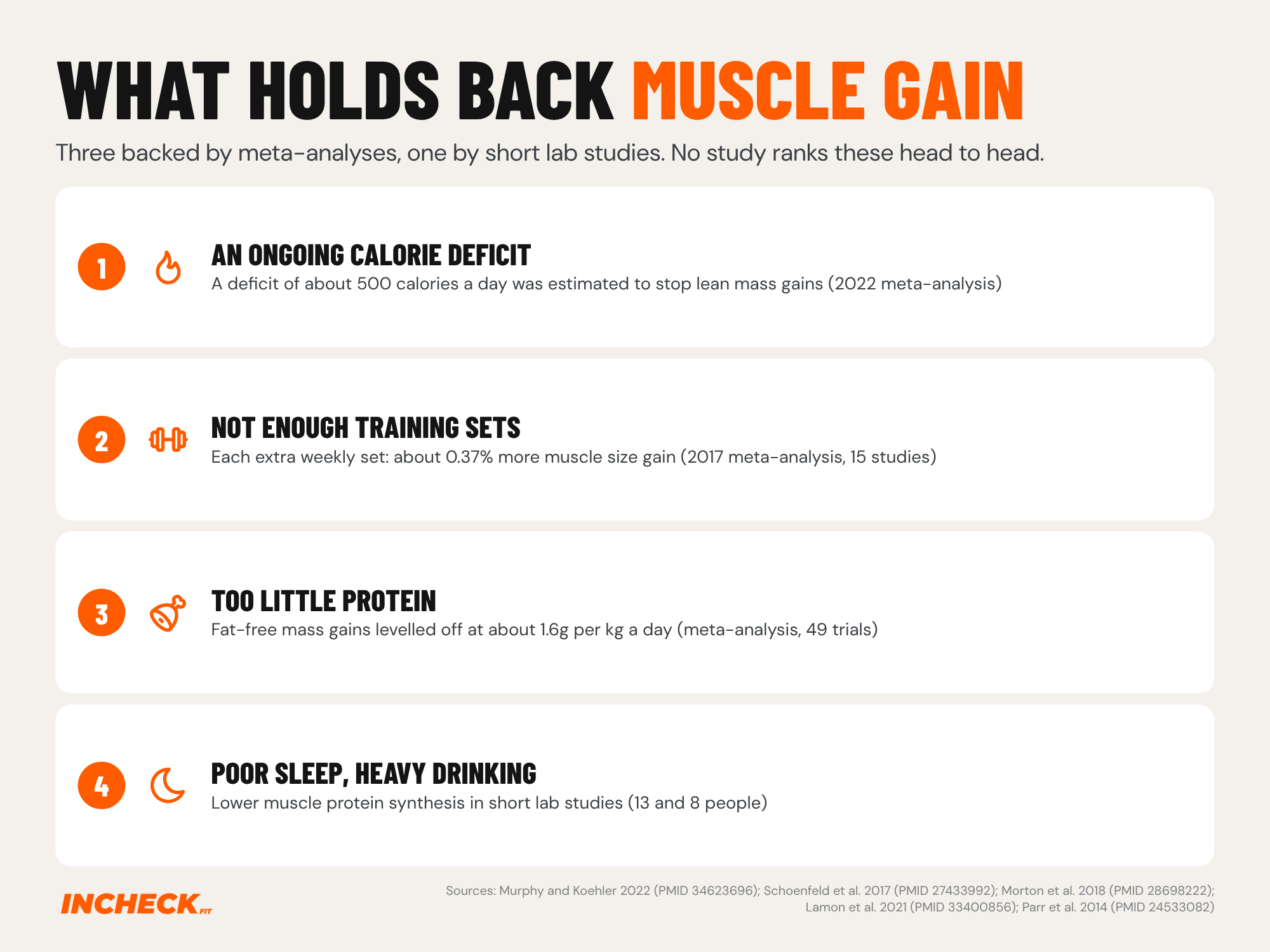
- Not eating enough. A 2022 meta-analysis of resistance training trials found that training in a calorie deficit held back gains in lean mass, though strength gains were similar. Its estimate: a deficit of about 500 calories a day was enough to stop lean mass gains. Our take: this is the main reason a lean bulk uses a surplus at all.
- Not doing enough training (sets). In a 2017 meta-analysis of 15 studies, each extra weekly set was linked to about 0.37 percentage points more gain in muscle size (for example, a 5% gain becoming about 5.4%). Our take: food supports muscle growth; training drives it. Here’s more on why strength training matters.
- Too little protein. As above, a meta-analysis estimated that gains in fat-free mass stopped improving above about 1.6g per kg a day. Below that, the analysis suggests some gains may be left on the table.
- Poor sleep and heavy drinking. The evidence here is short-term lab work, not long trials. In 13 healthy young adults, one night without sleep cut muscle protein synthesis (the process of building new muscle protein) by about 18%. In 8 active men, about 12 standard drinks after a weights-plus-cycling session cut it by 24% even when taken with protein (37% when the protein was swapped for carbs). A small 2024 study found people who habitually slept 1 to 2 hours less still made similar training gains over 16 sessions, so the long-term effect of ordinary short nights isn’t clear.
Where an app helps
The hard part of a lean bulk isn’t the maths. It’s eating a little more than usual, every day, with enough protein, for months. INCHECK FIT builds your weekly meal plan around your calorie and protein targets, including a build muscle goal, with the quantities and shopping list worked out. You still follow the portions in each recipe, but the planning is done for you.
Frequently asked questions
-
What is a lean bulk? A lean bulk is a muscle-building phase where you eat a small calorie surplus and gain weight slowly. A 2019 review of nutrition for bodybuilders in the off-season suggested about 10 to 20% above maintenance and about 0.25 to 0.5% of body weight a week for beginner and intermediate lifters, with advanced lifters more conservative. A 2023 trial’s authors suggested 5 to 20%, with more experienced lifters at the smaller end.
-
How much should I eat for a lean bulk? Work out your maintenance calories, then add a small surplus. Our calculator suggests 10% by default. For an example 28-year-old man who is 180cm, 75kg and moderately active, that is about 2,967 calories a day against maintenance of about 2,697. Then let your weekly average weight tell you whether to adjust.
-
How fast should I gain weight on a lean bulk? Expert recommendations suggest about 0.25 to 0.5% of body weight a week, which is about 0.19 to 0.38kg a week for a 75kg person. In a 2023 trial of 17 trained lifters, the authors concluded that faster weight gain mainly increased skinfold thickness (a measure of fat under the skin) rather than muscle size or strength, though the larger-surplus group did gain more bench press strength.
-
Is lean bulking better than dirty bulking? In small trials of trained lifters and athletes, bigger surpluses consistently added more fat, while extra muscle showed up in some trials but not others. In our Europe PMC search (10 November 2026) we found no trial comparing “dirty” foods with whole foods at the same calories. The closest, a 2024 trial in 32 athletes, gave either peanut-based or high-carb snacks for the same planned extra 500 calories a day; the peanut group gained less weight, with no clear difference in lean mass.
-
What do you eat for a lean bulk? Normal meals, slightly bigger, with protein at each one. A meta-analysis of 49 trials estimated that gains in fat-free mass levelled off at about 1.6g of protein per kg a day; we use 1.7g per kg for women and 1.8g for men. Fill the rest with carbs and fats you enjoy. In a small trial of 10 rowers, splitting the same food into three or six meals made no difference to body composition or appetite.
-
Can you lean bulk without gaining fat? Some fat gain is normal in a surplus, and keeping the surplus small keeps it down. Some trained people have gained fat-free mass (which includes muscle) without a surplus: in a 2026 trial, trained young adults eating 2.5g of protein per kg gained about 1kg of fat-free mass at maintenance and in a moderate deficit.
-
What kills muscle gain the most? No study ranks the causes against each other. One of the best-studied is an ongoing calorie deficit: a 2022 meta-analysis estimated about 500 calories a day below maintenance was enough to stop lean mass gains. Too few training sets and protein below about 1.6g per kg a day also limit gains. Poor sleep and heavy drinking lowered muscle protein synthesis (a short-term marker of muscle building) in short lab studies.
References
- Iraki J, Fitschen P, Espinar S, Helms E. “Nutrition Recommendations for Bodybuilders in the Off-Season: A Narrative Review.” Sports (Basel). 2019;7(7):154. PMID: 31247944. DOI: 10.3390/sports7070154. [Narrative review. Abstract verified 10 Nov 2026 via Europe PMC: “A hyper-energetic diet (~10-20%) should be consumed with a target weight gain of ~0.25-0.5% of bodyweight/week for novice/intermediate bodybuilders. Advanced bodybuilders should be more conservative”. No corrections listed.]
- Helms ER, Spence AJ, Sousa C, et al. “Effect of Small and Large Energy Surpluses on Strength, Muscle, and Skinfold Thickness in Resistance-Trained Individuals: A Parallel Groups Design.” Sports Medicine - Open. 2023;9(1):102. PMID: 37914977. DOI: 10.1186/s40798-023-00651-y. [Randomised parallel-group trial, human, 21 randomised and 17 completers, resistance-trained lifters, 8 weeks, maintenance vs 5% vs 15% surplus. Abstract and full text read 10 Nov 2026 via Europe PMC: body mass change +0.4 kg (maintenance), +3.3 kg (5%), +3.3 kg (15%); “both MOD and HIGH, on average, were in a similar energy surplus”; “faster rates of BM gain (and by proxy larger surpluses) primarily increase rates of fat gain rather than augmenting 1-RM or MT”; recommends “5–20% over maintenance energy or rates of weight gain of 0.25–0.5% of body mass per week, scaled to RT experience”. No corrections listed.]
- Garthe I, Raastad T, Sundgot-Borgen J. “Long-term effect of nutritional counselling on desired gain in body mass and lean body mass in elite athletes.” Applied Physiology, Nutrition, and Metabolism. 2011;36(4):547-554. PMID: 21851204. DOI: 10.1139/h11-051. [Randomised trial, human, n=21 elite athletes, 8 to 12 weeks with 4 strength sessions a week. Abstract verified 10 Nov 2026 via Europe PMC: surplus “of 506 ± 84 kcal·day(-1)”; “LBM increased in the NCG during the intervention (2.8% ± 0.5%)… whereas LBM in the ALG was unchanged.” No corrections listed.]
- Garthe I, Raastad T, Refsnes PE, Sundgot-Borgen J. “Effect of nutritional intervention on body composition and performance in elite athletes.” European Journal of Sport Science. 2013;13(3):295-303. PMID: 23679146. DOI: 10.1080/17461391.2011.643923. [Randomised trial, human, n=39 elite athletes, 8 to 12 weeks. Abstract verified 10 Nov 2026 via Europe PMC: “BW increased more in NCG than in ALG (3.9±0.6% vs. 1.5±0.4%). Fat mass (FM) increased more in NCG than in ALG (15±4 vs. 3±3%), but gain in LBM was not different between groups.” Whether the 2011 and 2013 samples overlap is not stated in either abstract. No corrections listed.]
- Ribeiro AS, Nunes JP, Schoenfeld BJ, Aguiar AF, Cyrino ES. “Effects of Different Dietary Energy Intake Following Resistance Training on Muscle Mass and Body Fat in Bodybuilders: A Pilot Study.” Journal of Human Kinetics. 2019;70:125-134. PMID: 31915482. DOI: 10.2478/hukin-2019-0038. [Randomised pilot, human, n=11 male competitive bodybuilders, 4 weeks. Abstract verified 10 Nov 2026 via Europe PMC: body fat “G1 = +7.4% vs. G2 = +0.8%”; muscle mass “G1 = +2.7% vs. G2 = +1.1%”. No corrections listed.]
- Morton RW, Murphy KT, McKellar SR, et al. “A systematic review, meta-analysis and meta-regression of the effect of protein supplementation on resistance training-induced gains in muscle mass and strength in healthy adults.” British Journal of Sports Medicine. 2018;52(6):376-384. PMID: 28698222. DOI: 10.1136/bjsports-2017-097608. [Meta-analysis and meta-regression, human, 49 trials, n=1,863 healthy adults doing resistance training. Verified 10 Nov 2026 via Europe PMC: “Protein supplementation beyond total protein intakes of 1.62 g/kg/day resulted in no further RET-induced gains in FFM.” One correction (2020, competing interests) does not change the results.]
- Schoenfeld BJ, Aragon AA. “How much protein can the body use in a single meal for muscle-building? Implications for daily protein distribution.” Journal of the International Society of Sports Nutrition. 2018;15:10. PMID: 29497353. DOI: 10.1186/s12970-018-0215-1. [Narrative review. Verified 10 Nov 2026 via Europe PMC: “0.4 g/kg/meal across a minimum of four meals”. No corrections listed.]
- Henselmans M, Vårvik FT, Izquierdo M. “The Effect of Carbohydrate Intake on Muscle Hypertrophy: A Systematic Review and Meta-analysis.” Sports Medicine. 2026;56(3):691-702. PMID: 41712097. DOI: 10.1007/s40279-025-02341-z. [Systematic review and meta-analysis of randomised trials, 11 studies. Abstract verified 10 Nov 2026 via Europe PMC: “no significant effect of carbohydrate intake on muscle hypertrophy (SMD = 0.15, p = 0.23)… GRADE certainty of evidence was low”. No corrections listed.]
- Taguchi M, Hara A, Murata H, Torii S, Sako T. “Increasing Meal Frequency in Isoenergetic Conditions Does Not Affect Body Composition Change and Appetite During Weight Gain in Japanese Athletes.” International Journal of Sport Nutrition and Exercise Metabolism. 2021;31(2):109-114. PMID: 33361498. DOI: 10.1123/ijsnem.2020-0139. [Randomised crossover, human, n=10 male collegiate rowers. Abstract verified 10 Nov 2026 via Europe PMC: “partitioning identical excess dietary intakes over three or six meals does not influence changes in body composition or appetite during weight gain in athletes.” No corrections listed.]
- Larson-Meyer DE, Krason RK, Meyer LM. “Weight Gain Recommendations for Athletes and Military Personnel: a Critical Review of the Evidence.” Current Nutrition Reports. 2022;11(2):225-239. PMID: 35233712. DOI: 10.1007/s13668-022-00395-3. [Critical review. Abstract verified 10 Nov 2026 via Europe PMC: “consuming larger portions, incorporating energy-dense foods, and prioritizing liquid over solid foods, may prove helpful.” An erratum (PMID 35467302) is listed; its content was not available to read.]
- Vargas-Molina S, García-Palumbo A, García-Sillero M, et al. “Comparison of two nutritional protocols in body re-composition of resistance-trained participants.” European Journal of Applied Physiology. 2026;126(7):4019-4030. PMID: 41940947. DOI: 10.1007/s00421-026-06209-6. [Randomised trial, human, n=30 resistance-trained young adults including an unsupervised control group, 10 weeks, training 4 days a week, both diet groups on 2.5g protein per kg a day. Abstract read 10 Nov 2026 via the PMC full text on Europe PMC: fat-free mass rose in the maintenance group (Δ = 0.97 kg) and the deficit group (Δ = 1.04 kg). No corrections listed.]
- Longland TM, Oikawa SY, Mitchell CJ, Devries MC, Phillips SM. “Higher compared with lower dietary protein during an energy deficit combined with intense exercise promotes greater lean mass gain and fat mass loss: a randomized trial.” American Journal of Clinical Nutrition. 2016;103(3):738-746. PMID: 26817506. DOI: 10.3945/ajcn.115.119339. [Randomised trial, human, n=40 young men, 4 weeks, about 40% energy deficit, training 6 days a week. Abstract verified 10 Nov 2026 via Europe PMC: “LBM increased (P < 0.05) in the PRO group (1.2 ± 1.0 kg)”. No corrections listed.]
- Murphy C, Koehler K. “Energy deficiency impairs resistance training gains in lean mass but not strength: A meta-analysis and meta-regression.” Scandinavian Journal of Medicine & Science in Sports. 2022;32(1):125-137. PMID: 34623696. DOI: 10.1111/sms.14075. [Meta-analysis and meta-regression of resistance training trials, human. Abstract verified 10 Nov 2026 via Europe PMC: “LM gains were impaired in RT+ED vs RT+CON… but strength gains were comparable”; “an energy deficit of ~500 kcal · day-1 prevented gains in LM.” No corrections listed.]
- Schoenfeld BJ, Ogborn D, Krieger JW. “Dose-response relationship between weekly resistance training volume and increases in muscle mass: A systematic review and meta-analysis.” Journal of Sports Sciences. 2017;35(11):1073-1082. PMID: 27433992. DOI: 10.1080/02640414.2016.1210197. [Systematic review and meta-analysis, human, 15 studies. Abstract verified 10 Nov 2026 via Europe PMC: “Each additional set was associated with an increase in effect size (ES) of 0.023 corresponding to an increase in the percentage gain by 0.37%”. A published comment and reply exist; no correction.]
- Lamon S, Morabito A, Arentson-Lantz E, et al. “The effect of acute sleep deprivation on skeletal muscle protein synthesis and the hormonal environment.” Physiological Reports. 2021;9(1):e14660. PMID: 33400856. DOI: 10.14814/phy2.14660. [Randomised crossover, human, n=13 healthy young adults, one night of total sleep deprivation. Abstract verified 10 Nov 2026 via Europe PMC: “Acute sleep deprivation reduced muscle protein synthesis by 18%”. No corrections listed.]
- Parr EB, Camera DM, Areta JL, et al. “Alcohol ingestion impairs maximal post-exercise rates of myofibrillar protein synthesis following a single bout of concurrent training.” PLoS One. 2014;9(2):e88384. PMID: 24533082. DOI: 10.1371/journal.pone.0088384. [Randomised crossover, human, n=8 physically active men, alcohol about 12 standard drinks after concurrent (resistance plus cycling) training; the 37% arm replaced protein with carbohydrate. Abstract verified 10 Nov 2026 via Europe PMC: “a hierarchical reduction in MPS with ALC-PRO (24%, P<0.05) and with ALC-CHO (37%, P<0.05).” No corrections listed.]
- Borba DA, Facundo LA, Brant VM, et al. “Could a Habitual Sleep Restriction of One-two Hours Be Detrimental to the Benefits of Resistance Training?” Sleep Science. 2024;17(3):e244-e254. PMID: 39268337. DOI: 10.1055/s-0044-1787297. [Non-randomised comparison, human, 12 habitual short sleepers vs 12 normal sleepers, 16 training sessions. Abstract verified 10 Nov 2026 via Europe PMC: “the chronic 1-2-hour reduction in average recommended sleep time was not able to affect the positive effects of resistance training.” No corrections listed.]
- Sanchez AD, Reynolds JC, Marinik EL, et al. “A Randomized Trial of Healthy Weight Gain in Athletic Individuals.” Medicine & Science in Sports & Exercise. 2024;56(8):1454-1466. PMID: 38537251. DOI: 10.1249/mss.0000000000003427. [Randomised trial, human, n=32 athletes (19 men, 13 women), 10 weeks, +500 kcal a day from peanut-based or high-carbohydrate snacks, supervised resistance training 3 days a week, body composition by DXA. Abstract verified 10 Nov 2026 via Europe PMC: “Total body mass (TBM) increased 2.2 ± 1.3 kg with 1.5 ± 1.1 kg as LBM after week 10”; “The PNT group… gained less TBM than the CHO group… (1.6 ± 1.1 kg vs 2.7 ± 1.2 kg, respectively, P = 0.007) with no differences in LBM (1.2 ± 1.1 kg vs 1.9 ± 1.0 kg, P = 0.136).” No corrections listed.]
- Slater GJ, Dieter BP, Marsh DJ, Helms ER, Shaw G, Iraki J. “Is an Energy Surplus Required to Maximize Skeletal Muscle Hypertrophy Associated With Resistance Training.” Frontiers in Nutrition. 2019;6:131. PMID: 31482093. DOI: 10.3389/fnut.2019.00131. [Narrative review. Full text read 10 Nov 2026 via Europe PMC: “drinks have lower satiety than solid foods and thus, provide greater potential for facilitating a positive energy balance”. No corrections listed.]
Last reviewed: November 2026