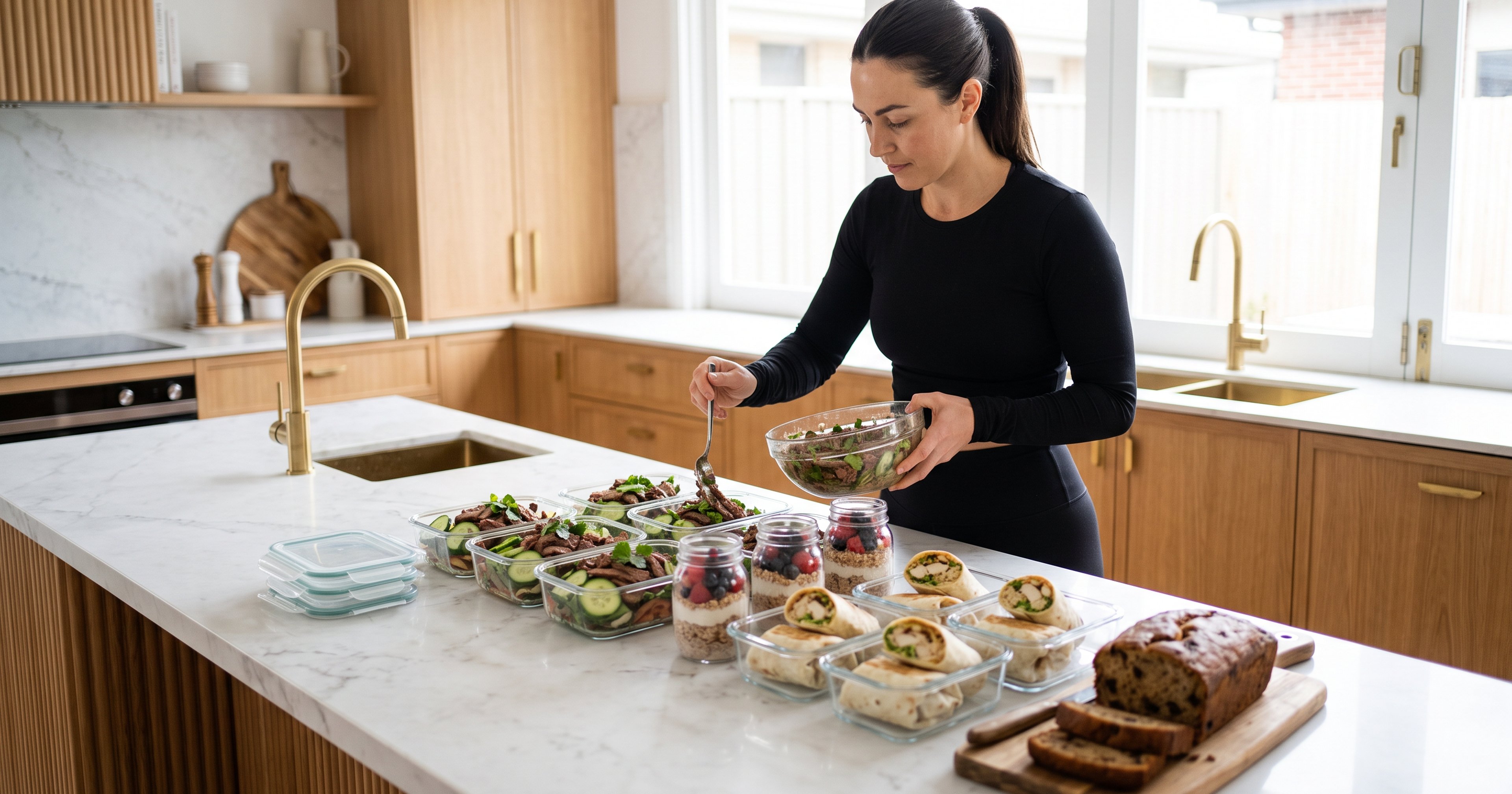
A good meal plan for high protein starts with your own protein number, then builds every meal around a protein anchor: eggs or yoghurt at breakfast, meat, fish or tofu at lunch and dinner, and a protein snack in between. Spread across three or four meals, in our coaching experience that gets most people to their target without protein shakes at every meal.
As a personal trainer, I see the same thing again and again. People know protein matters, but their day still runs on toast, a wrap and pasta, with protein as an afterthought. A high protein plan flips that order: protein first, then everything else fits around it.
Below is how to build one in four steps, what the research does and doesn’t show about high protein eating, and a sample day made from real INCHECK FIT recipes. The sample day is an example only, not a plan for you. Your own numbers depend on your body, your goal and your training.
How much protein is “high protein”?
For fat loss, the International Society of Sports Nutrition (ISSN) 2026 position stand on diets for weight loss says 1.2 to 1.6g of protein per kg of body weight a day is appropriate for the general population. It adds that 1.6 to 2.2g per kg, combined with resistance training, may help build muscle (Aragon et al., 2026). Both ranges are well above Australia’s minimum recommended intake. You may also see 1.4 to 2.0g per kg quoted. That figure comes from a separate ISSN position stand on protein and exercise, which gives it as enough for most people who exercise (Jäger et al., 2017). The two stands answer different questions, and the ranges overlap.
A position stand is an official summary of the evidence. The 1.6 to 2.2g range for people who lift weights lines up with a 2018 analysis of 49 trials in 1,863 healthy adults doing resistance training. In it, the extra gain in fat-free mass (everything that isn’t fat, including muscle) levelled off at about 1.6g per kg a day on average (Morton et al., 2018).
For comparison, Australia’s Recommended Dietary Intake for adults aged 19 to 70 is 0.84g per kg a day for men and 0.75g per kg for women (NHMRC). That figure is set to cover the needs of nearly all healthy people, not to support fat loss or muscle gain. So “high protein” in this article means roughly 1.2 to 2.2g per kg a day, depending on your goal.
Our free calorie and protein calculator works out your daily calorie and protein targets in about a minute. If you want the detail behind the number, see how much protein to lose fat.
What is a good meal plan for a high protein diet?
A good meal plan for a high protein diet hits your daily protein target, spreads it across three or four meals, and still includes vegetables, fruit, whole grains and foods you enjoy. Protein leads each meal, but it doesn’t replace everything else. The best plan is one you can repeat most days.
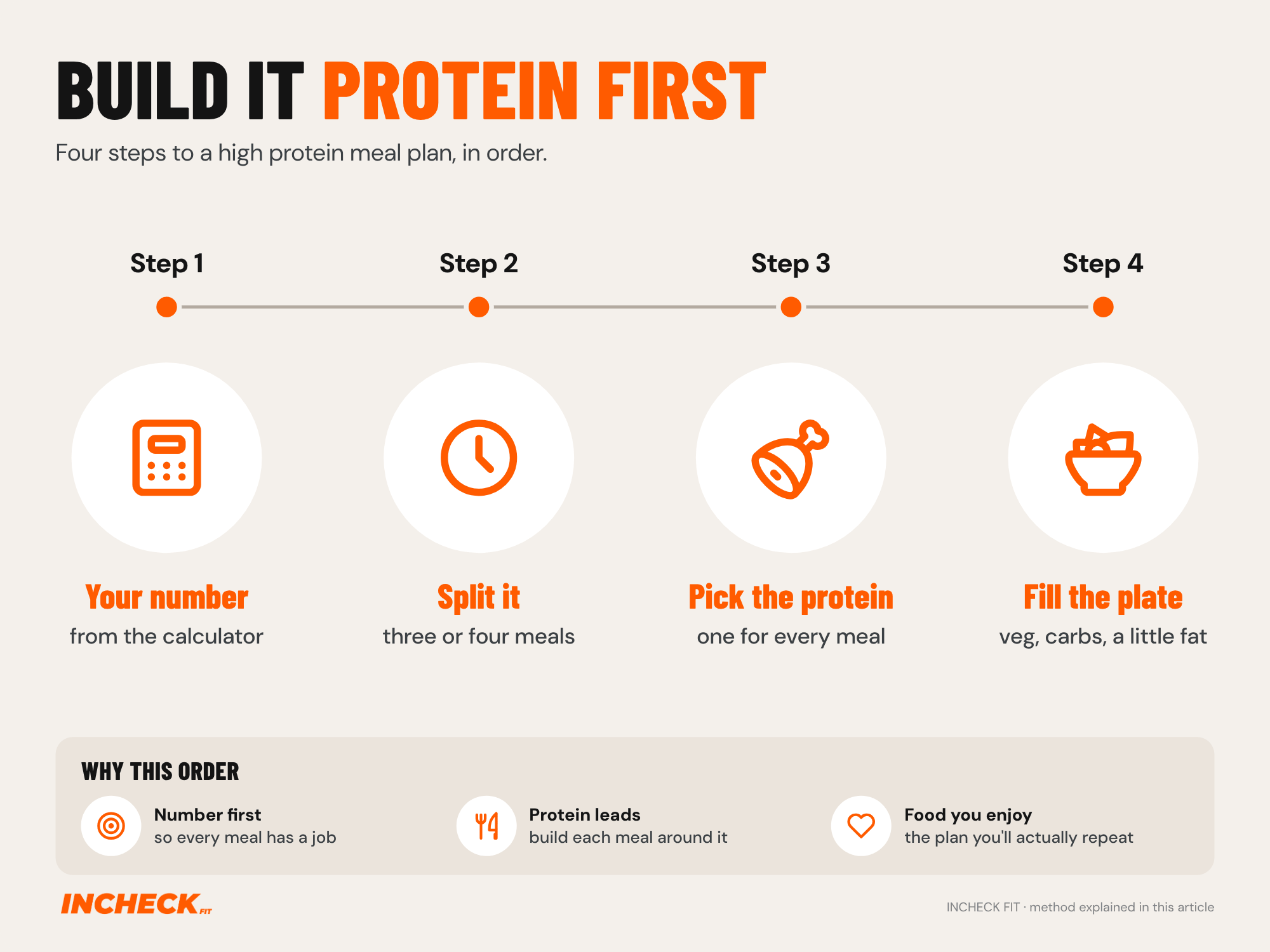
Here’s how to build one, step by step.
Step 1: Set your daily target
Start with your weight and goal. Our coaching rule of thumb: if you’re losing fat, aim for about 1.6 to 2g per kg a day. If you don’t lift weights, the lower ISSN range of 1.2 to 1.6g is fine. If you’re building muscle instead, our lean bulk guide covers how much extra to eat. Take our example person: a 30-year-old woman, 168cm and 70kg, who is moderately active, lifts weights and wants to lose fat. Our calculator gives her about 1.7g per kg, which is 119g of protein a day, and about 1,900 calories a day at its default 15% deficit.
Step 2: Split it across your meals
Divide your target by the number of times you eat. A 2018 review suggested about 0.4g per kg per meal across at least four meals for people trying to maximise muscle building (Schoenfeld and Aragon, 2018). The 2026 ISSN position stand also says spreading protein across at least three protein-rich meals may help active people keep lean mass (which includes muscle) while in a calorie deficit (Aragon et al., 2026). For our 70kg example, 0.4g per kg is about 28g a meal. Splitting her 119g mostly across three main meals works out at about 40g each, with snacks adding a little more. There’s more on this in how much protein per meal.
Step 3: Choose a protein anchor for each meal
Pick the protein first, then build the meal around it. Breakfast might be eggs, Greek or protein yoghurt, or cottage cheese. Lunch and dinner might be chicken, lean beef, fish, prawns, tofu or lentils. Snacks can be yoghurt, a protein shake or leftovers.
Step 4: Fill the rest of the plate
Add vegetables or salad, a carbohydrate you like (potato, rice, oats, bread or pasta) and a little fat for flavour. The amounts of these depend on your calorie target. If you want to plan the carbs and fats too, how to make a macro meal plan walks through the full process.
A sample high protein day
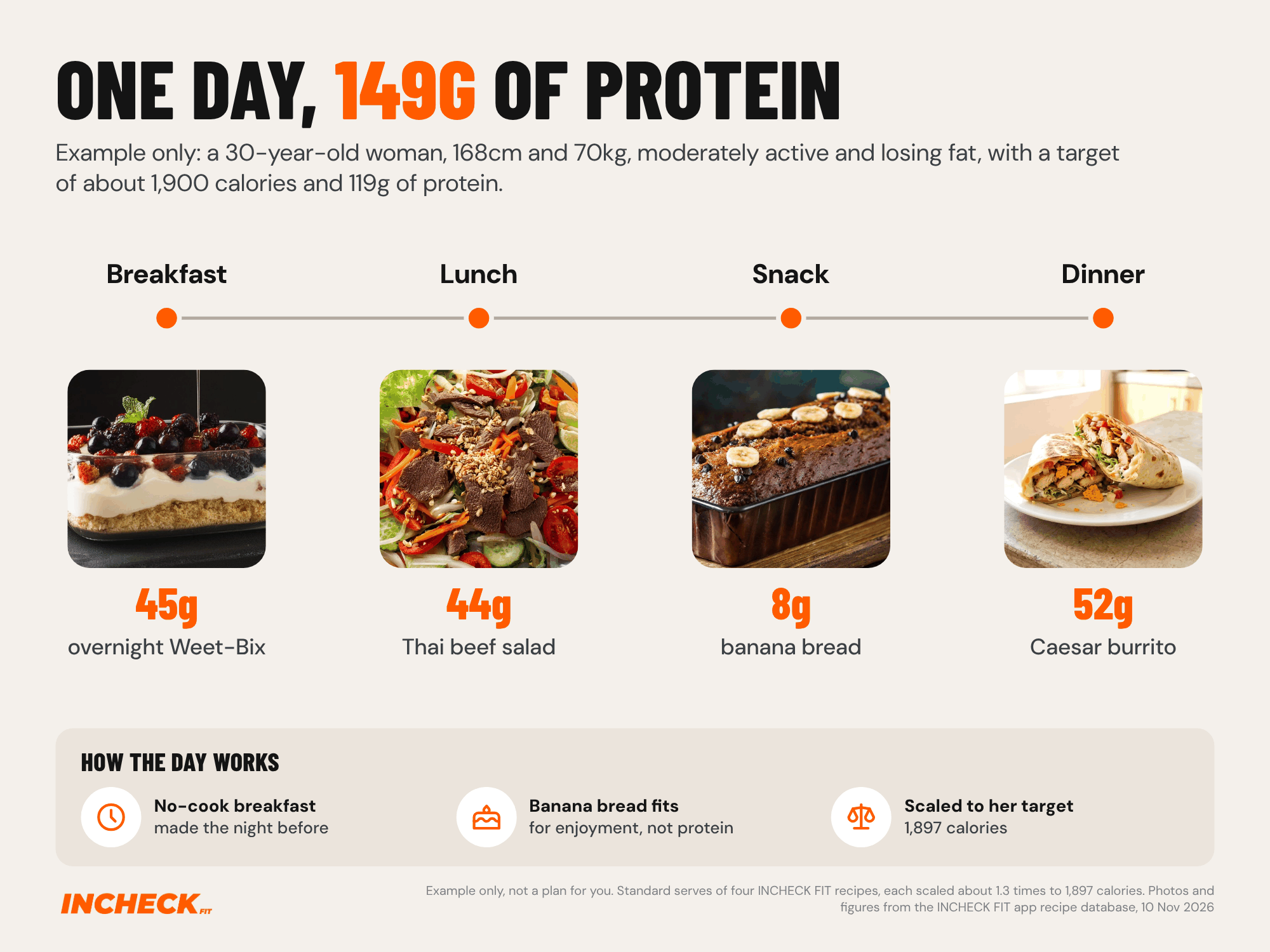
This is an example only, not a plan for you. It shows what a high protein day could look like for our example person, using four recipes from the INCHECK FIT recipe library. To bring the day to her target of about 1,900 calories, we’ve scaled every recipe’s standard serve (its default portion) by the same amount, about 1.3 times. In the app, portions are set to your own calorie and protein targets, so yours would be different.
This example is a balanced day with a breakfast you make the night before and don’t need to cook.
| Meal | INCHECK FIT recipe | Protein | Calories |
|---|---|---|---|
| Breakfast (no cooking) | Berry Overnight Weet-Bix | 45g | 455 |
| Lunch | Thai Beef Salad | 44g | 364 |
| Snack | Choc Chip Banana Bread | 8g | 393 |
| Dinner | GYG Caesar Burrito Fakeaway | 52g | 685 |
| Total | 149g | 1,897 |
Each recipe’s standard serve scaled by about 1.3 times. Standard serves calculated from the INCHECK FIT recipe and ingredient database on 10 November 2026.
That’s about 149g of protein, about 2.1g per kg for her. It’s above her 119g target, which is fine: it sits within the ISSN’s 1.6 to 2.2g per kg range for people who lift weights. It comes from three meals and a snack: overnight Weet-Bix with protein yoghurt and berries, a beef and vegetable salad, a slice of choc chip banana bread, and a chicken Caesar burrito, our take on the Guzman y Gomez favourite. Yes, a slice of banana bread fits a high protein day. It’s there for enjoyment, not protein, and the three main meals carry the load.
What is a good meal with high-protein?
As our coaching rule of thumb, a good high protein meal has 25 to 50g of protein from one main source, plus vegetables and a carbohydrate. Grilled chicken with potato and salad, salmon with rice and greens, a beef stir fry or a lentil and tofu curry all fit. The protein leads; the rest makes it a meal.
The easiest way to get there is to choose a protein you’d happily eat in a normal-sized portion. A cooked chicken breast of about 110g, a cooked salmon fillet of about 140g, or three eggs with a small tub of Greek yoghurt each land in that range. If a meal comes up short, adding a side of yoghurt, cottage cheese or edamame is usually simpler than doubling the meat.
What are top 10 high protein foods daily?
Ten everyday high protein foods are chicken breast, lean beef, fish such as salmon or tuna, prawns, eggs, Greek or protein yoghurt, cottage cheese, tofu, lentils and milk (a useful top-up rather than a main source). Most people find it easiest to build each day from three or four of these they actually like, rather than trying to eat all ten.
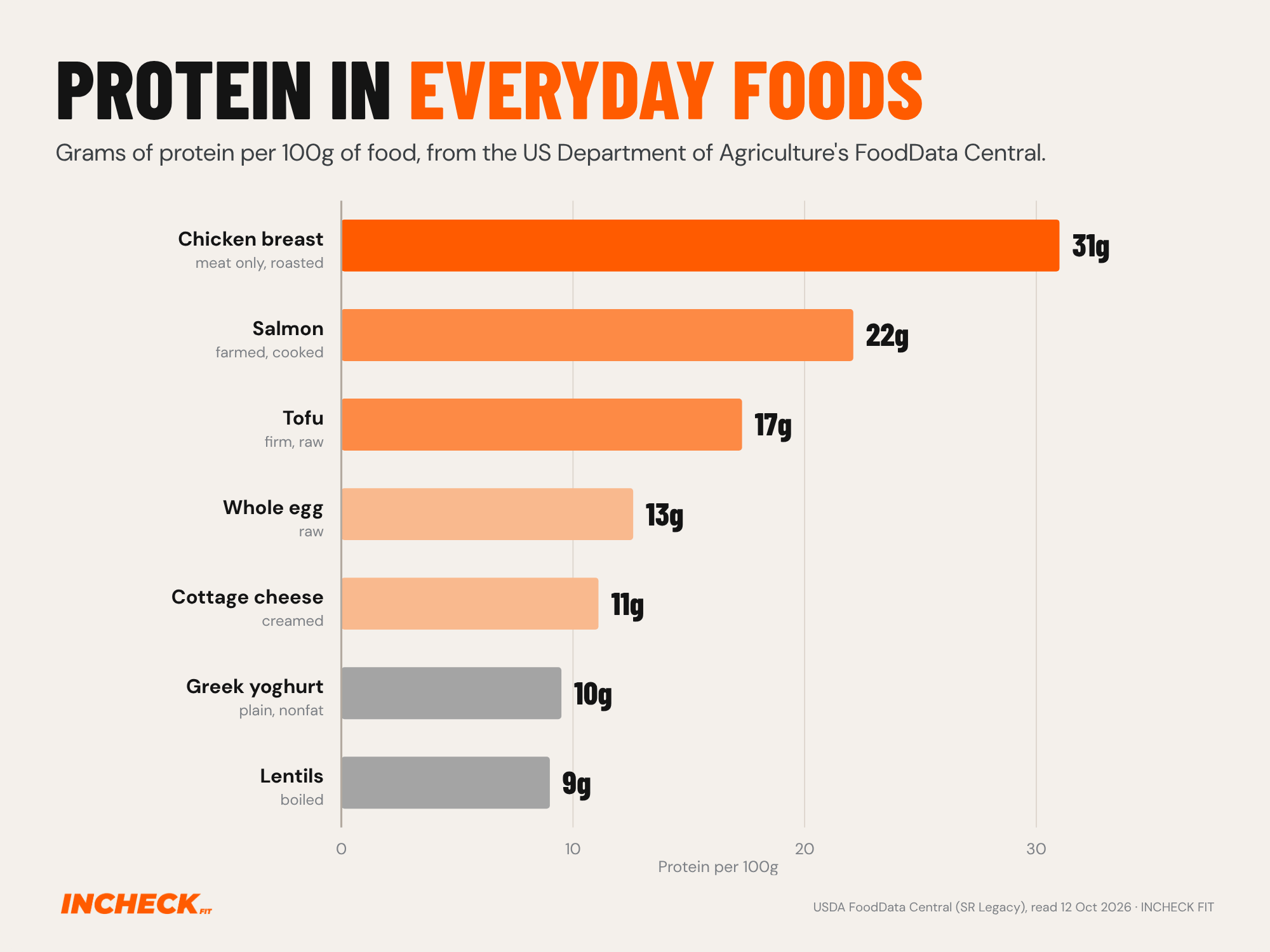
Here’s roughly how much protein a few of them carry, per 100g, from the US Department of Agriculture’s FoodData Central database:
Can I lose weight eating high protein meals?
Yes, if your overall calories are below what you burn. More protein can help modestly. In a 2021 review of 43 trials in adults carrying extra weight, diets with more protein led to about 1.6kg more weight loss than lower protein diets (Hansen et al., 2021). Protein helps, but calories still decide whether you lose weight.
A 2025 review of 83 articles from randomised trials found high protein diets led to about 0.6kg less fat mass and about 0.3kg more lean mass (which includes muscle) than normal protein diets (Yao et al., 2025). Part of the reason may be fullness. In a small 2005 study, after protein was raised from 15% to 30% of calories, the 19 people ate about 441 fewer calories a day without being told to (Weigle et al., 2005). That study had no control group, so treat it as a signal rather than proof.
The evidence isn’t all one way, and it’s worth saying so. A review of reviews (a study that pulls together many earlier reviews) for the German Nutrition Society, published online in 2023, found that without a calorie deficit, higher protein didn’t change weight, fat or waist size. In a calorie deficit, higher protein mostly lowered weight and fat mass, but the authors judged the evidence for this as insufficient (Egert et al., 2024). A 2025 analysis of 66 trials in 4,301 adults ranked a very low carbohydrate, low protein diet as the most appropriate for weight loss among the diets it compared (Lou et al., 2025). In other words, a diet doesn’t need to be high in protein to work for weight loss.
Our take: protein is a useful tool for fat loss, mostly because it helps you keep muscle and feel full, but it’s not a shortcut. A calorie deficit you can stick to is still what drives the result. If you’re working on that number, start with what a calorie deficit is.
What is the 3-3-3 protein rule?
The “3-3-3 protein rule” is a popular online tip, not a research-based guideline. Versions vary, but most set a number of protein meals or amounts at set times. In a search of titles and abstracts in the Europe PMC research database on 9 November 2026, we found no peer-reviewed study that defines or tests a “3-3-3 protein rule”.
The useful idea underneath it is sound: spread your protein across the day rather than leaving most of it for dinner. The 2026 ISSN position stand says at least three protein-rich meals may help active people keep lean mass while in a calorie deficit (Aragon et al., 2026). You don’t need a numbered rule for that. Hitting your daily total, split across the meals you already eat, does the same job.
Is a high protein diet safe for your kidneys?
For healthy adults, trials so far haven’t shown that higher protein diets reduce kidney function, but long-term effects are still uncertain. A 2018 analysis of 28 trials in 1,358 adults without kidney disease found changes in kidney function did not differ between higher and lower protein diets (Devries et al., 2018).
A 2026 analysis of 22 trials in adults without chronic kidney disease found eGFR (a blood-test estimate of how well your kidneys filter) was higher on high protein diets. The authors said this “may primarily reflect short-term” changes in blood flow, and that long-term effects “remain uncertain” (Teixeira Silva et al., 2026).
If you have kidney disease, diabetes or another medical condition, talk to your doctor or an Accredited Practising Dietitian before raising your protein intake.
Where an app helps
Working out your number is quick. Turning it into a week of meals that hit it, while still eating food you like, is where most people get stuck.
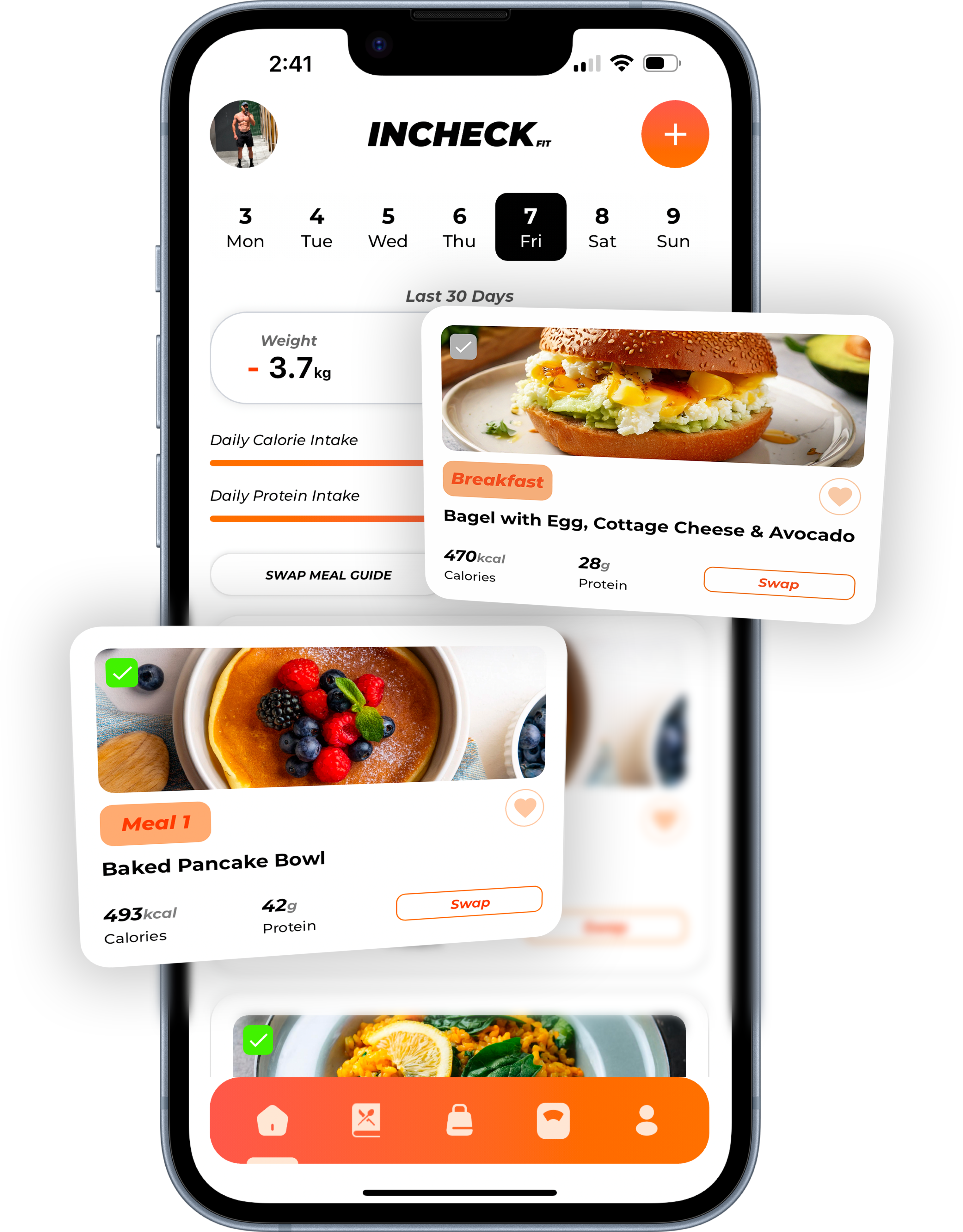
That’s the part INCHECK FIT does. It builds a weekly meal plan from its recipe library around your calorie and protein targets, gives you the quantities and a shopping list, and adjusts your targets each week based on your progress. You still weigh or measure food to the amounts given; what it removes is the planning and the daily maths. It’s A$29.90 a month on the Australian App Store with a 7-day free trial.
If you’d rather do it yourself, the four steps above and your number from the calculator are all you need. If you want your own version of the sample day built around your numbers, that’s what the app is for.
Frequently asked questions
-
How much protein should I eat on a high protein meal plan? For most adults, about 1.2 to 1.6g per kg of body weight a day is appropriate for supporting weight and fat loss, according to the International Society of Sports Nutrition’s 2026 position stand. People who lift weights may benefit from 1.6 to 2.2g per kg a day, alongside resistance training, to help build muscle. A 70kg woman using our calculator’s 1.7g per kg would aim for about 119g a day.
-
What is a good meal plan for a high protein diet? One that hits your daily protein target across three or four meals, with a protein anchor in each, plus vegetables, fruit, whole grains and foods you enjoy. Protein leads each meal but doesn’t replace everything else. The best plan is one you can repeat most days.
-
Can I lose weight eating high protein meals? Yes, if you’re in a calorie deficit. Across 43 trials in adults carrying extra weight, higher protein diets led to about 1.6kg more weight loss than lower protein diets. Higher protein may help you keep lean mass and feel fuller, but your total calories still decide whether you lose weight.
-
What is the 3-3-3 protein rule? It’s a popular online tip rather than a research-based guideline. In a search of titles and abstracts in the Europe PMC research database on 9 November 2026, we found no peer-reviewed study that defines or tests it. The idea behind it, spreading protein across the day, has some support: the ISSN says at least three protein-rich meals may help active people keep lean mass while dieting. The specific numbers haven’t been tested in any study we found.
-
Do I need protein shakes on a high protein meal plan? No. Most people can reach their target with food, such as meat, fish, eggs, dairy, tofu and lentils, across three or four meals. A shake is a convenient way to top up a meal that comes up short, not a requirement.
-
Is a high protein diet bad for your kidneys? In healthy adults, trials haven’t shown higher protein reduces kidney function. A 2018 analysis of 28 trials in 1,358 adults without kidney disease found no difference in kidney function between higher and lower protein diets, but long-term effects remain uncertain. If you have kidney disease or another medical condition, check with your doctor first.
References
- Aragon AA, Campbell BI, Schoenfeld BJ, et al. “International Society of Sports Nutrition position stand: diets for body weight reduction.” Journal of the International Society of Sports Nutrition. 2026;23(1). PMCID: PMC13665703. DOI: 10.1080/15502783.2026.2740266. [Position stand. Full text read 9 Nov 2026 on europepmc.org (Jordan’s Chrome): “a daily protein intake of 1.2–1.6 g/kg BW is appropriate for supporting total body weight and fat loss”; “1.6–2.2 g/kg BW combined with resistance training may optimize muscle anabolism”; at least three protein-rich meals “may optimize lean mass retention” in active populations during deficits; kidney concerns “lack evidentiary support in healthy populations”. No PMID indexed yet; no corrections shown.]
- Morton RW, Murphy KT, McKellar SR, et al. “A systematic review, meta-analysis and meta-regression of the effect of protein supplementation on resistance training-induced gains in muscle mass and strength in healthy adults.” British Journal of Sports Medicine. 2018;52(6):376-384. PMID: 28698222. DOI: 10.1136/bjsports-2017-097608. [Meta-analysis and meta-regression, human, 49 trials, n=1,863 healthy adults doing resistance training. Breakpoint 1.62g/kg/day. Verified 12 Oct 2026 via Europe PMC; one correction (2020, competing interests) does not change the figures.]
- National Health and Medical Research Council. Nutrient Reference Values for Australia and New Zealand: Protein. RDI 0.84g/kg/day (men) and 0.75g/kg/day (women), ages 19 to 70. Read 12 Oct 2026 on eatforhealth.gov.au.
- Schoenfeld BJ, Aragon AA. “How much protein can the body use in a single meal for muscle-building? Implications for daily protein distribution.” Journal of the International Society of Sports Nutrition. 2018;15:10. PMID: 29497353. DOI: 10.1186/s12970-018-0215-1. [Narrative review. Verified 27 Oct 2026 via Europe PMC: 0.4g/kg/meal across a minimum of four meals.]
- Hansen TT, Astrup A, Sjödin A. “Are dietary proteins the key to successful body weight management? A systematic review and meta-analysis of studies assessing body weight outcomes after interventions with increased dietary protein.” Nutrients. 2021;13(9):3193. PMID: 34579069. DOI: 10.3390/nu13093193. [Systematic review and meta-analysis of RCTs, human, 43 trials in adults with excess body weight. Protein 18 to 59% of energy reduced body weight by 1.6 (1.2 to 2.0) kg. Abstract read 9 Nov 2026 on europepmc.org; no corrections shown.]
- Yao Y, Lin S, He Z, Kim JE. “Impact of other macronutrient composition within high-protein diet on body composition and cardiometabolic health: a systematic review, pairwise, and network meta-analysis of randomized controlled trials.” International Journal of Obesity. 2025;49(8):1480-1489. PMID: 40360850. DOI: 10.1038/s41366-025-01806-5. [Systematic review with pairwise and network meta-analysis of RCTs, human, 83 articles. Fat mass MD -0.64kg (95% CI -0.98 to -0.29), lean body mass MD +0.34kg (0.11 to 0.57) versus normal protein. Abstract read 9 Nov 2026 on europepmc.org; no corrections shown.]
- Weigle DS, Breen PA, Matthys CC, et al. “A high-protein diet induces sustained reductions in appetite, ad libitum caloric intake, and body weight despite compensatory changes in diurnal plasma leptin and ghrelin concentrations.” American Journal of Clinical Nutrition. 2005;82(1):41-48. PMID: 16002798. DOI: 10.1093/ajcn/82.1.41. [Sequential diet study, no control group, human, n=19. Protein 15% to 30% of energy; spontaneous intake fell 441 kcal/day. Verified 12 Oct 2026 via Europe PMC.]
- Egert S, et al. (German Nutrition Society). “Protein intake and body weight, fat mass and waist circumference: an umbrella review of systematic reviews for the evidence-based guideline on protein intake of the German Nutrition Society.” European Journal of Nutrition. 2024;63(1):3-32. PMID: 37794213. DOI: 10.1007/s00394-023-03220-x. [Umbrella review, 33 systematic reviews (29 based on RCTs). Without energy restriction, a high-protein diet “did not modulate BW, FM and WC”; under hypoenergetic diets it mostly decreased weight and fat mass but evidence was “insufficient”. Abstract read 9 Nov 2026 on europepmc.org; published online 4 Oct 2023.]
- Lou Y, Wang H, Wang L, et al. “Comparison with dietary groups of various macronutrient ratios on body weight and cardiovascular risk factors in adults: a systematic review and network meta-analysis.” Nutrients. 2025;17(16):2683. PMID: 40871713. DOI: 10.3390/nu17162683. [Bayesian network meta-analysis, 66 RCTs, n=4,301 adults. Very low carbohydrate, low protein diet ranked most appropriate for weight loss. Abstract read 9 Nov 2026 on europepmc.org.]
- Devries MC, Sithamparapillai A, Brimble KS, et al. “Changes in kidney function do not differ between healthy adults consuming higher- compared with lower- or normal-protein diets: a systematic review and meta-analysis.” Journal of Nutrition. 2018;148(11):1760-1775. PMID: 30383278. DOI: 10.1093/jn/nxy197. [Systematic review and meta-analysis of RCTs, 28 trials, n=1,358 adults without kidney disease. Verified 12 Oct 2026 via Europe PMC.]
- Teixeira Silva PR, Santos P, de Miranda Silva Nogueira PA, et al. “Effects of high-protein diets on renal function and body composition in adults without chronic kidney disease: a systematic review and meta-analysis of randomised trials.” Diabetes, Obesity and Metabolism. 2026;28(9):7672-7683. PMID: 42289790. DOI: 10.1111/dom.70996. [Systematic review and meta-analysis, 22 RCTs, adults without CKD. eGFR SMD 0.39 (0.09 to 0.69); authors: rise “may primarily reflect short-term hemodynamic adaptations”, long-term implications “remain uncertain”. Abstract read 9 Nov 2026 on europepmc.org.]
- US Department of Agriculture. FoodData Central (SR Legacy), protein per 100g: chicken breast, meat only, roasted 31.0g; Atlantic salmon, farmed, cooked 22.1g; tofu, raw, firm 17.3g; whole egg 12.6g; cottage cheese, creamed 11.1g; Greek yoghurt, plain, nonfat 9.5g; lentils, boiled 9.0g. Read 12 Oct 2026.
- INCHECK FIT recipe and ingredient database (admin export, 10 Nov 2026). Standard-serve protein and calories for Berry Overnight Weet-Bix, Thai Beef Salad, Choc Chip Banana Bread and GYG Caesar Burrito Fakeaway, calculated from each recipe’s main ingredients, then scaled about 1.3 times to 1,897 calories for the example person. Example person’s targets from incheckfit.com/calculator (Mifflin-St Jeor, moderately active 1.55, default 15% deficit, protein 1.7g/kg for women), checked against the calculator code 10 Nov 2026.
- Jäger R, Kerksick CM, Campbell BI, et al. “International Society of Sports Nutrition Position Stand: protein and exercise.” Journal of the International Society of Sports Nutrition. 2017;14:20. PMID: 28642676. DOI: 10.1186/s12970-017-0177-8. [Position stand. Abstract and full text verified 12 Oct 2026 via Europe PMC (record carried from how-much-protein-to-lose-fat): 1.4 to 2.0g per kg body weight a day for most exercising people; no corrections found.]
Last reviewed: November 2026