
Should you eat back exercise calories? Usually not. If your calorie target was set using an activity level, your training is already counted in it, so adding your watch’s calories on top counts the same workout twice.
The second problem is the number itself. In a review of lab tests published up to 2019, wearables estimated calories burned to within 3% of the lab’s gold-standard measurement in only 9.2% of 305 comparisons (each time a device was checked against the lab counts as one comparison). That’s under 1 in 10.
So eating back exercise calories usually means eating back a workout you’ve already been given food for, using a number that’s probably off. Below, I’ll walk through both reasons, what to do if your target was set as sedentary, and what your watch is actually good for.
Your calorie target already includes your training
A common way to set a calorie target starts with two steps. First comes an estimate of what you burn at rest. Then that number is multiplied by an activity factor: a multiplier for how active you are, covering your daily movement as well as your training.
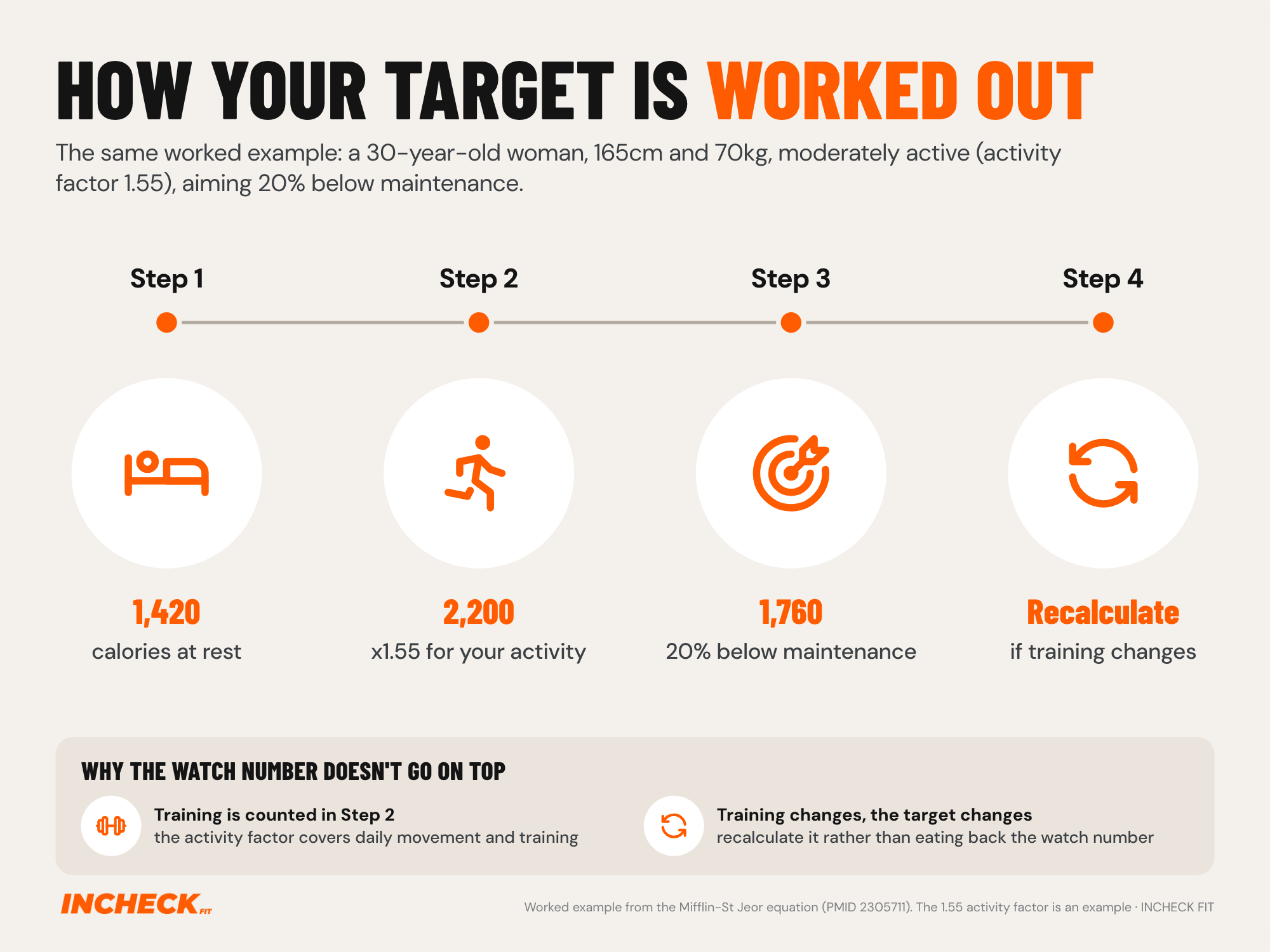
Here’s a worked example using the Mifflin-St Jeor equation, a standard formula for estimating the calories you burn at rest. A 30-year-old woman who is 165cm and 70kg is estimated to burn about 1,420 calories a day at rest. If she trains a few times a week, a typical “moderately active” factor of 1.55 takes her to about 2,200 calories. That’s her estimated maintenance: the calories she’d need to stay the same weight.
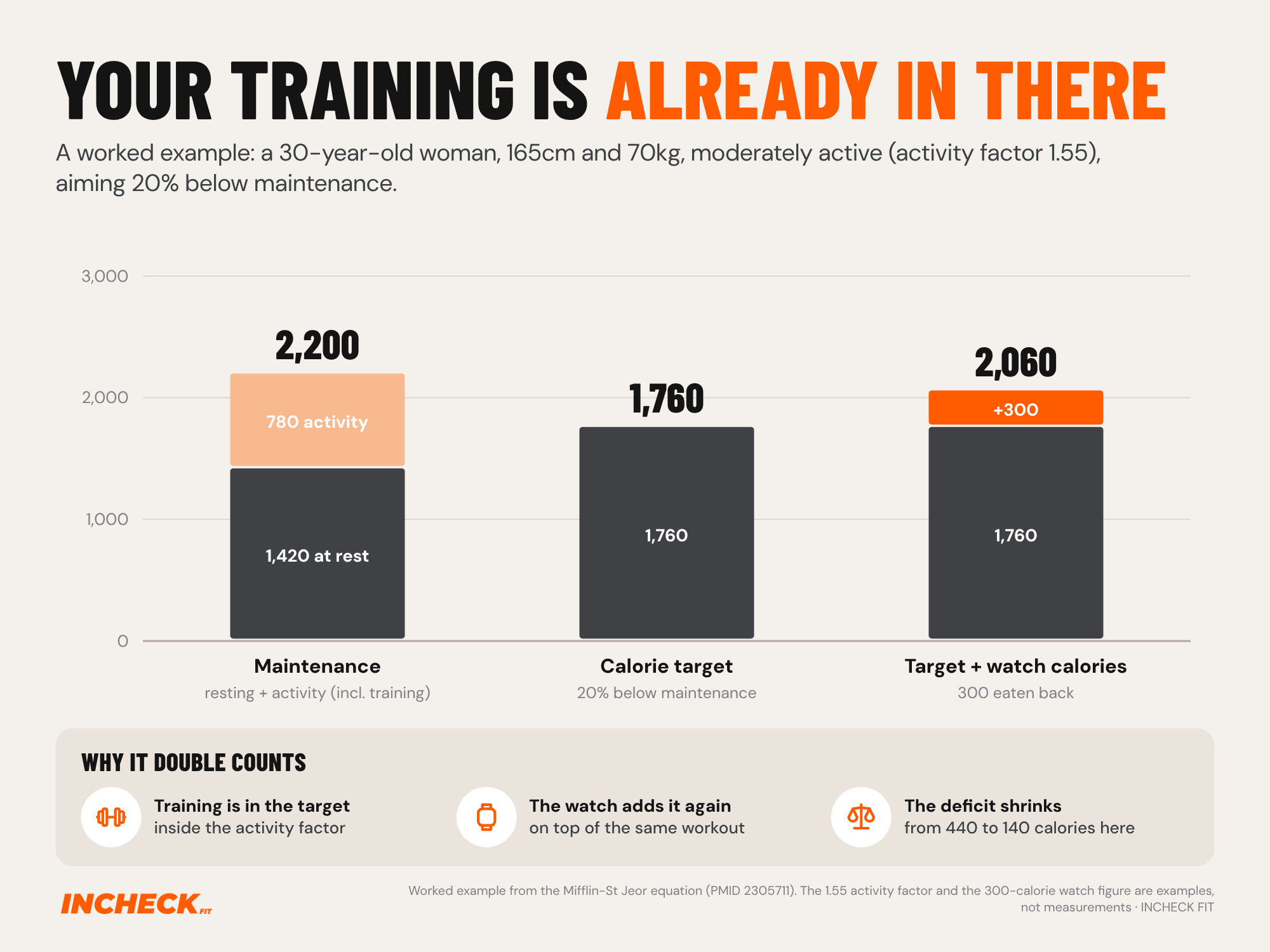
Notice what that 1.55 is doing. It adds roughly 780 calories a day for everything she does beyond resting, and her training is part of that. If she wants to lose fat and aims 20% below maintenance, her target becomes about 1,760 calories a day.
Now say she finishes a workout and her watch says she burned 300 calories. If she eats those back, she’s at 2,060 calories for the day. Her planned calorie deficit (the gap between what she eats and what she’d need to maintain) drops from 440 calories to 140, because she’s eating for that workout twice: once inside the activity factor, and again from the watch.
That’s why the honest answer to “should I eat back my exercise calories” is “check how your target was set first.” If it asked about your training, the training is already in there.
Watch calorie numbers are rarely close to the lab
Even if your target didn’t include your training, the number on your watch is a shaky thing to eat to.
A large systematic review gathered lab studies of consumer wearables published up to May 2019. It covered wrist, waist and chest devices tested in controlled lab conditions. For heart rate, devices came within 3% of the lab measure in 56.5% of 177 comparisons. For calories burned, they came within 3% in only 9.2% of 305 comparisons.
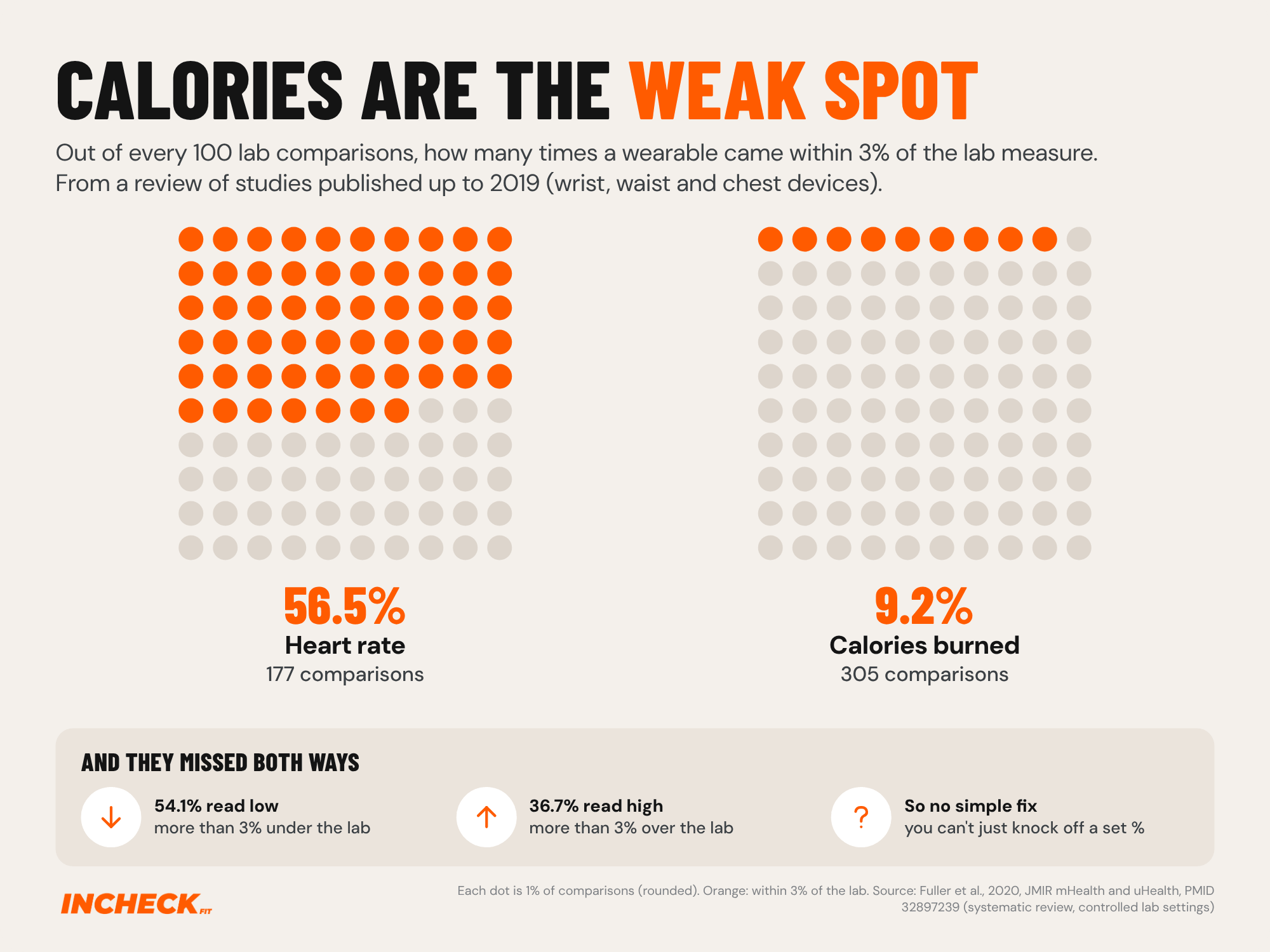
The misses also went both ways. In the same review, 54.1% of calorie comparisons read more than 3% low and 36.7% read more than 3% high. So you can’t fix the number by knocking off a set percentage, because the error went in different directions depending on the device and activity tested.
Other studies point the same way:
- A 2017 Stanford lab study of 60 adults tested seven wrist-worn devices. None estimated calories burned to within 20%. Typical errors (the middle result) ranged from about 27% for the closest device to about 93% for the furthest.
- A 2026 study of 58 Hispanic adults tested four smartwatches (models such as the Apple Watch Series 8) during a 10-minute exercise bike session in the lab. The Apple Watch, Garmin and Samsung watches all overestimated calories burned on average. Across the watches, typical errors were roughly 15% to 25%. Apple overestimated the least and Garmin the most. Fitbit’s results were inconsistent, and about 13% of its estimates were excluded as implausible.
- A 2022 review and meta-analysis of 52 studies of Fitbit devices found they tended to underestimate calories burned overall, though individual studies went both ways. The authors concluded the calorie measurement “may be inaccurate for some research purposes.”
- A 2020 meta-analysis combining 60 studies of wrist and arm activity monitors found accuracy varied by activity. Adding heart rate or heat sensing to the movement sensor reduced error for most activities, but the authors still called for better calorie estimates.
Our take: the watch estimates your effort from movement and heart rate, then estimates calories from that. Use the calorie number loosely, if at all, and don’t eat to it calorie for calorie.
People guess high too, even without a watch
It isn’t only watches. In one small study, people’s own guesses of what a workout burned ran well over the real number.
In a 2010 study, 16 normal-weight, moderately active adults (8 men and 8 women, aged 20 to 35) exercised on a treadmill until they’d burned 200 calories, measured in the lab (the study also tested a 300-calorie session). They didn’t know the real number. Afterwards, they guessed their burn and were asked to eat that many calories back at a buffet.
On average they guessed 825 calories for a session that burned 200, though the guesses varied widely. When they ate it back, they ate an average of 557 calories. The authors concluded people overestimated exercise calories by 3 to 4 times, and that eating it back still came to 2 to 3 times what they’d actually burned.
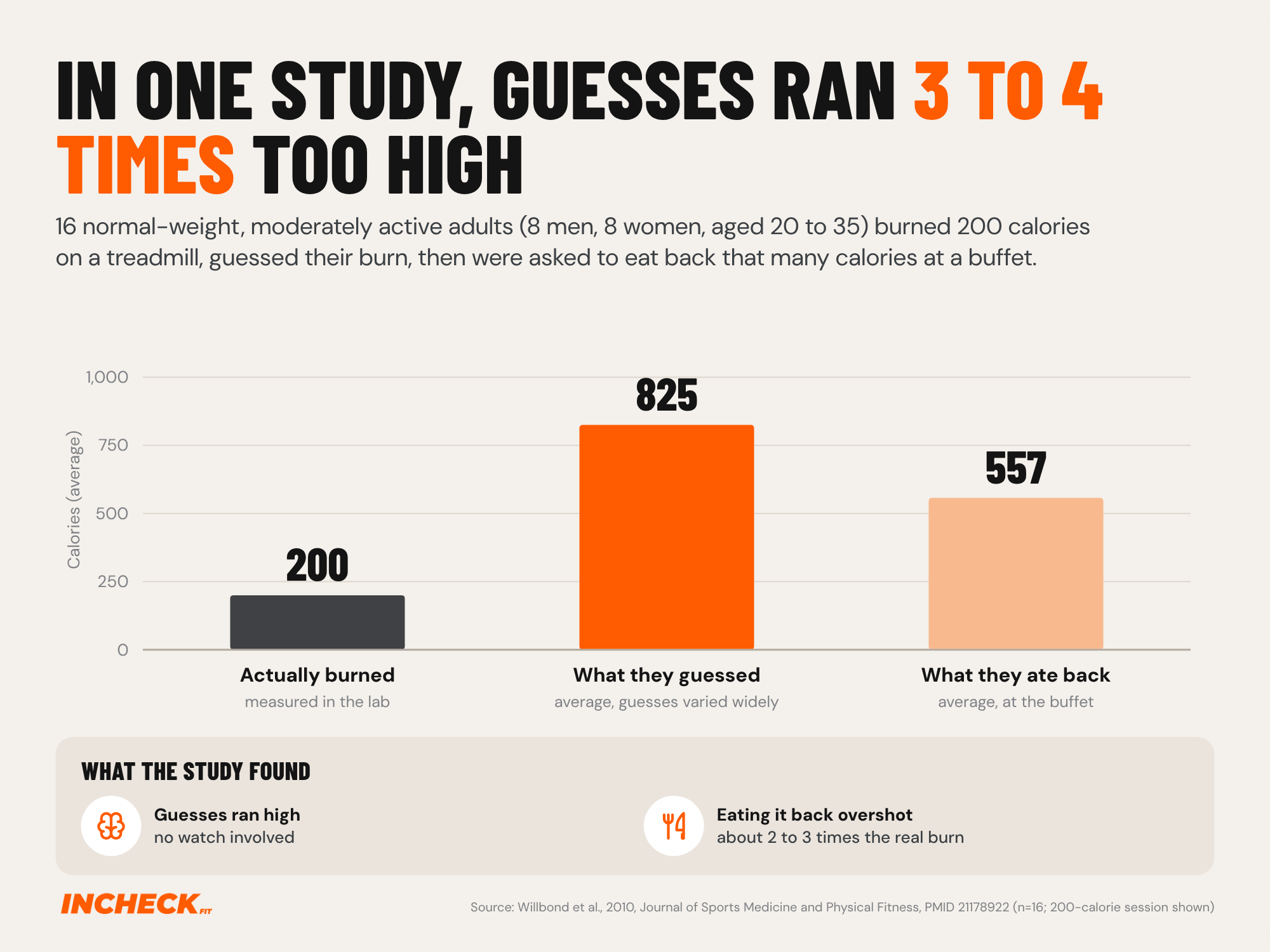
It’s a small study, so treat the exact numbers with care. But it illustrates the trap: in this study, eating back a guess more than cancelled out the workout.
To be fair to exercise, there’s a flip side. A 2013 meta-analysis of 51 trials from 29 studies found that after a single 30 to 120 minute workout, people ate only trivially more at a meal up to 2 hours later and generally didn’t make up the calories burned, though results varied between studies. So in the short term, exercise doesn’t automatically make you eat it all back. The risk comes from deliberately adding calories back based on a number that’s too high.
What if your target was set as sedentary?
If your app set your target as sedentary and adds workouts back as you log them, the double-counting problem doesn’t apply in the same way. But the accuracy problem still does.
As a coach, my approach here is simple: stick to your target, and don’t eat back the watch number day to day. Instead, if your training has genuinely changed (say you’ve gone from no training to four sessions a week), recalculate your target with an activity level that matches your new routine. Then judge it by your weekly average weight over two to three weeks, not by what your watch said on any one day.
That gives you a target that reflects your real routine, without chasing a daily number that might be out by 20% or more.
This isn’t a reason to eat less than your target. If you’re training hard and feeling constantly run-down, dizzy or unusually tired, that’s worth raising with your GP or an accredited practising dietitian.
When eating more for training does make sense
There are times when your intake should go up with your training. They just don’t involve your watch.
If your training has stepped up for the long term, your activity level should step up with it. That’s the recalculation above. As a coach, I treat very high training loads as a separate case. If you’re training for hours most days, for example for an endurance event, a standard activity factor may not cover your needs. That’s worth working through with an accredited practising dietitian or sports dietitian rather than guessing.
And if you’re trying to build muscle rather than lose fat, as a coach I’d usually have you eat at or a little above maintenance. Your training still belongs in the activity factor, though, not added back from your watch.
Our take: change the target when your routine changes, and leave the daily watch number out of it.
What your watch is actually good for
None of this means your watch is useless. In the review of lab studies up to 2019, heart rate came within 3% of the lab in 56.5% of comparisons, against 9.2% for calories.
So use it for:
- Heart rate during and between sessions
- Trends over weeks, such as whether you’re moving more or less than usual
- Consistency, like showing up for your training sessions
Just don’t treat the calorie number as food you’ve earned back. You’ve probably already been given it.
This is also why INCHECK FIT asks about your activity level when it sets your targets, then reviews your weekly check-ins and adjusts your targets from there. Your training is built in, so there’s nothing to add back. If you’d like to see how training changes your numbers, try the calorie calculator.
Frequently asked questions
-
Should I eat back the calories my Apple Watch says I burned? Usually not. In a 2026 lab study of 58 Hispanic adults doing a 10-minute exercise bike session, the Apple Watch Series 8 overestimated less than the Garmin and Samsung watches, but it still overestimated calories burned on average. If your calorie target already uses an activity level, your training is already counted, so eating the watch number back counts it twice.
-
Should I eat back active calories or total calories? Neither, if your target already includes an activity level. On many watches, “total” calories include an estimate of your resting burn as well as your activity, so eating those back would count your resting burn too. If your target was set as sedentary, it’s better to recalculate it for your real training routine than to eat back either number day to day.
-
Is it bad not to eat back exercise calories? Not if your target was set with your training included, because those calories are already in your plan. Not eating them back simply keeps the deficit you planned. If you’re feeling constantly drained or your training is suffering, your target may need adjusting, and a GP or accredited practising dietitian can help.
-
How many calories should I eat if I exercise? Start from your maintenance calories, which is your resting burn multiplied by an activity factor that includes your training, then set your target from there. In a worked example of a 30-year-old woman, 165cm and 70kg, moderately active, that’s about 2,200 calories for maintenance and about 1,760 for a 20% deficit. Check it against your weekly average weight over two to three weeks and adjust if needed.
-
Should I eat back calories burned from steps? Generally no, for the same reason. Your activity factor is meant to cover your usual daily movement as well as your training. If your daily steps change a lot for the long term, update your activity level rather than adding steps back each day.
-
Why do watches get calories wrong? Watches don’t measure calories directly. They estimate them from movement, heart rate and your details. In a review of lab studies published up to 2019, wearables came within 3% of the lab for calories burned in only 9.2% of 305 comparisons, and the misses went both ways.
-
What if I’m really hungry after a workout? Eat a meal or snack from your plan rather than adding extra on top. As a coach, I find a protein-rich meal around training helps many clients feel fuller. If you’re hungry after training most days for a couple of weeks, look at the whole target rather than eating back your watch number.
References
-
Mifflin MD, St Jeor ST, Hill LA, Scott BJ, Daugherty SA, Koh YO. A new predictive equation for resting energy expenditure in healthy individuals. American Journal of Clinical Nutrition. 1990;51(2):241-247. PMID: 2305711. DOI: 10.1093/ajcn/51.2.241. [Equation development study, human, 498 healthy adults aged 19 to 78. Abstract verified 7 Oct 2026 via Europe PMC; record re-read 9 Nov 2026 via Europe PMC in Chrome; no corrections linked. The 1.55 activity factor is a standard multiplier, not from this paper.]
-
Fuller D, Colwell E, Low J, Orychock K, Tobin MA, Simango B, Buote R, Van Heerden D, Luan H, Cullen K, Slade L, Taylor NGA. Reliability and Validity of Commercially Available Wearable Devices for Measuring Steps, Energy Expenditure, and Heart Rate: Systematic Review. JMIR mHealth and uHealth. 2020;8(9):e18694. PMID: 32897239. DOI: 10.2196/18694. [Systematic review, human, controlled lab settings; 305 energy expenditure comparisons and 177 heart rate comparisons; wrist, waist/hip and torso devices; English-language articles to May 2019. Full text verified 7 Oct 2026 via Europe PMC; record re-read 9 Nov 2026; no corrections linked.]
-
Shcherbina A, Mattsson CM, Waggott D, Salisbury H, Christle JW, Hastie T, Wheeler MT, Ashley EA. Accuracy in Wrist-Worn, Sensor-Based Measurements of Heart Rate and Energy Expenditure in a Diverse Cohort. Journal of Personalized Medicine. 2017;7(2):3. PMID: 28538708. DOI: 10.3390/jpm7020003. [Lab validation study, human, 60 volunteers, 7 wrist-worn devices. Full text verified 7 Oct 2026 via Europe PMC; record re-read 9 Nov 2026; only a linked preprint, no erratum or retraction. The abstract and results rank devices differently, so no device is named as best here.]
-
Kostrna J, Oparina E, Palacios C, Rodriguez AJ, Pei J, Ajmal A, Ramella-Roman JC. Body fat, skin tone, and the accuracy of smartwatch caloric expenditure estimates. PLOS ONE. 2026;21(7):e0353261. DOI: 10.1371/journal.pone.0353261. [Lab validation study, human, 58 Hispanic adults aged 18 to 50, a single 10-minute recumbent cycle bout, COSMED K5 indirect calorimetry as reference; Apple Watch Series 8, Fitbit Sense 2, Samsung Galaxy Watch 5, Garmin Forerunner 955. Article page read 9 Nov 2026 via the publisher (journals.plos.org); no correction shown.]
-
Chevance G, Golaszewski NM, Tipton E, Hekler EB, Buman M, Welk GJ, Patrick K, Godino JG. Accuracy and Precision of Energy Expenditure, Heart Rate, and Steps Measured by Combined-Sensing Fitbits Against Reference Measures: Systematic Review and Meta-analysis. JMIR mHealth and uHealth. 2022;10(4):e35626. DOI: 10.2196/35626. [Systematic review and meta-analysis, human, 52 studies, 1,628 participants, searches January 2015 to July 2021. Article page read 9 Nov 2026 via the publisher (mhealth.jmir.org); no correction shown.]
-
O’Driscoll R, Turicchi J, Beaulieu K, Scott S, Matu J, Deighton K, Finlayson G, Stubbs J. How well do activity monitors estimate energy expenditure? A systematic review and meta-analysis of the validity of current technologies. British Journal of Sports Medicine. 2020;54(6):332-340. PMID: 30194221. DOI: 10.1136/bjsports-2018-099643. [Systematic review and meta-analysis, human, healthy adults, 60 studies, 104 effect sizes, wrist- and arm-worn monitors. Abstract verified 9 Nov 2026 via Europe PMC; no corrections linked.]
-
Willbond SM, Laviolette MA, Duval K, Doucet E. Normal weight men and women overestimate exercise energy expenditure. Journal of Sports Medicine and Physical Fitness. 2010;50(4):377-384. PMID: 21178922. [Randomised crossover trial, human, 16 normal-weight, moderately active adults (8 men, 8 women) aged 20 to 35; 200 and 300 calorie treadmill sessions measured by indirect calorimetry. Abstract verified 9 Nov 2026 via Europe PMC; no corrections linked. No DOI listed in the record.]
-
Schubert MM, Desbrow B, Sabapathy S, Leveritt M. Acute exercise and subsequent energy intake. A meta-analysis. Appetite. 2013;63:92-104. PMID: 23274127. DOI: 10.1016/j.appet.2012.12.010. [Meta-analysis, human, 29 studies comprising 51 trials of a single exercise bout with an ad libitum meal 0 to 2 hours later. Abstract verified 9 Nov 2026 via Europe PMC; no corrections linked.]
Last reviewed: November 2026