The short answer:
- Protein before or after a workout both work. Trials that compared the two found similar muscle gains and mostly similar strength gains.
- The 30-minute “anabolic window” is mostly a myth. Instead, researchers suggest watching the time between your protein meals either side of training.
- A practical guideline from a 2013 review: keep the protein meal before a session and the one after it within about 3 to 4 hours of each other.
- If you train fasted first thing, or your last protein meal was more than about 3 to 4 hours before you start training, eat protein as soon as you can after the session.
- Your daily total comes first. Spreading it across the day comes second.
Protein before or after a workout? Either works, and you don’t need to sprint to a shake within 30 minutes of your last set. A 2013 review suggests a more useful question: how long has it been since your last protein meal?
As a personal trainer, it’s a question I get asked a lot. The 30-minute rule sounds precise, so people stress about it. This guide covers what the research found, how to work out your own gap with three everyday examples, and what matters more than the minutes after training: your daily total and how you spread it across the day.
Is the 30-minute anabolic window real?
Mostly, no. The “anabolic window” is the idea that there’s a short time after training when your muscles soak up protein best, so protein has to land within about 30 minutes. The research doesn’t support a window that narrow.
The best evidence comes from trials that changed when people ate protein. A 2013 study combined the results of 23 earlier trials, with 525 people, and asked whether eating protein close to training led to more muscle growth. At first glance it looked like it did. But once the researchers made a fair comparison, adjusting for other differences between the trials including how much protein people ate in total, the timing effect was no longer significant. Total protein intake was the thing that best explained who grew more muscle.
Trials since then point the same way. In a 2017 study of 21 men who had been lifting weights for over a year, having 25g of protein straight before training or straight after it gave similar results over 10 weeks. And a 2025 review that combined 5 studies comparing protein before versus after training found no difference in lean mass (everything except fat, so muscle plus water, bone and organs).
So what does that mean for you? The window is real in a loose sense, because training does make your muscles more responsive to protein for a while. But that’s measured in hours, not minutes.
The gap to watch: time since your last protein meal
Here’s the more useful number. A 2013 review of the timing research suggested keeping the protein meals before and after a session no more than about 3 to 4 hours apart. With large mixed meals, it allowed up to 5 to 6 hours. That was for a typical 45 to 90 minute workout. It’s a practical guideline the authors drew from the research, not something trials have tested directly.
The same review said that if you start training more than about 3 to 4 hours after your last meal, it makes sense to eat protein as soon as you can after the session.
That flips the question around. Instead of watching the clock after training, look at when you last ate protein. Three examples make it clear.
Morning session: no rush
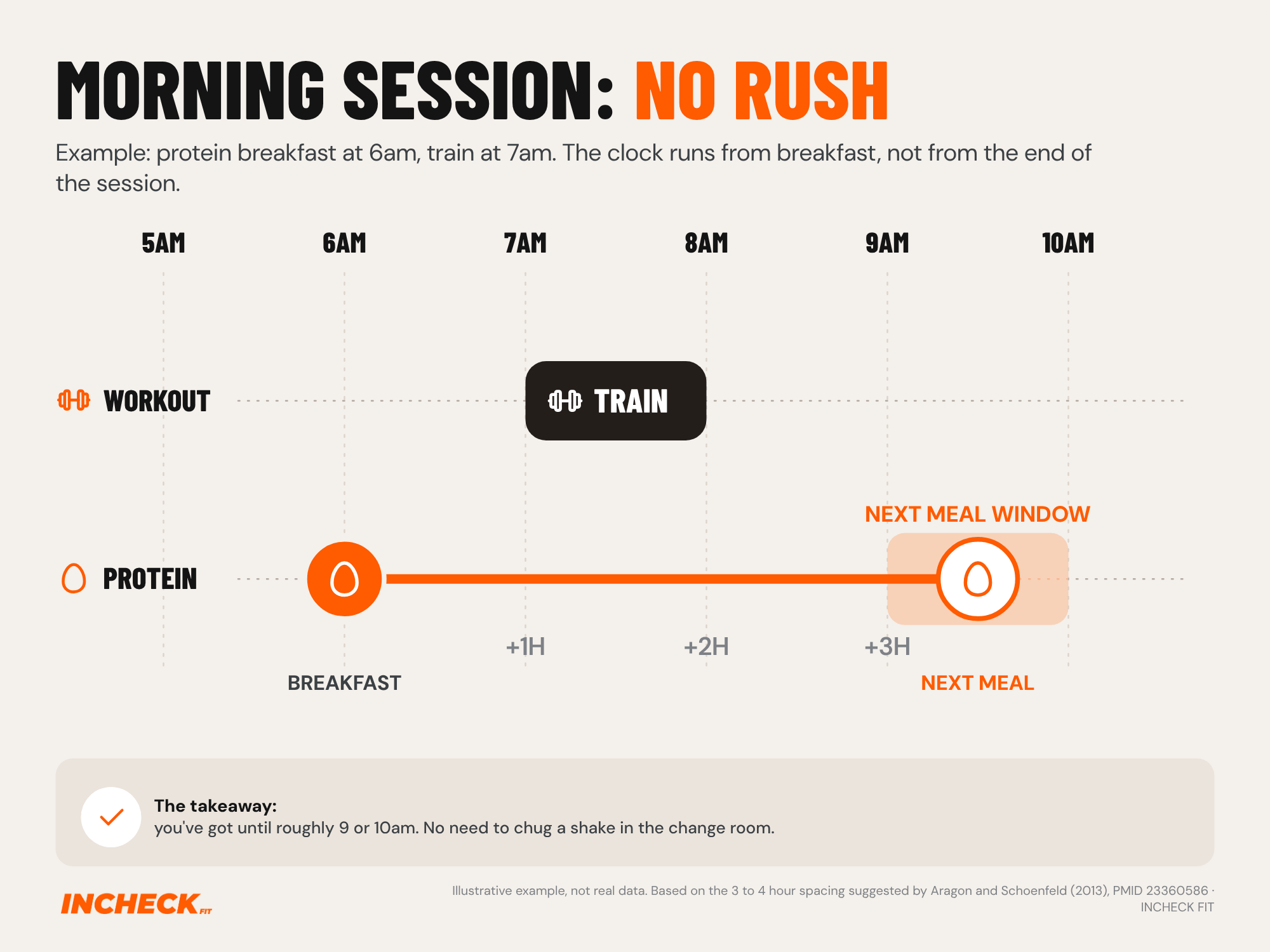
Say you have a protein breakfast at 6am and train at 7am. The clock started at breakfast, not at the end of your session. A 3 to 4 hour gap puts your next protein meal at roughly 9 or 10am, so there’s no need to chug a shake in the change room.
Evening session: eat soon
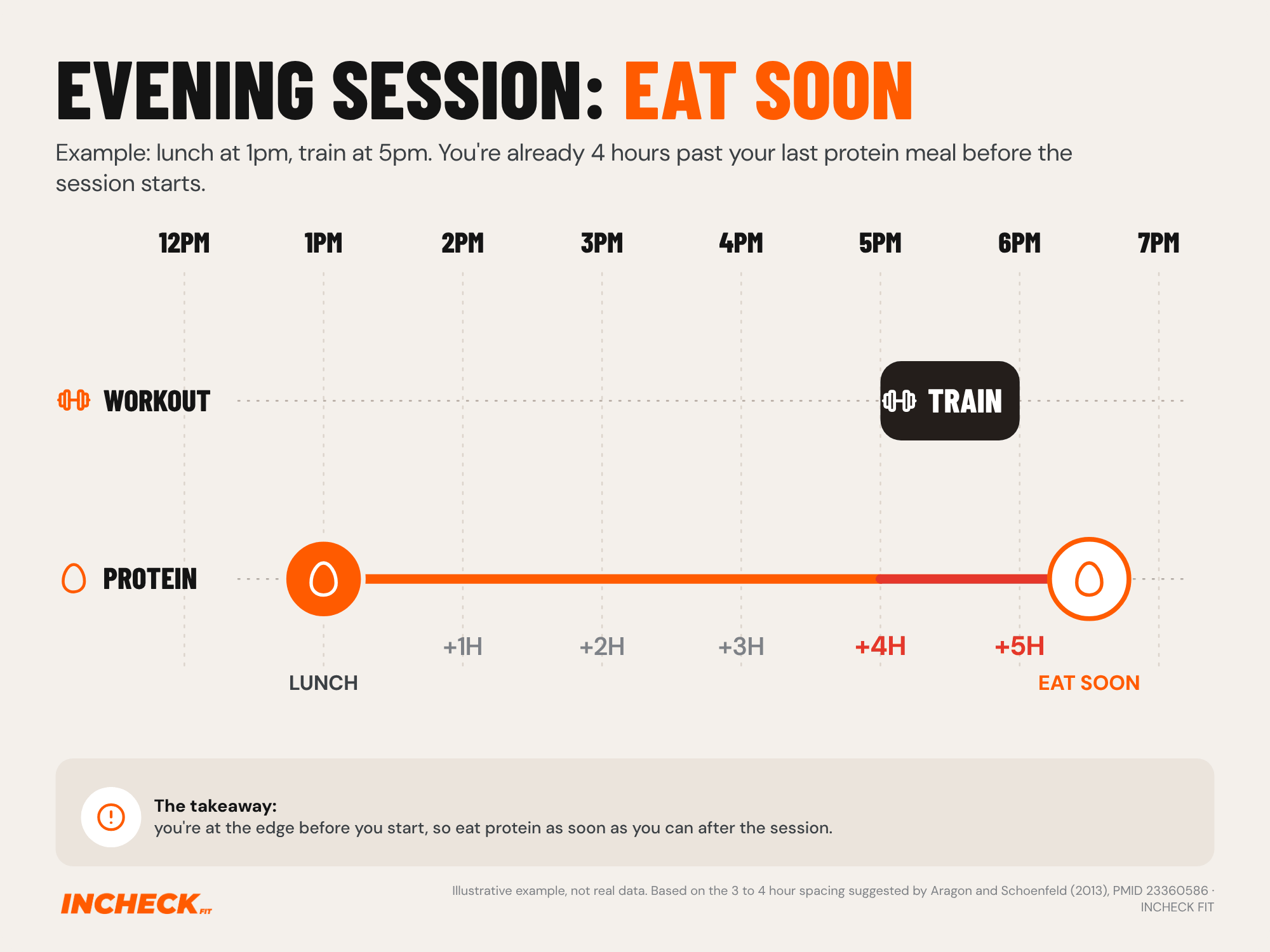
Now say you have lunch at 1pm and train at 5pm. You’re already 4 hours past your last protein meal before the session even starts. This is the situation where it makes sense to eat protein as soon as you can after the session.
Trained fasted: eat soon
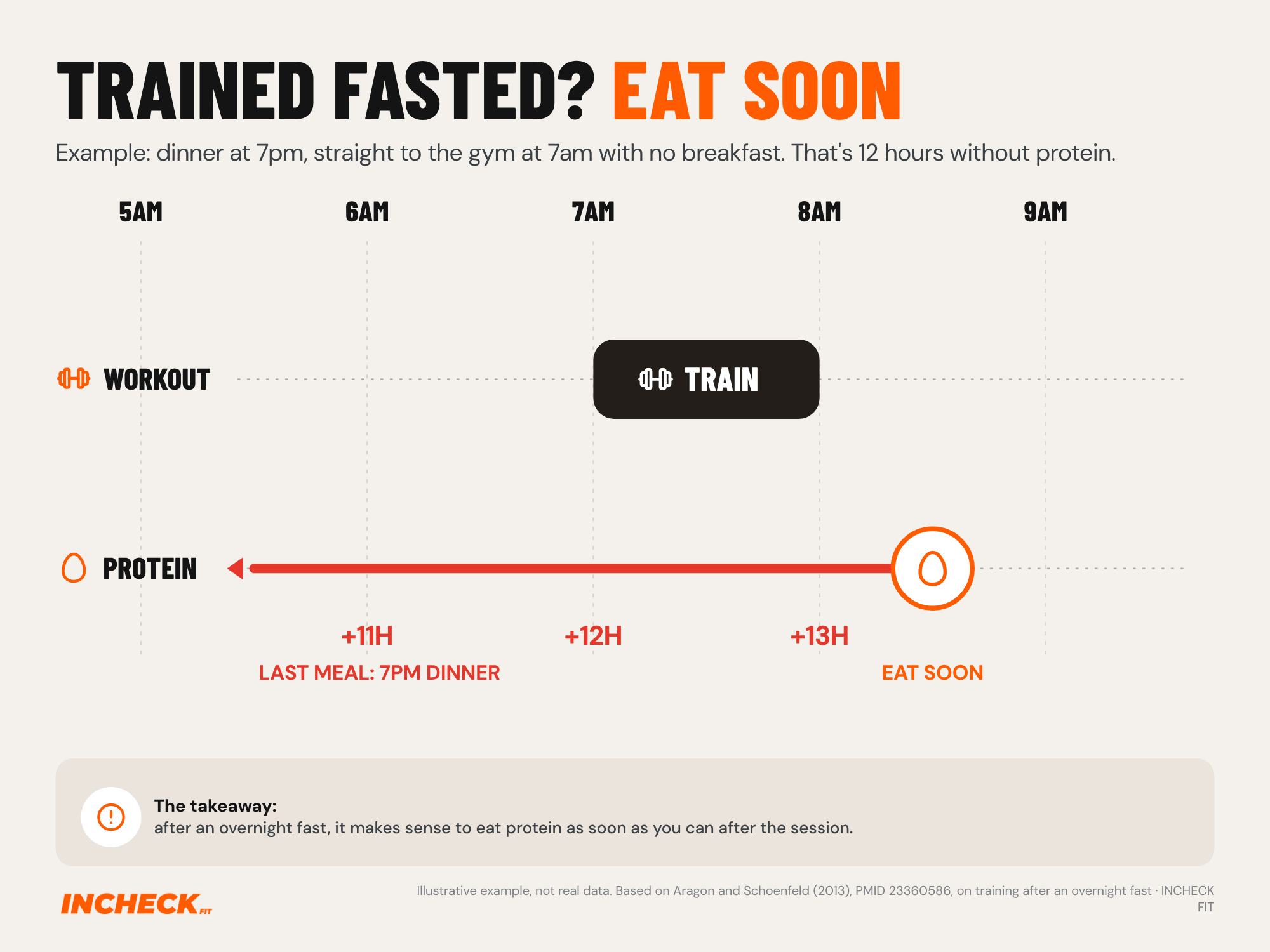
The original window idea was largely based on people training on an empty stomach. If you had dinner at 7pm and roll into the gym at 7am before eating anything that morning, that’s 12 hours without protein. The same 2013 review said that after training on an overnight fast, it makes sense to eat protein as soon as you can after the session. This is where the old advice still makes sense.
Should you have protein before or after a workout?
Either is fine, so pick what suits your stomach and your schedule. In the 2017 trial of 21 men who lifted weights, 25g of protein straight before or straight after training led to similar gains. The 2025 review of 5 studies that compared before versus after found no difference in lean mass.
That review did find one hint. For leg press strength, protein before training came out ahead. But when the researchers checked whether legs and upper body really responded differently, the result wasn’t strong enough to be sure, and they said more research is needed. Treat it as a maybe, not a rule.
There’s also a fair point on the other side. A large 2024 analysis combined 116 trials with 4,711 adults. Compared with people who took a dummy supplement with no protein, protein taken after exercise was the most effective timing for muscle mass. The authors said more trials comparing timings directly are needed. And the International Society of Sports Nutrition (ISSN) says the muscle-building effect of exercise lasts at least 24 hours, but likely fades the longer you wait.
Our take: eating protein around your session is a sensible habit, not a deadline. If your protein meals either side are within about 3 to 4 hours of each other, you’ve covered it.
Where timing may matter more: spreading protein across the day
There’s also research on a different kind of timing: how you split your protein through the day.
In a 2013 study, 24 trained men each had the same 80g of whey protein (the protein in most protein powders) over 12 hours after a workout, split three ways. The group that had 20g every 3 hours had a bigger response than the groups who had 10g every 90 minutes or 40g every 6 hours. Their response was 31 to 48% higher.
The study measured muscle protein synthesis, the process your body uses to build new muscle protein, over hours in a lab. It hints at muscle growth but isn’t the same thing.
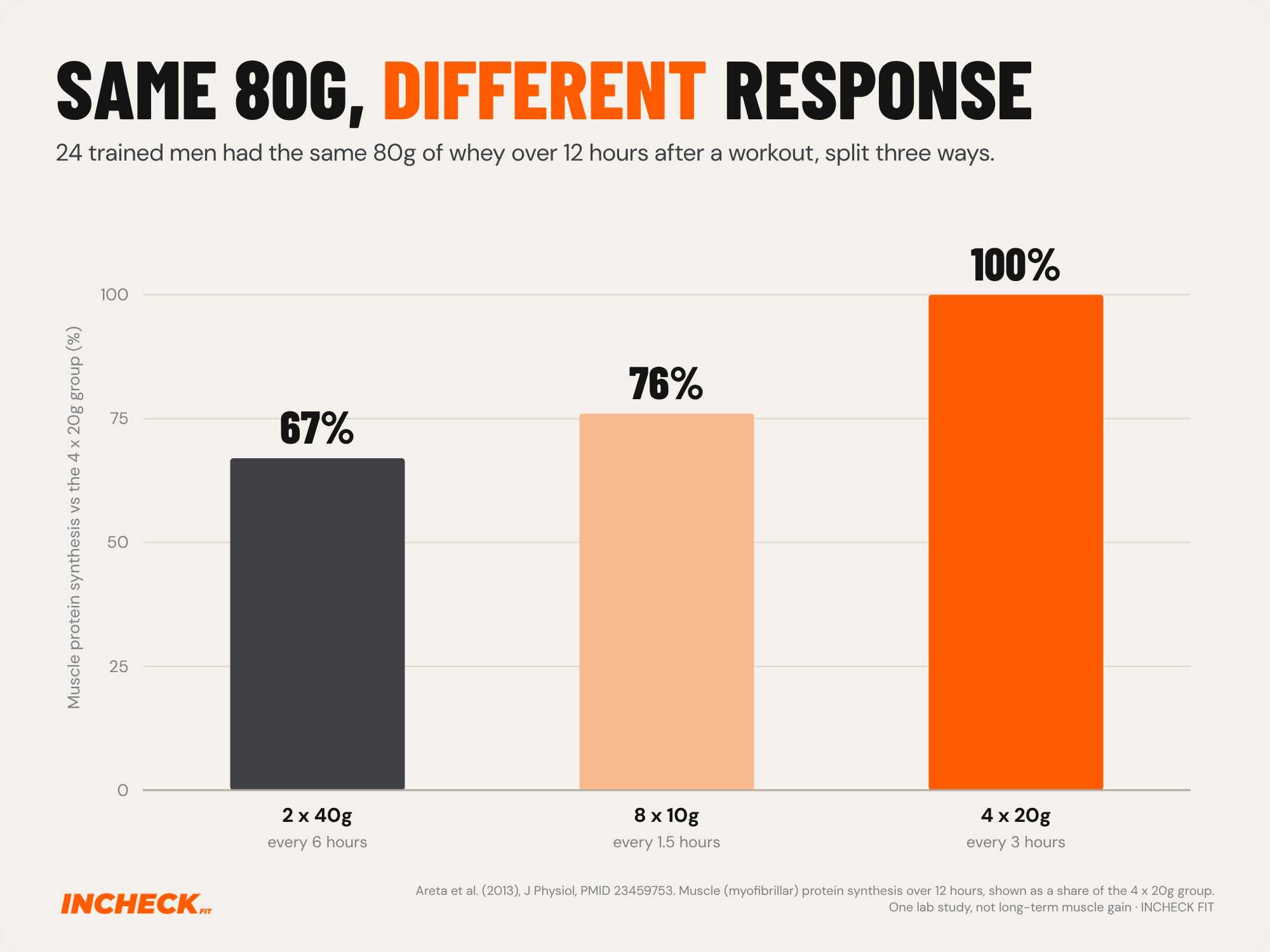
That was one lab study measuring muscle protein building over 12 hours, not muscle gained over months. But it lines up with the ISSN’s advice to spread protein evenly, every 3 to 4 hours. Our guide on how much protein per meal covers the per-meal side in more detail.
How much protein after a workout?
A normal protein-rich meal is usually enough. The ISSN’s general recommendation is about 0.25g of high-quality protein per kilo of body weight per serving, or 20 to 40g. It notes the best amount depends on age and recent training. For a 70kg person, 0.25g per kilo is about 18g, so a meal with 20 to 40g covers it.
Our take: you don’t need a special post-workout dose on top of your normal meals. Just make the meal after training a protein-rich one. Any meal or shake with 20 to 40g of protein does the job, for example a chicken stir-fry or a protein shake (check the label for the amount).
What to focus on first
If you want to get protein right, work through it in this order:
- Hit your daily total. For most people who exercise, the ISSN says 1.4 to 2.0g per kilo of body weight a day is enough. Our macro calculator can work out your number.
- Spread it out. Have a protein meal roughly every 3 to 4 hours through the day.
- Mind the gap around training. Keep the protein meals either side of a session within about 3 to 4 hours of each other.
- If you train fasted, or more than about 3 to 4 hours after your last protein meal, eat protein as soon as you can after the session. This is when the old advice still mostly applies.
If you’d rather not juggle the numbers, INCHECK FIT builds your weekly meal plan around your calorie and protein targets. If you’re losing fat at the same time, how much protein to lose fat covers the targets for a deficit, and can you build muscle in a calorie deficit covers what to expect.
Frequently asked questions
-
Is it better to drink protein before or after a workout? Either works. In a 2017 trial of 21 men who had been lifting weights for over a year, 25g of protein straight before or straight after training gave similar muscle and strength gains over 10 weeks. Pick whichever suits your schedule and stomach.
-
What is the 30 minute protein rule? It’s the idea that you need protein within 30 minutes of finishing a workout or you miss out on muscle gains. The research doesn’t support a window that narrow. A 2013 analysis of 23 trials found no significant timing effect once other differences between the trials, including total protein intake, were taken into account.
-
What is the 2 hour protein rule? People use it to mean eating protein within 2 hours of training. The International Society of Sports Nutrition notes that protein eaten from straight after to 2 hours after exercise strongly boosts muscle protein synthesis. That’s the short-term muscle-building process measured in lab studies. That’s a good habit, not a hard cut-off: a 2013 review suggests keeping your protein meals either side of training within about 3 to 4 hours of each other.
-
Is the anabolic window real? In a loose sense, yes. Training makes muscles more responsive to protein for a while, and the International Society of Sports Nutrition says that effect lasts at least 24 hours but likely fades over time. A narrow 30-minute window isn’t supported by the trials that tested timing directly.
-
Should I have a protein shake before or after a workout? Either is fine. Trials comparing protein before versus after training found similar results for muscle. A shake is just a convenient way to get 20 to 40g in, which is the per-serving amount the International Society of Sports Nutrition generally recommends.
-
What happens if I don’t eat protein after a workout? If you ate protein before training and your protein meals either side are within about 3 to 4 hours of each other, probably very little. In the 2017 trial of 21 trained men, the group who had their protein straight before training did as well as the group who had it straight after. Researchers suggest the gap between protein meals is more useful to watch than the minutes after your last set. If you trained fasted, or your last protein meal was more than about 3 to 4 hours before you started training, eat protein as soon as you can after the session.
-
Does it matter more if I train fasted? Probably. A 2013 review reasoned that after training on an overnight fast, it makes sense to eat protein as soon as you can after the session, ideally with some carbohydrate. That’s based on short-term lab measures, not long-term trials.
-
How much protein should I have after a workout? About 20 to 40g, or roughly 0.25g per kilo of body weight, is the general recommendation from the International Society of Sports Nutrition. Our take: a normal protein-rich meal covers it, so you don’t need extra on top of your usual meals.
References
- Aragon AA, Schoenfeld BJ. “Nutrient timing revisited: is there a post-exercise anabolic window?” Journal of the International Society of Sports Nutrition. 2013;10:5. PMID: 23360586. DOI: 10.1186/1550-2783-10-5. [Narrative review, human research. Full text read 4 Nov 2026 via Europe PMC (PMC3577439, through Firecrawl); no corrections listed.]
- Schoenfeld BJ, Aragon AA, Krieger JW. “The effect of protein timing on muscle strength and hypertrophy: a meta-analysis.” Journal of the International Society of Sports Nutrition. 2013;10:53. PMID: 24299050. DOI: 10.1186/1550-2783-10-53. [Meta-regression of randomised trials, human; hypertrophy analysis 525 people in 23 studies, strength analysis 478 people in 20 studies. Abstract verified 4 Nov 2026 via Europe PMC (through Firecrawl); one published comment (PMID 27777541), no corrections.]
- Schoenfeld BJ, Aragon A, Wilborn C, et al. “Pre- versus post-exercise protein intake has similar effects on muscular adaptations.” PeerJ. 2017;5:e2825. PMID: 28070459. DOI: 10.7717/peerj.2825. [Randomised trial, human, n=21 resistance-trained men, 10 weeks. Abstract verified 4 Nov 2026 via Europe PMC (through Firecrawl); a published correction exists (PMID 28785512), content not read.]
- Casuso RA, Goossens L. “Does Protein Ingestion Timing Affect Exercise-Induced Adaptations? A Systematic Review with Meta-Analysis.” Nutrients. 2025;17(13):2070. PMID: 40647175. DOI: 10.3390/nu17132070. [Systematic review and meta-analysis, human, 5 studies comparing protein before versus after training for at least 4 weeks. Abstract verified 4 Nov 2026 via Europe PMC (through Firecrawl); no corrections found.]
- Zhou HH, Liao Y, Zhou X, et al. “Effects of Timing and Types of Protein Supplementation on Improving Muscle Mass, Strength, and Physical Performance in Adults Undergoing Resistance Training: A Network Meta-Analysis.” International Journal of Sport Nutrition and Exercise Metabolism. 2024;34(1):54-64. PMID: 38039960. DOI: 10.1123/ijsnem.2023-0118. [Network meta-analysis, human, 116 trials, 4,711 adults. Abstract verified 4 Nov 2026 via Europe PMC (through Firecrawl); no corrections found.]
- Areta JL, Burke LM, Ross ML, et al. “Timing and distribution of protein ingestion during prolonged recovery from resistance exercise alters myofibrillar protein synthesis.” Journal of Physiology. 2013;591(9):2319-2331. PMID: 23459753. DOI: 10.1113/jphysiol.2012.244897. [Randomised trial, human, n=24 healthy trained men, 8 per group, 80g whey over 12 hours. Abstract verified 4 Nov 2026 via Europe PMC; group rates for the chart carried from the 3 Nov 2026 claims record; two published comments, no corrections.]
- Jäger R, Kerksick CM, Campbell BI, et al. “International Society of Sports Nutrition Position Stand: protein and exercise.” Journal of the International Society of Sports Nutrition. 2017;14:20. PMID: 28642676. DOI: 10.1186/s12970-017-0177-8. [Position stand. Abstract verified 4 Nov 2026 via Europe PMC (through Firecrawl); no corrections found.]
- Kerksick CM, Arent S, Schoenfeld BJ, et al. “International society of sports nutrition position stand: nutrient timing.” Journal of the International Society of Sports Nutrition. 2017;14:33. PMID: 28919842. DOI: 10.1186/s12970-017-0189-4. [Position stand. Abstract verified 4 Nov 2026 via Europe PMC (through Firecrawl); no corrections found.]
Last reviewed: November 2026