
A reverse dieting plan raises your calories in small weekly steps after a diet, until you reach maintenance (the calories that keep your weight steady). Early results from the first randomised trial of reverse dieting, in adults who lift weights, found it didn’t reduce weight regain compared with going straight to maintenance. In my coaching experience, its real use is making the move from dieting to maintenance feel calmer, which matters if eating more after a diet makes you anxious.
So I use it as a bridge, not a fix. The research is still thin: most of it is early results presented at conferences, plus studies of physique athletes after competition. Below is what reverse dieting is, what that research shows, what experts recommend, and the step-by-step method I use with clients.
What is reverse dieting?
Reverse dieting means slowly increasing your daily calories, in steps, after a period of eating in a calorie deficit (eating fewer calories than you burn). It’s best known from physique sport. A 2014 review of metabolic adaptation in athletes described it as popular among physique athletes, involving “slowly increasing caloric intake in a stepwise fashion”, in other words in small steps, to avoid rapid fat gain after a diet ends (Trexler et al., 2014). The same review said research was needed to test whether it works.
It’s common practice among coaches in physique sport. In a 2024 survey of weight loss coaches who work with natural bodybuilding athletes, presented at a sports nutrition conference, 84% said they use a reverse diet after a fat loss phase. On average, they added about 117 calories a day each week for women and about 169 for men, over about 9 weeks (Shelton et al., 2024). In a second survey by the same group, 66 coaches of natural athletes responded: 47 said they used reverse dieting to help build sustainable eating habits, and 27 said they had stopped a reverse diet because of trouble sticking to it.
It’s often pitched as a way to let a slowed metabolism “recover” before you reach full maintenance. As we’ll see, in the studies below the extra slowdown was modest, and it shrank once people ate more.
Does reverse dieting work?
It depends what you want it to do. Here’s what the research shows so far, in plain terms.
It didn’t reduce weight regain in the first trial
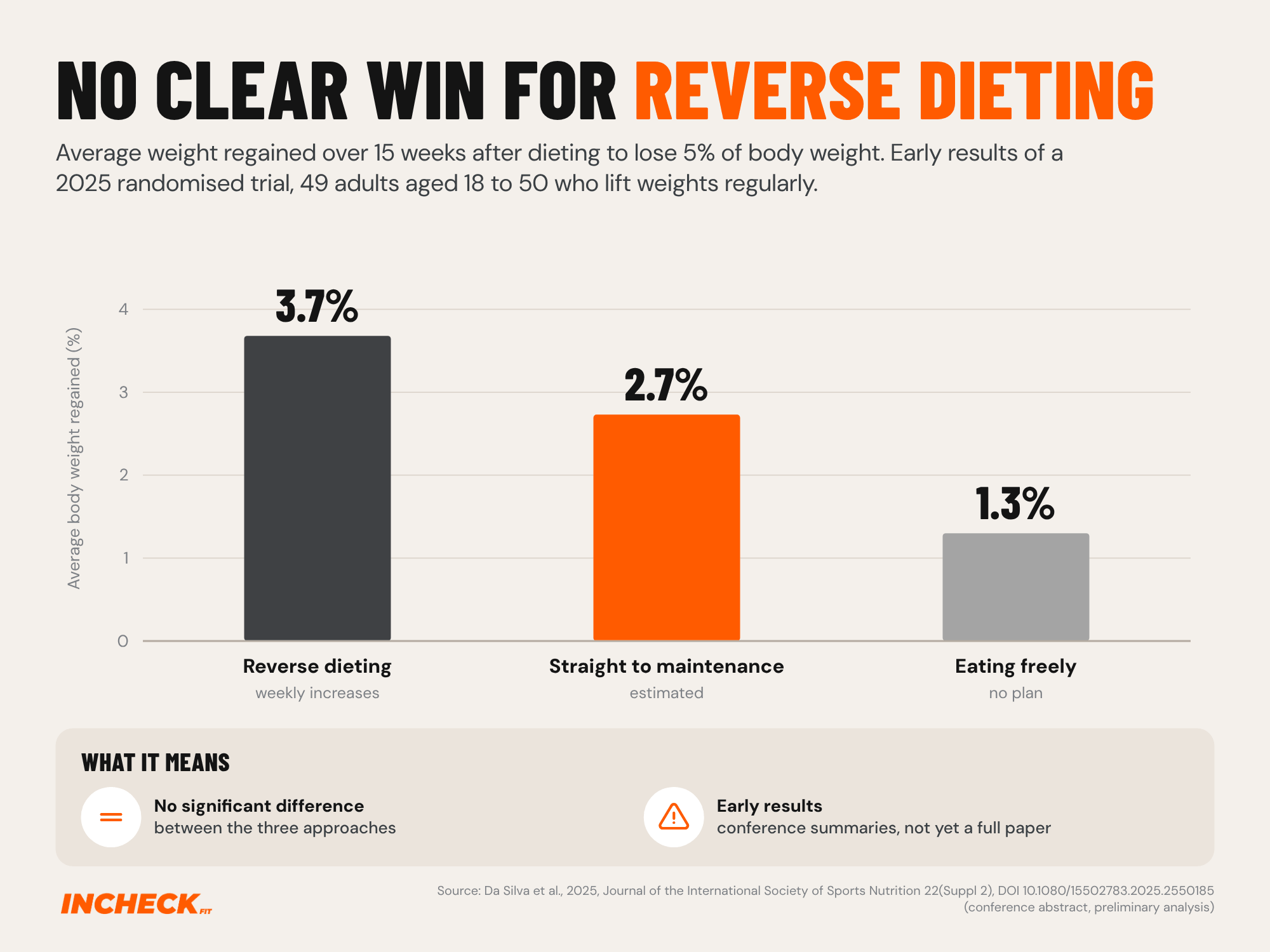
The first randomised trial of reverse dieting has so far been reported only as short summaries presented at a conference in 2025, not as a full paper. Different summaries from the trial analysed different numbers of people. Adults who lift weights regularly dieted to lose 5% of their body weight. They were then assigned by chance to one of three approaches for 15 weeks: reverse dieting with weekly calorie increases, going straight back to their estimated maintenance, or eating freely (Da Silva et al., 2025a).
In the 49 adults aged 18 to 50 analysed for weight, all three groups regained some weight on average, and no group on average regained the full 5% they’d lost. Regain averaged 3.68% of body weight with reverse dieting, 2.73% going straight to maintenance and 1.30% eating freely. The gaps between groups were small enough that they could be down to chance, and the authors concluded that reverse dieting “may not be more effective” at limiting regain (Da Silva et al., 2025a).
It changed how hungry people felt, both ways
The same trial asked 90 participants how they felt each week. The reverse dieting group, still eating less at first, reported more hunger and less fullness early on than the group that went straight to maintenance. Later, as their calories kept rising, they reported more fullness and less hunger than the other two groups, but found the plan harder to stick to in the final weeks (Monahan et al., 2025). The authors concluded that no single approach was best for everyone, and that the choice should follow what the person prefers.
Dropout rates also didn’t clearly differ between groups. Among 75 participants, mostly women, 45% of the reverse dieting group withdrew, against 30% going straight to maintenance and 24% eating freely, a difference that could be down to chance (Da Silva et al., 2025b). Both planned groups also ate less than they were prescribed.
The metabolic slowdown is modest, and it recovers when you eat more
Your body burns less energy after weight loss, partly because there’s less of you to fuel. It can also drop a little further than your new size predicts. This extra slowdown is called metabolic adaptation.
In a 2020 study, 71 adults with obesity ate 1,000 calories a day for 8 weeks. Straight afterwards, the calories they burned at rest were on average about 92 a day lower than predicted for their new size. After 4 more weeks of eating to hold their weight steady, the average gap was about 38 calories a day (Martins et al., 2020). In a subset of 45 people measured again at one year, it averaged about 7 calories a day, small enough that it could be down to chance.
Physique athletes, who diet much harder, show the same pattern. In a 2017 pilot study of 15 natural physique athletes, average calories burned at rest rose from 92% of the predicted level (about 8% below what their size predicts) in the week before competition to 105% within a week after it, as they ate more (Trexler et al., 2017). In a 2026 cohort study that followed 19 natural physique athletes after competition, an exploratory analysis found that those who increased their food more tended to see their resting metabolism recover faster, though fat was regained at the same time (Buechel et al., 2026b).
So eating more is what brings the slowdown back up; in the athlete study, bigger increases went with faster recovery. There’s more on this in does starvation mode exist.
Experts who work with physique athletes don’t favour it
In a 2026 Delphi consensus (a structured survey repeated in rounds until experts agree), 15 international bodybuilding and powerlifting experts, including coaches and dietitians, answered three rounds of questions. They did not favour reverse dieting after competition. Instead, they recommended “an initial acute energy increase followed by a gradual rate of gain”: a bigger first jump in food, then slower increases (Buechel et al., 2026a). The experts still disagreed on many details: all 21 statements that failed to reach agreement were about how to refeed after competition.
A 2022 scoping review (a map of what research exists) on recovery after physique contests found three approaches proposed: a gradual increase to maintenance, eating freely, or going straight to maintenance. It concluded that more research is needed to know which works best (Chica-Latorre et al., 2022).
These are athletes coming off extreme diets, not everyday dieters. But reverse dieting became popular with this group, and the experts who coach them did not favour it.
Why the scale goes up when you eat more
When you eat more, especially more carbs, your body refills its stored carbohydrate (glycogen). According to a 1992 paper on glycogen and weight change, each gram of glycogen is stored with about three to four grams of water (Kreitzman et al., 1992). So the scale often ticks up soon after you raise your calories. In my coaching experience, much of that early rise is extra food, stored carbs and their water, rather than fat.
This is where reverse dieting earns its place for some people. A small, expected rise is easier to live with than a sudden jump that feels like you’ve “undone” your diet. With clients, I tell them it’s coming before it happens. Here’s more on why the scale can jump overnight.
The real problem: coming off a diet is hard
Our take: the harder part after a diet is often appetite, not metabolism. In a 2011 study, 50 adults with overweight or obesity, without diabetes, started a 10-week very low-calorie diet. One year later, in those followed up, levels of several hunger-related hormones (including ghrelin and leptin), and their own hunger ratings, were still different from before the diet (Sumithran et al., 2011).
Regaining some weight is common. A study that pooled the results of 29 US weight loss programs, each followed for at least two years, found people kept off on average 29% of the weight they’d lost after very low-calorie diets and 17% after balanced low-calorie diets (Anderson et al., 2001). Five years on, the average person in those programs was still more than 3kg below their starting weight.
Our take: what decides how much you keep off is the routine you build at maintenance, not how slowly you add the calories back. Reverse dieting is useful when it makes that routine easier to settle into. It isn’t a way to lock in results on its own.
Do you need to reverse diet?
In my coaching experience, most people don’t. Going straight to your new maintenance is a reasonable choice: in early results from the first randomised trial, in adults who lift weights regularly, it did no worse than reverse dieting at limiting regain, and people felt less hungry than the reverse dieting group in the first two weeks, though hungrier later on (Da Silva et al., 2025a; Monahan et al., 2025). Work out your new maintenance with our calorie calculator, eat to it, and judge the weekly average of your morning weigh-ins over two to three weeks.
In my experience coaching, a reverse diet is worth it when:
- Eating more makes you anxious. Small steps make the change feel safe, and you can see how the scale responds at each one.
- You tend to overeat when a diet ends. A planned increase gives you more food straight away, without the “diet’s over” free-for-all.
- You’re not sure what your maintenance really is. Stepping up slowly, then checking your weigh-ins, lets you fine-tune the formula’s estimate.
The clients I coach are everyday dieters, not physique competitors coming off an extreme diet, so the expert advice for competitors (Buechel et al., 2026a) doesn’t map directly onto them. The shape of my approach is similar, though: I usually start with a slightly larger first step of about 10 to 12.5%, then increase more steadily, by about 5 to 7.5% a week. If coming off a diet feels hard to manage, or food and weight are taking up a lot of your headspace, a GP or an Accredited Practising Dietitian is the right person to help you plan it.
How to reverse diet: a step-by-step plan
This is the method I use with clients. It’s our coaching approach, not a protocol tested in a trial. The steps are percentages of what you’re eating now. For someone eating about 1,800 a day, a 10 to 12.5% first step is about 180 to 225 calories, and later steps of 5 to 7.5% are about 90 to 150 calories a week, close to the averages coaches reported in the 2024 survey (about 117 calories a day each week for women and 169 for men).
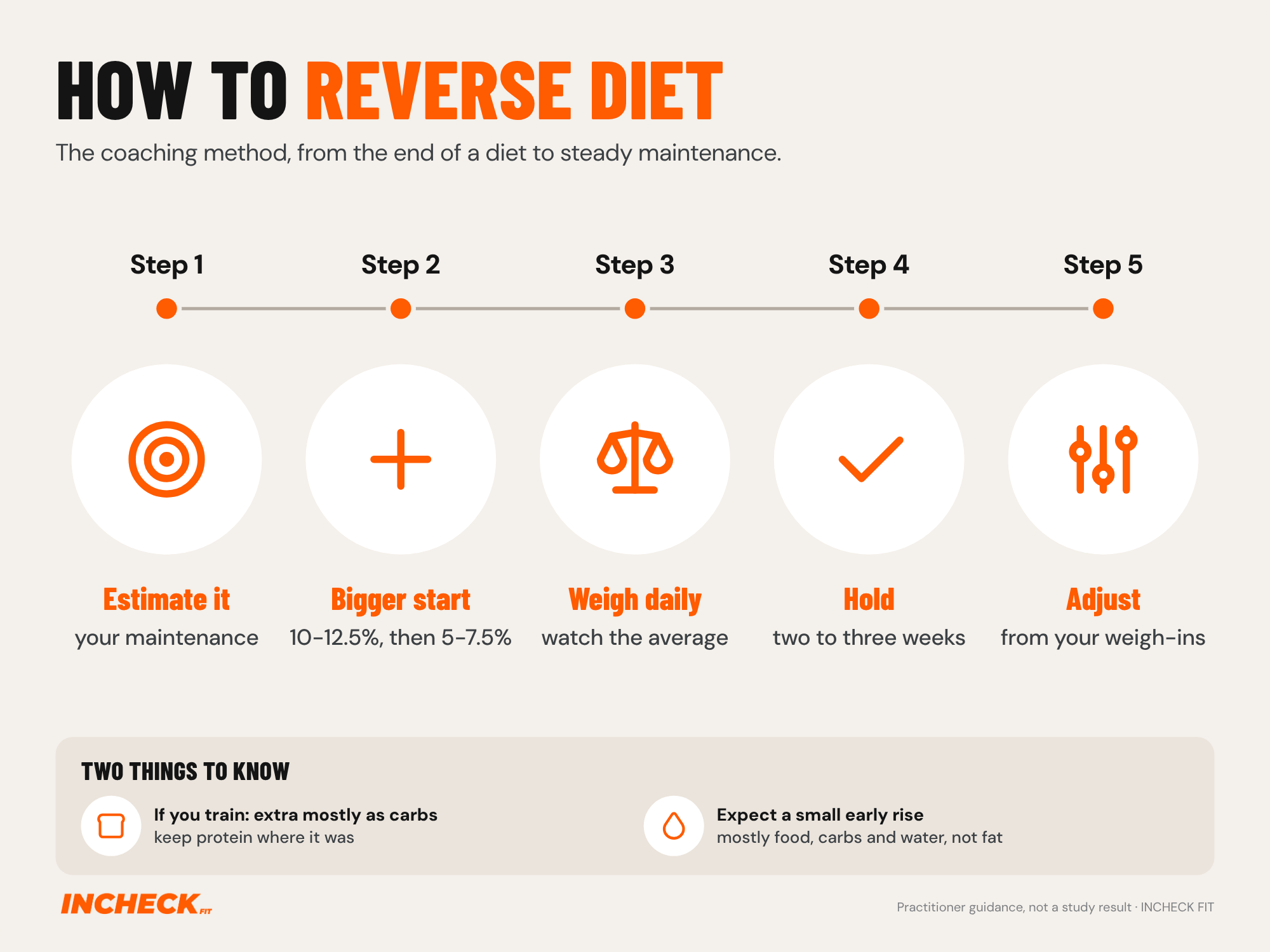
- Estimate your target. Estimate your new maintenance for your current weight. It will be lower than before your diet, because a smaller body uses less energy. Our calculator does this.
- Start with a first step of about 10 to 12.5% of what you’re eating now, then add about 5 to 7.5% each week after that. Keep your protein where it was. If you train, add the extra calories mostly as carbs, which fuel your sessions.
- Weigh in each morning and watch the weekly average. Expect a small rise in the first week or two. In my experience that’s mostly food and stored carbohydrate with its water, not fat.
- Stop at your estimated maintenance, then hold. Stop adding when you reach your estimated maintenance, then hold there. If your weekly average holds steady for two to three weeks, that’s your maintenance.
- Adjust from your own weigh-ins. If your weekly average keeps rising for two to three weeks at maintenance, your estimate is a little high, so bring it down slightly. If it keeps falling for two to three weeks, add a little more.
A worked example
Here’s how that looks for one person. It’s a worked example of the method, not a plan for you.
A 30-year-old woman who is 165cm, 65kg and moderately active has an estimated resting energy use of about 1,370 calories a day, using a standard formula (the Mifflin-St Jeor equation; Mifflin et al., 1990). Multiplied by a standard moderate-activity factor of 1.55, that gives an estimated maintenance of about 2,124. She’s been eating about 1,805 a day, a 15% deficit. With a slightly larger first step of about 10% (about 180 calories a day), she’d eat about 1,985 in week one. A second step of about 7% (about 140 calories) takes her to 2,124, her estimated maintenance, in week two.
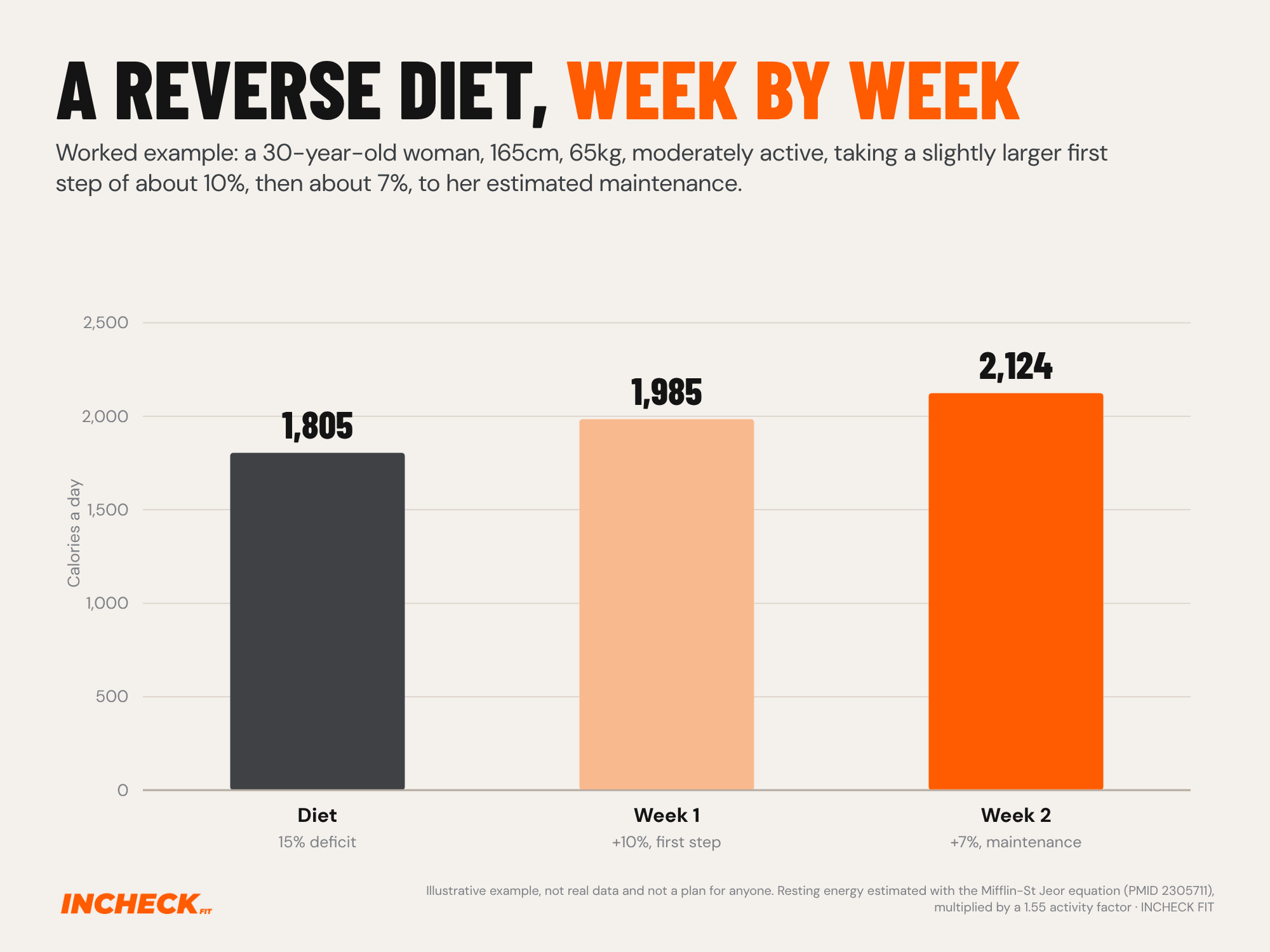
For her, the step-up phase takes two weeks, then two to three weeks of holding to confirm maintenance. Someone further below maintenance, or who wants smaller steps, would take longer.
Reverse dieting vs a diet break
A diet break is a different thing: a planned stretch at maintenance in the middle of a diet, before going back into a deficit. Reverse dieting is one way to finish a diet.
One well-known diet break trial is MATADOR. In it, 51 men with obesity were assigned by chance to 16 weeks of dieting, either in one continuous run or as two-week blocks of dieting alternating with two-week blocks at maintenance. In the reported results, the men taking breaks lost an average of 14.1kg against 9.1kg for those dieting continuously, including 12.3kg against 8.0kg of fat (Byrne et al., 2018). Of the 51 men, 36 completed the plan, and the break group’s diet took 30 weeks in total rather than 16.
That’s a finding about breaks during a diet, in men with obesity. It doesn’t mean eating more causes weight loss, and it says nothing about how to finish a diet.
Frequently asked questions
-
Can you lose weight by reverse dieting? Reverse dieting isn’t designed for weight loss. It raises your calories towards maintenance, so the goal is to hold your weight steady after a diet, not to keep losing. In early results from a 2025 randomised trial of 49 adults aged 18 to 50 who lift weights regularly and had dieted to lose 5% of body weight, all three groups regained some weight on average, with no significant difference between reverse dieting, going straight to maintenance and eating freely.
-
How long should reverse dieting take? It depends how far below maintenance you are and how big your steps are. With our coaching approach, a first step of about 10 to 12.5%, then about 5 to 7.5% each week, someone eating 15% under maintenance would reach it in about two steps (two weeks), for example about 10% then about 7%. In a 2024 conference survey of weight loss coaches who work with natural bodybuilding athletes, the average reverse diet lasted about 9 weeks. Our coaching approach is then to hold at your estimated maintenance; if your weekly average holds steady for two to three weeks, that’s your maintenance.
-
Is reverse dieting pointless? In my coaching experience it’s not pointless, but often unnecessary. In early results from a 2025 randomised trial in adults who lift weights regularly, it didn’t reduce regain compared with going straight to maintenance, and a 2026 consensus of 15 bodybuilding and powerlifting experts didn’t favour it after competition. Our take is that it’s useful for people who feel anxious eating more after a diet, because small steps make the change easier to trust.
-
What do you eat on a reverse diet? The same foods you ate while dieting, just more of them. Our coaching approach is to keep protein where it was and, if you train, add most of the extra calories as carbs, which fuel your sessions. There’s no special reverse dieting food.
-
How many calories should I increase in a reverse diet? Our coaching approach is a first step of about 10 to 12.5% of what you’re eating now, then about 5 to 7.5% each week. For someone eating about 1,800 a day, that’s about 180 to 225 calories, then about 90 to 150. In a 2024 conference survey of weight loss coaches who work with natural bodybuilding athletes, the average was about 117 calories a day each week for women and about 169 for men. Stop adding when you reach your estimated maintenance, then hold there; if your weekly average holds steady for two to three weeks, that’s your maintenance.
-
Will I gain fat when I reverse diet? Expect a small rise in the first week or two; in my experience that’s mostly food and stored carbohydrate with its water, not fat. Some fat regain is possible too: in studies of physique athletes, fat was regained in the weeks after competition as they ate more. According to a 1992 paper on glycogen, each gram of stored carbohydrate holds about three to four grams of water. If your weekly average keeps rising for two to three weeks at maintenance, your estimate is a little high, so bring it down slightly.
-
Is reverse dieting the same as a diet break? No. A diet break is a planned stretch at maintenance in the middle of a diet, before going back into a deficit. Reverse dieting is a gradual way to finish a diet and settle at maintenance.
-
Do I need to reverse diet after a calorie deficit? In my coaching experience, most people don’t. Going straight to your new maintenance is a reasonable choice: in early results from a 2025 randomised trial in adults who lift weights regularly, it did no worse than reverse dieting at limiting regain. In my experience, a reverse diet suits people who feel anxious about eating more or tend to overeat when a diet ends.
References
- Trexler ET, Smith-Ryan AE, Norton LE. “Metabolic adaptation to weight loss: implications for the athlete.” Journal of the International Society of Sports Nutrition. 2014;11(1):7. PMID: 24571926. DOI: 10.1186/1550-2783-11-7. [Narrative review. Describes reverse dieting as popular among physique athletes and states that research is needed to evaluate its efficacy. Read 2 Nov 2026 via the Europe PMC REST API; no corrections linked.]
- Shelton G, Ayers-Creech WA, Blanke S, et al. “Defining ‘reverse dieting’: a quantitative survey of post diet strategies among weight loss coaches for natural bodybuilding athletes”, and Shelton G, Ayers-Creech WA, Wu D, et al. “Defining ‘reverse dieting’: a qualitative survey of post diet strategies among weight loss coaches for natural athletes.” In: Proceedings of the Twenty-First International Society of Sports Nutrition (ISSN) Conference and Expo. Journal of the International Society of Sports Nutrition. 2024. PMID: 40678833. DOI: 10.1080/15502783.2024.2374669. [Conference abstracts, online surveys of coaches. Quantitative: 84% of coaches used a reverse diet; average weekly increase 116.7 kcal/day (females) and 169.1 kcal/day (males), mean 8.7 weeks; 74% reduced cardio or steps. Qualitative: 66 responses; 47 cited sustainable eating habits; 27 reported clients stopping for adherence; 10 reported increased body fat. Full text read 2 Nov 2026 via the Europe PMC REST API (PMC11229765).]
- Da Silva VR, Muniz M, Shelton G, et al. “The effects of reverse dieting on mitigating weight regain after a caloric deficit: a preliminary analysis.” Journal of the International Society of Sports Nutrition. 2025;22(Suppl 2):2550185. DOI: 10.1080/15502783.2025.2550185. PMCID: PMC12381988. [Conference abstract (preliminary analysis), randomised parallel-group, human, n=49 resistance-trained men and women aged 18 to 50; diet to lose 5% of body weight, then 15 weeks of reverse dieting (weekly increases of 8.5% for men, 11.7% for women), immediate return to estimated maintenance, or ad libitum control; regain 3.68% vs 2.73% vs 1.30%, no significant difference (p = 0.053). No PMID. Full text read 2 Nov 2026 via the Europe PMC REST API; not retracted. Cited in text as Da Silva et al., 2025a.]
- Monahan S, Da Silva VR, Atehortua S, et al. “Qualitative insights into post-dieting strategies: reverse dieting, maintenance, and ad libitum approaches following caloric restriction: a preliminary analysis.” Journal of the International Society of Sports Nutrition. 2025;22(Suppl 2):2550189. DOI: 10.1080/15502783.2025.2550189. PMCID: PMC12381969. [Conference abstract, same randomised trial, n=90 (35 reverse, 31 maintenance, 24 ad libitum), weekly 12-item survey; reverse dieting more hunger early (weeks 1 to 2 vs maintenance), more fullness later (weeks 5 to 15 vs ad libitum, 8 to 15 vs maintenance) and less hunger later (weeks 6 to 15 vs ad libitum, 8 to 15 vs maintenance); ease of sticking to the plan lower than maintenance in weeks 14 to 15 and ad libitum in weeks 10 to 15. Full text read 2 Nov 2026 via the Europe PMC REST API.]
- Da Silva VR, Holtje J, Bratton A, et al. “Adherence and compliance rates across post-dieting strategies: a preliminary analysis.” Journal of the International Society of Sports Nutrition. 2025;22(Suppl 2):2550186. DOI: 10.1080/15502783.2025.2550186. PMCID: PMC12381968. [Conference abstract, same randomised trial, n=75 (86.7% female); withdrawal 45.2% reverse, 30.4% maintenance, 23.8% ad libitum, no significant difference (p = 0.2488); both prescribed groups under-ate their prescription. Full text read 2 Nov 2026 via the Europe PMC REST API. Cited in text as Da Silva et al., 2025b.]
- Martins C, Roekenes J, Salamati S, Gower BA, Hunter GR. “Metabolic adaptation is an illusion, only present when participants are in negative energy balance.” American Journal of Clinical Nutrition. 2020;112(5):1212-1218. PMID: 32844188. DOI: 10.1093/ajcn/nqaa220. [Human study, n=71 adults with obesity, 1,000 kcal/day for 8 weeks then 4 weeks of weight stabilisation; resting metabolic rate only; adaptation -92 kcal/day at week 9 and -38 at week 13; subset n=45, -7 kcal/day at 1 year (not significant). Abstract read 2 Nov 2026 via the Europe PMC REST API; three published comments, no errata.]
- Trexler ET, Hirsch KR, Campbell BI, Smith-Ryan AE. “Physiological changes following competition in male and female physique athletes: a pilot study.” International Journal of Sport Nutrition and Exercise Metabolism. 2017;27(5):458-466. PMID: 28422530. DOI: 10.1123/ijsnem.2017-0038. [Pilot study, human, 15 natural physique athletes (7 male, 8 female); resting metabolic rate 1,612 kcal/day (92.0% of predicted) within a week before competition, 1,881 (105.3%) within a week after, 1,778 (99.6%) at 4 to 6 weeks; fat mass preferentially regained by 4 to 6 weeks. Abstract read 2 Nov 2026 via the Europe PMC REST API; no corrections linked.]
- Buechel C, Pumpa K, Etxebarria N, et al. “Post-competition recovery in natural physique athletes: body composition, metabolic adaptation, and refeeding responses.” Journal of the International Society of Sports Nutrition. 2026;23(1):2676190. PMID: 42175739. DOI: 10.1080/15502783.2026.2676190. [Prospective cohort, human, 19 natural physique athletes (8 male, 11 female), measured through contest preparation and 12 weeks of recovery; exploratory modelling: larger post-competition increases in energy intake associated with greater recovery of adjusted resting metabolic rate, with fat mass regained concurrently. Abstract read 2 Nov 2026 via the Europe PMC REST API; no corrections linked. Cited in text as Buechel et al., 2026b.]
- Buechel C, Pumpa K, Etxebarria N, Minehan M. “Expert consensus on weight management strategies for strength and physique athletes before and after competition.” Journal of Strength and Conditioning Research. 2026;40(2):e155-e163. PMID: 41549835. DOI: 10.1519/jsc.0000000000005295. [Delphi consensus, 15 international bodybuilding and powerlifting experts (coaches and dietitians), 3 rounds; “Reverse dieting was not favored, with experts recommending an initial acute energy increase followed by a gradual rate of gain”; the 21 statements that failed consensus all concerned post-competition refeeding. Abstract read 2 Nov 2026 via the Europe PMC REST API. Cited in text as Buechel et al., 2026a.]
- Chica-Latorre S, Buechel C, Pumpa K, Etxebarria N, Minehan M. “After the spotlight: are evidence-based recommendations for refeeding post-contest energy restriction available for physique athletes? A scoping review.” Journal of the International Society of Sports Nutrition. 2022;19(1):505-528. PMID: 35966021. DOI: 10.1080/15502783.2022.2108333. [Scoping review, 12 peer-reviewed articles; three proposed strategies (gradual increase to maintenance, ad libitum, immediate return to maintenance); future research required to determine which best supports recovery. Abstract read 2 Nov 2026 via the Europe PMC REST API.]
- Kreitzman SN, Coxon AY, Szaz KF. “Glycogen storage: illusions of easy weight loss, excessive weight regain, and distortions in estimates of body composition.” American Journal of Clinical Nutrition. 1992;56(1 Suppl):292S-293S. PMID: 1615908. DOI: 10.1093/ajcn/56.1.292S. [Short supplement paper with human data. Glycogen is stored in hydrated form, three to four parts water. Abstract read 2 Nov 2026 via the Europe PMC REST API; no corrections linked.]
- Sumithran P, Prendergast LA, Delbridge E, et al. “Long-term persistence of hormonal adaptations to weight loss.” New England Journal of Medicine. 2011;365(17):1597-1604. PMID: 22029981. DOI: 10.1056/NEJMoa1105816. [Human clinical study, 50 adults with overweight or obesity without diabetes, 10-week very low energy diet, measured at baseline, week 10 and week 62; at one year several appetite hormones and hunger still differed significantly from baseline. Number analysed at one year not confirmed. Abstract read 2 Nov 2026 via the Europe PMC REST API; three published letters, no errata.]
- Anderson JW, Konz EC, Frederich RC, Wood CL. “Long-term weight-loss maintenance: a meta-analysis of US studies.” American Journal of Clinical Nutrition. 2001;74(5):579-584. PMID: 11684524. DOI: 10.1093/ajcn/74.5.579. [Meta-analysis of 29 US structured weight loss programs with at least 2 years of follow-up; 29% (very low energy diets) and 17% (balanced low-calorie diets) of weight loss maintained; more than 3kg maintained at five years. Abstract read 2 Nov 2026 via the Europe PMC REST API; no corrections linked.]
- Byrne NM, Sainsbury A, King NA, Hills AP, Wood RE. “Intermittent energy restriction improves weight loss efficiency in obese men: the MATADOR study.” International Journal of Obesity. 2018;42(2):129-138. PMID: 28925405. DOI: 10.1038/ijo.2017.206. [RCT, human, 51 men with obesity randomised (47 started, 36 completed per protocol); 16 weeks of restriction at 67% of maintenance, continuous or in 2-week blocks alternating with 2-week blocks at energy balance (30 weeks total); weight loss 14.1 vs 9.1kg, fat mass 12.3 vs 8.0kg. Abstract read 2 Nov 2026 via the Europe PMC REST API; no corrections linked.]
- Mifflin MD, St Jeor ST, Hill LA, Scott BJ, Daugherty SA, Koh YO. “A new predictive equation for resting energy expenditure in healthy individuals.” American Journal of Clinical Nutrition. 1990;51(2):241-247. PMID: 2305711. DOI: 10.1093/ajcn/51.2.241. [Equation development study, human, n=498 healthy adults aged 19 to 78; estimates resting energy expenditure, the basis of the worked example. PMID, DOI and sample carried from the verified reference list of the published calorie deficit article (25 Sep and 27 Oct 2026), not re-read this session.]
Search: Europe PMC, “reverse dieting” OR “reverse diet” (230 results) and physique or bodybuilding athletes after competition or refeeding (242 results), all screened 2 November 2026. ClinicalTrials.gov and web searches were also checked. A 2016 observational feasibility study of 3 male powerlifters is registered (ClinicalTrials.gov NCT03434431), but no results are posted there or published in an indexed journal, so it isn’t included.
Last reviewed: November 2026