The best weight loss app for women is one that sets targets from your own body and that you’ll keep using, not one with “for women” in its name. The basics are the same for women and men: a steady calorie deficit (eating fewer calories than you burn), enough protein and some strength training. A review that pooled 49 higher-quality weight loss trials found little evidence that women and men need different weight loss strategies (Williams et al., 2015).
What differs is the numbers. Women usually need fewer calories, so the same deficit is a bigger share of the day. Weight can also move with the menstrual cycle, and the mix of fat and lean mass shifts in the years around menopause. So the useful question isn’t which app is made for women. It’s which app gets those numbers right and asks for an amount of daily effort you’ll keep up. Below we cover what differs for women, then compare seven apps marketed to women or built around meal plans and workouts, on what they do and what they cost in AUD.
A note before you read: INCHECK FIT is our app, and it’s one of the apps below. We’ve described every app, including ours, by what it actually does, using each app’s Australian App Store page and, where we checked it, its website, on 2 November 2026. INCHECK FIT’s details are from our own product information. For the calorie trackers (MyFitnessPal, MacroFactor and others), see our main comparison of the best apps to lose weight further down.
Do women need a different weight loss app?
Not really. A systematic review (a study that pools the results of many trials) synthesised 49 higher-quality weight loss trials. It found small differences in weight loss favouring men, for both diet and diet-plus-exercise programs. The authors found little evidence that men and women should use different weight loss strategies (Williams et al., 2015).
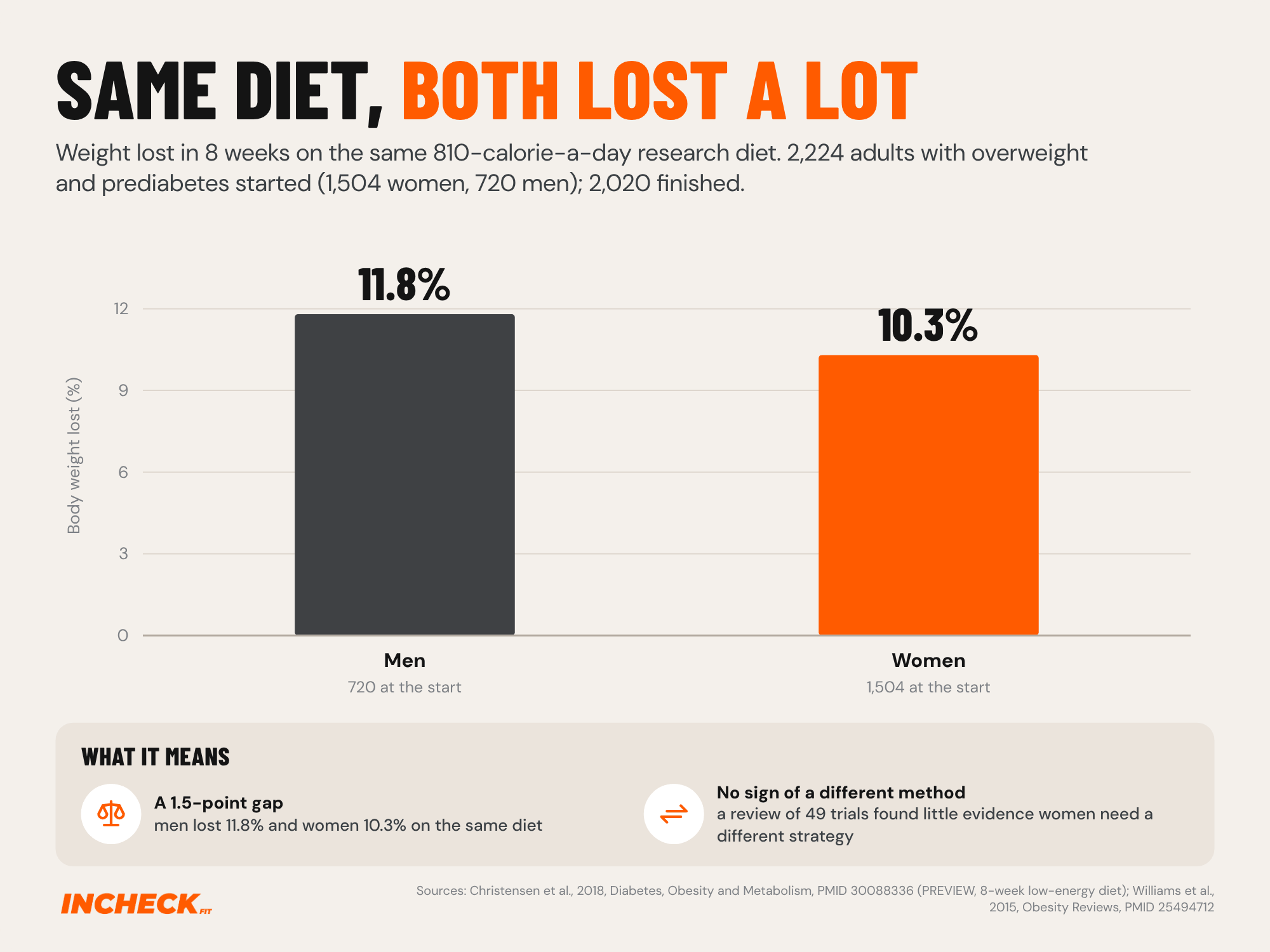
One large example comes from the PREVIEW study. There, 2,224 adults with overweight and prediabetes (1,504 women and 720 men) started the same 8-week, 810-calorie-a-day diet, and 2,020 finished it. Men lost 11.8% of their body weight and women lost 10.3% (Christensen et al., 2018). That was a research diet run by a study team, not something to try on your own. Even after taking into account that men lost more weight, women in that study lost a bigger share of fat-free mass (everything that isn’t fat, including muscle and water).
Our take: you don’t need a different method. You need the method set up for your body, which is mostly about the numbers below.
What actually differs for women
Your calorie target is usually lower
A common way to estimate your daily calorie needs is the Mifflin-St Jeor equation, built in 1990 from measurements of 498 healthy adults aged 19 to 78 (Mifflin et al., 1990). For the same height, weight and age, the women’s version comes out 166 calories a day lower at rest than the men’s. The equation also uses height and weight, so a smaller body gets a lower estimate again.
That matters because a deficit that feels easy for a larger man can be steep for a smaller woman. Here’s a worked example of the maths, not a target for anyone. A 30-year-old woman who is 165cm, 65kg and moderately active has estimated maintenance (the calories that keep her weight steady) of about 2,124 calories a day. A 15% deficit puts her at about 1,805. A man with the exact same stats would sit at about 2,381, and his 15% deficit would be about 2,024.
Our take: set your deficit as a percentage of your own maintenance, not a fixed number like “1,500 calories” that you saw somewhere. As a coaching rule, we suggest not going below about 1,200 calories a day for women without support from a GP or dietitian. It’s a floor, not a goal, and most women won’t need to get near it. That figure is the lower end of the daily range a 2013 US guideline suggests for women with overweight or obesity who are losing weight (Jensen et al., 2014). Our calorie deficit calculator does the maths for you.
Your protein target is set per kilo
Our take: protein is one of the main ways to hold on to muscle while you lose fat. For people who exercise, the International Society of Sports Nutrition recommends 1.4 to 2.0g of protein per kg of body weight a day (Jäger et al., 2017). For fat loss, our coaching standard is about 1.7g per kg for women. For a 65kg woman, that’s about 110g a day. A good app gives you a protein number based on your weight, not a generic one. Here’s more on how much protein to eat to lose fat.
Your weight can move with your cycle
The scale can read a little higher around your period. In a 2023 study that measured 42 women twice a week across one cycle, body weight was about 0.45kg higher during menstruation, which the authors linked to a 0.474kg rise in water outside the cells, not fat (Kanellakis et al., 2023). A separate year-long diary study of 62 healthy women found that self-reported fluid retention peaked on the first day of the period (White et al., 2011).
Our take: judge progress on your weekly average weight over two to three weeks, and if your cycle is regular, compare the same point in each cycle. An app that adjusts your targets off a single weigh-in can cut calories for no reason. Here’s more on why your weight can go up overnight.
Your body composition shifts in the menopause transition
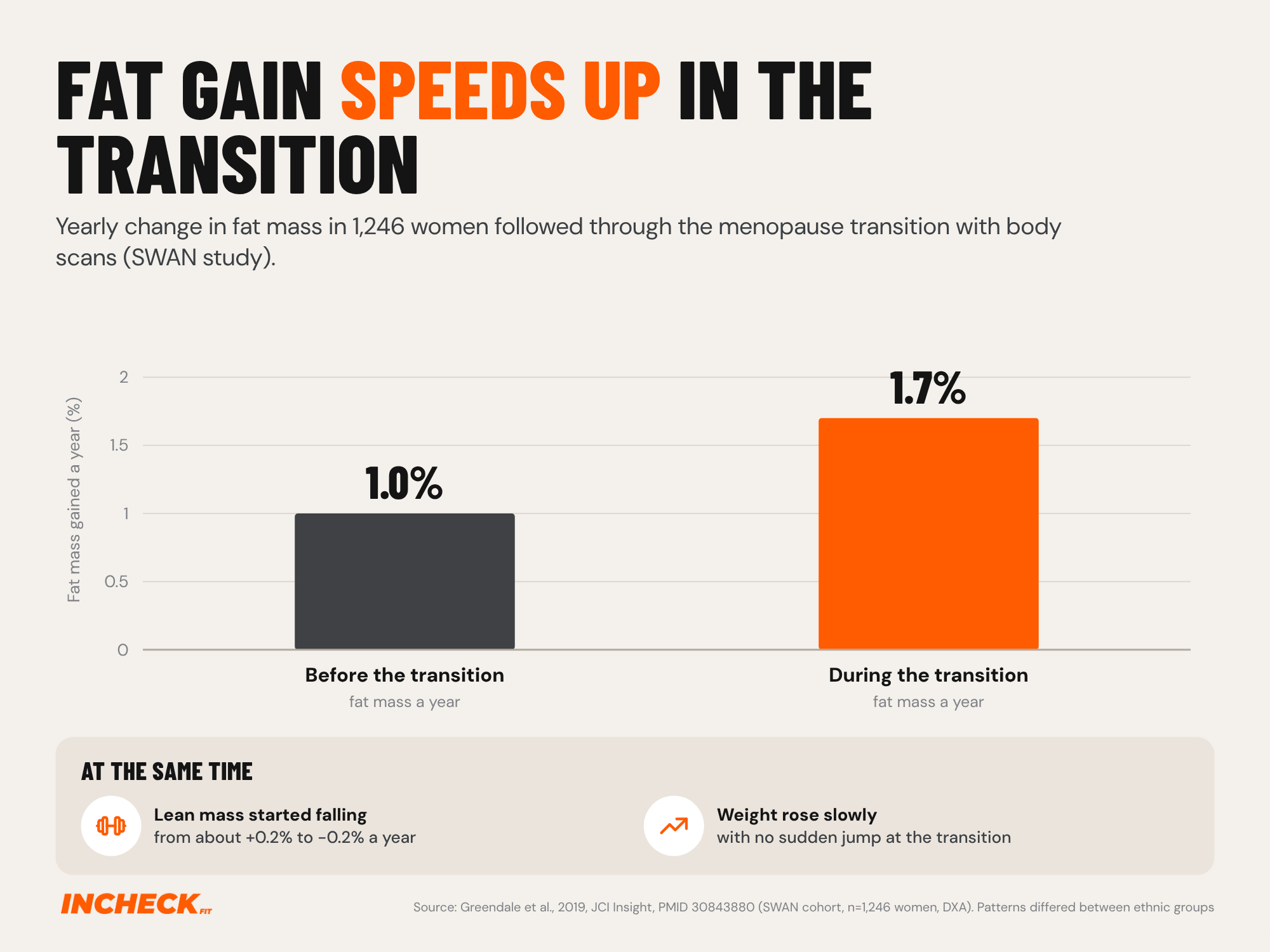
The menopause transition is the years around your last period. In the SWAN study, which followed 1,246 women through menopause with body scans, the transition changed the mix of fat and lean mass more than the pace of weight gain. The rate of fat gain sped up at the start of the transition, from about 1.0% to 1.7% of fat mass a year, and lean mass, which includes muscle, started falling at about 0.2% a year (Greendale et al., 2019). In those women, weight itself kept climbing slowly, with no sudden jump. These patterns differed between ethnic groups in the study.
Our take: strength training is the part you can most control. In a small trial of 16 postmenopausal women with overweight (average age about 68) on the same 500-calorie-a-day deficit for 16 weeks, the 8 who did strength training 3 days a week kept their fat-free mass (down 0.3kg, which the authors counted as unchanged). The 8 who didn’t lost about 1.6kg of it (Campbell et al., 2009). Weight loss was 5.0kg with strength training and 5.8kg without. A separate meta-analysis of 26 observational studies in 745 healthy postmenopausal and older women aged 50 to 80, who were not dieting, found small-to-moderate gains in lean mass from strength training (Thomas et al., 2021).
Perimenopause and menopause symptoms, and any medication for them or for weight, are a conversation for your GP. We don’t give medical advice, and no app replaces that conversation.
Weight loss apps compared for women
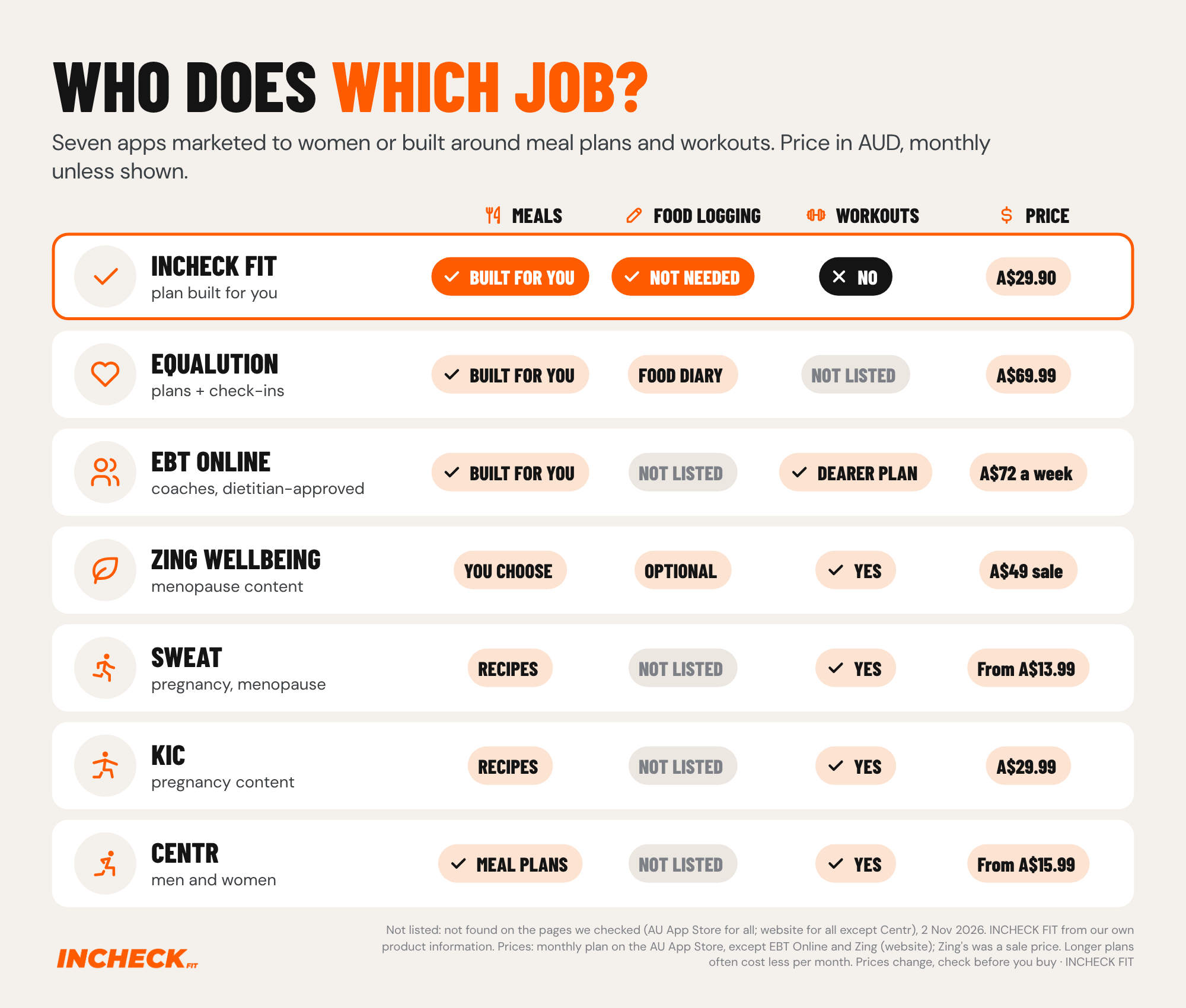
Prices below are in AUD from each app’s Australian App Store page or website on 2 November 2026. They change often, and several apps were running sales that day, so check before you buy. “Not listed” means we couldn’t find it on the pages we checked.
INCHECK FIT
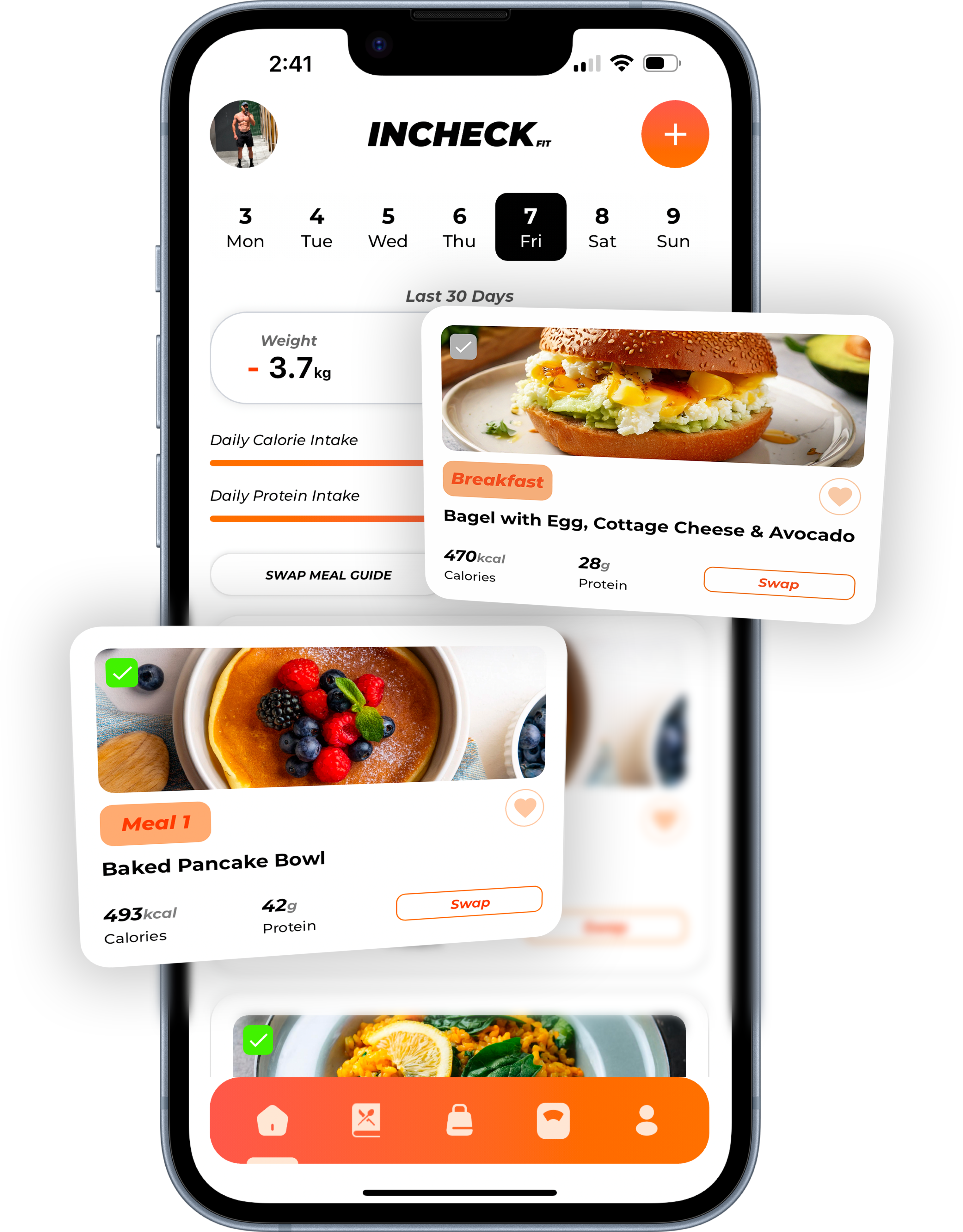
What it does: INCHECK FIT builds you a weekly meal plan to your calorie and protein targets, with quantities for each meal, from more than 500 recipes. You can swap any meal, your shopping list is built automatically, and each week it reviews your progress and adjusts your targets. That review isn’t based on a single weigh-in, so one heavy morning around your period doesn’t throw your plan out. You don’t log meals; you follow the plan. You do still weigh or measure your food to the amounts the plan gives you.
Price: A$29.90 a month, with a 7-day free trial.
Less good for: there are no workouts, no human coach and no cycle or menopause content. It’s newer, with far fewer reviews than the established apps.
Best for: women who know roughly what to do but find the daily decisions and logging are what make them stop.
Equalution (equ app)
What it does: equ describes itself as “made for real women and real results”. It gives you meal plans built for you: its website says up to three tailored meal plans a week, while its App Store listing says one full-day meal plan a week. You keep a food diary, helped by a photo scanner, and do a weekly check-in with chat support. We couldn’t find workouts listed.
Price: A$69.99 a month on the Australian App Store after a 7-day free trial. Its website lists A$69 a month, or from A$49 a month on a six-month plan.
Best for: women who want planned meals with more check-in support, and don’t mind tracking.
EBT Online
What it does: EBT Online is a coaching service with an app. Each fortnight you get two personalised single-day meal plans approved by dietitians, with check-ins with a coach every fortnight. The dearer plan adds a training program. It isn’t marketed to women specifically, but its website lists pregnancy and breastfeeding among the goals it coaches for.
Price: A$72 a week for nutrition only, or A$95 a week with training, billed weekly with an 8-week minimum, according to its website.
Best for: women who want coach check-ins and dietitian-approved plans, and have the budget.
Zing Wellbeing
What it does: Zing describes itself as a “women’s only health and wellness program”. It has recipes, a library of meal plans you choose and customise, on-demand workouts, mental wellbeing programs and a women-only support group. Of the apps here, it lists the most menopause features: a menopause meal plan, a menopause hub and a menopause filter on its workouts. It also has PCOS and “hormone balancing” meal plans. A calorie tracker was added to its recipes tab, and the company sells supplements alongside the program. We couldn’t find “over 40” positioning on its program page.
Price: A$49 a month (usually A$99), A$79 every six months or A$99 a year on its website on 2 November, marked as a sale price. The app is a free download, and you join through the website.
Best for: women who want workouts, recipes and a community in one place, especially through perimenopause and menopause.
SWEAT
What it does: SWEAT is a workout app, listed on the App Store as “Fitness App For Women”. It has programs (strength, HIIT, Pilates, yoga and more), community challenges and recipes. It includes pregnancy and postnatal workouts and two at-home perimenopause and menopause programs. We couldn’t find food logging or meal plans built for you.
Price: from A$13.99 to A$24.99 a month, or A$134.99 a year, on the Australian App Store. Its website lists a 7-day free trial.
Best for: women whose main goal is a structured training program, with nutrition sorted elsewhere.
KIC
What it does: KIC (kicwellness.com) has more than 1,000 guided workouts (Pilates, strength, HIIT, yoga and mobility), more than 20 strength and running programs, meditations and more than 1,000 recipes approved by dietitians. It has pregnancy-friendly and postnatal content. Its app description doesn’t target women specifically. We couldn’t find meal plans built for you or food logging.
Price: A$29.99 a month, A$69.99 for three months or A$134.99 a year on the Australian App Store, after a 7-day free trial.
Best for: women who want guided workouts, recipes and mindset content together.
Centr
What it does: Centr offers personalised workouts at home or in the gym, plus meal plans built around your food preferences. Its App Store listing says training is offered for men and women. We couldn’t find pregnancy, cycle or menopause content listed.
Price: A$15.99 to A$29.99 a month depending on the plan, or A$119.99 a year, on the Australian App Store, after a 7-day free trial.
Best for: women who want workouts and a set meal plan in one app.
What about Noom, WeightWatchers and the trackers?
They aren’t made for women, but some now add women-specific features. WeightWatchers lists a menopause program and a GLP-1 program on its Australian website. WeightWatchers and Noom both offer services for people on GLP-1 medication (a type of weight loss medication). MacroFactor, a calorie and macro tracker that adjusts your targets as you go, now includes a period tracker. We compare MyFitnessPal, Lose It!, Lifesum, Cronometer and the rest in detail, with prices, in the best apps to lose weight. If you’re mainly after a meal planner, see the best meal planner apps in 2026.
Do weight loss apps actually work?
They help a little, on average. A 2022 meta-analysis (a study that pools results from many trials) of 16 trials in adults with overweight or obesity found that app users lost about 2.2kg more than comparison groups at 3 months (11 trials) and about 1.6kg more at 9 to 12 months (5 trials) (Chew et al., 2022). The authors called the effect “minimal” in apps’ current form, and rated the risk of bias as unclear or high in every trial.
An older systematic review of 22 studies found a consistent link between self-monitoring (writing down food, exercise or weight) and losing weight, though the authors rated the evidence as weak (Burke et al., 2011). Our take: an app works through the habit it builds. The one you’ll still be opening in three months beats the one with the most features.
Which app should you choose?
- You want the meal planning done for you: INCHECK FIT, or Equalution if you want check-ins and don’t mind tracking.
- You want a coach checking in and dietitian-approved plans: EBT Online.
- You want workouts first: SWEAT, KIC or Centr.
- You’re going through perimenopause or menopause: Zing Wellbeing lists the most menopause features, SWEAT has two programs, and WeightWatchers lists a menopause program. Talk to your GP about symptoms.
- You like tracking every number: a tracker such as MacroFactor or MyFitnessPal, compared in our main roundup linked above.
Whichever you pick, check that it sets your calories from your own stats, gives you a protein target per kilo, and judges progress on more than one weigh-in.
Frequently asked questions
-
What is the best free app for women to lose weight? Most apps in this guide, including SWEAT, KIC, Centr and Equalution, offer a 7-day free trial rather than a free version, and Zing’s app is free to download but the program is paid. For free calorie tracking, see our main comparison of the best apps to lose weight, which covers the free versions of MyFitnessPal, Lose It! and Cronometer.
-
What is the #1 weight loss app? There isn’t one that’s best for everyone. A 2022 meta-analysis of 16 trials in adults with overweight or obesity found app users lost about 1.6 to 2.2kg more than comparison groups. Our take: which app you pick matters less than whether you keep using it. Pick by the job: a meal plan app if logging makes you quit, a tracker if you like control, a workout app if training is your focus.
-
Do any weight loss apps actually work? Yes, modestly. In a 2022 meta-analysis of trials in adults with overweight or obesity, app users lost about 2.2kg more than comparison groups at 3 months (11 trials) and about 1.6kg more at 9 to 12 months (5 trials). The authors called the effect minimal, so treat an app as a tool for a habit you’ll keep.
-
Is there a truly free weight loss app? Free versions exist, mostly for food tracking, and we cover them in our main comparison of the best apps to lose weight. They generally mean logging everything yourself. Most of the apps in this guide offer a 7-day free trial instead.
-
What is the best app for weight loss in Australia? It depends how much daily work you want to do. Of the apps here, INCHECK FIT (A$29.90 a month) and Equalution (A$69.99 a month on the App Store) plan your meals, EBT Online (A$72 a week) has dietitian-approved plans with a coach, and SWEAT, KIC and Centr focus on workouts. Prices are from 2 November 2026 and change often.
-
Do women lose weight more slowly than men? Often a little. In the PREVIEW study, 2,224 adults with overweight and prediabetes started the same 8-week, 810-calorie-a-day research diet (2,020 finished): men lost 11.8% of body weight and women 10.3%. A review of 49 trials found small differences favouring men and little evidence that women need a different strategy.
-
Why does my weight go up around my period? In a 2023 study of 42 women measured twice a week across one cycle, weight was about 0.45kg higher during menstruation, which the authors linked to extra water outside the cells, not fat. Judge progress on your weekly average over two to three weeks rather than single weigh-ins.
-
Is there a weight loss app for menopause? Some apps add menopause content: Zing Wellbeing has a menopause meal plan and hub, SWEAT has two perimenopause and menopause programs, and WeightWatchers lists a menopause program. In small studies of postmenopausal and older women, strength training helped keep fat-free mass during weight loss and added lean mass. For symptoms or medication, talk to your GP.
If you have a medical condition, are pregnant or breastfeeding, or if food, weight or eating less feels hard to manage, a GP or an Accredited Practising Dietitian is the right person to set your targets with you. This article is general information, not medical advice.
References
- Williams RL, Wood LG, Collins CE, Callister R. “Effectiveness of weight loss interventions: is there a difference between men and women: a systematic review.” Obesity Reviews. 2015;16(2):171-186. PMID: 25494712. DOI: 10.1111/obr.12241. [Systematic review of RCTs to March 2014, human, 58 eligible studies, 49 higher-quality studies synthesised; small differences favouring men (diet g = 0.489; diet plus exercise g = 0.240). Abstract verified 2 Nov 2026 via the Europe PMC REST API; no corrections linked.]
- Christensen P, Meinert Larsen T, Westerterp-Plantenga M, et al. “Men and women respond differently to rapid weight loss: metabolic outcomes of a multi-centre intervention study after a low-energy diet in 2500 overweight, individuals with pre-diabetes (PREVIEW).” Diabetes, Obesity and Metabolism. 2018;20(12):2840-2851. PMID: 30088336. DOI: 10.1111/dom.13466. [Phase 1 (8-week 810 kcal/day low-energy diet given to all participants) of the PREVIEW multi-centre study, human, 2,224 adults with overweight and prediabetes at baseline (1,504 women, 720 men), 2,020 completed; weight loss 11.8% men vs 10.3% women. Abstract verified 2 Nov 2026 via the Europe PMC REST API; no corrections linked.]
- Mifflin MD, St Jeor ST, Hill LA, Scott BJ, Daugherty SA, Koh YO. “A new predictive equation for resting energy expenditure in healthy individuals.” American Journal of Clinical Nutrition. 1990;51(2):241-247. PMID: 2305711. DOI: 10.1093/ajcn/51.2.241. [Equation development study, human, n=498 healthy adults aged 19 to 78. Carried from the verification record of 25 Sep and 27 Oct 2026 (Europe PMC); coefficients +5 for men and -161 for women.]
- Jensen MD, Ryan DH, Apovian CM, et al. “2013 AHA/ACC/TOS guideline for the management of overweight and obesity in adults.” Circulation. 2014;129(25 Suppl 2):S102-S138. DOI: 10.1161/01.cir.0000437739.71477.ee. [Clinical practice guideline, US, for adults with overweight or obesity. Recommendation 3a (1,200 to 1,500 kcal/day for women) carried from the record of 27 Oct 2026, read in a full-text copy.]
- Jäger R, Kerksick CM, Campbell BI, et al. “International Society of Sports Nutrition Position Stand: protein and exercise.” Journal of the International Society of Sports Nutrition. 2017;14:20. PMID: 28642676. DOI: 10.1186/s12970-017-0177-8. [Position stand. 1.4 to 2.0g per kg a day for most exercising people. Carried from the record of 12 and 27 Oct 2026 (Europe PMC); no corrections found.]
- Kanellakis S, Skoufas E, Simitsopoulou E, et al. “Changes in body weight and body composition during the menstrual cycle.” American Journal of Human Biology. 2023;35(11):e23951. PMID: 37395124. DOI: 10.1002/ajhb.23951. [Observational, human, n=42 women measured twice a week across one menstrual cycle (weight, circumferences, skinfolds, bioimpedance); weight 0.450kg higher during menstruation than week 1, attributed to extracellular water +0.474kg. Abstract verified 2 Nov 2026 via the Europe PMC REST API; no corrections linked.]
- White CP, Hitchcock CL, Vigna YM, Prior JC. “Fluid retention over the menstrual cycle: 1-year data from the prospective ovulation cohort.” Obstetrics and Gynecology International. 2011;2011:138451. PMID: 21845193. DOI: 10.1155/2011/138451. [Prospective observational daily-diary study, human, 62 healthy women, 765 cycles; self-reported fluid retention (0 to 4 scale) peaked on day 1 of flow. Abstract verified 2 Nov 2026 via the Europe PMC REST API; no corrections linked.]
- Greendale GA, Sternfeld B, Huang M, et al. “Changes in body composition and weight during the menopause transition.” JCI Insight. 2019;4(5):e124865. PMID: 30843880. DOI: 10.1172/jci.insight.124865. [Longitudinal cohort (SWAN), human, n=1,246 women, body composition by DXA; fat mass +1.0% a year before the transition and +1.7% a year during it; lean mass from about +0.2% to -0.2% a year; patterns differed by race and ethnicity. Abstract via the Europe PMC REST API and full text on insight.jci.org, read 2 Nov 2026; no corrections linked.]
- Campbell WW, Haub MD, Wolfe RR, et al. “Resistance training preserves fat-free mass without impacting changes in protein metabolism after weight loss in older women.” Obesity (Silver Spring). 2009;17(7):1332-1339. PMID: 19247271. DOI: 10.1038/oby.2009.2. [RCT, human, n=16 postmenopausal women with overweight (age about 68), 16 weeks, 500 kcal/day deficit; fat-free mass -1.6kg sedentary vs -0.3kg with resistance training 3 days a week (unchanged); weight -5.8 vs -5.0kg. Abstract verified 2 Nov 2026 via the Europe PMC REST API; no corrections linked.]
- Thomas E, Gentile A, Lakicevic N, et al. “The effect of resistance training programs on lean body mass in postmenopausal and elderly women: a meta-analysis of observational studies.” Aging Clinical and Experimental Research. 2021;33(11):2941-2952. PMID: 33880736. DOI: 10.1007/s40520-021-01853-8. [Meta-analysis of observational studies, human, 26 articles, 745 healthy women aged 50 to 80, not a weight loss setting; SMD 0.44 (small to moderate) for lean body mass; evidence rated moderate quality. Abstract verified 2 Nov 2026 via the Europe PMC REST API; no corrections linked.]
- Chew HSJ, Koh WL, Ng JSHY, Tan KK. “Sustainability of weight loss through smartphone apps: systematic review and meta-analysis on anthropometric, metabolic, and dietary outcomes.” Journal of Medical Internet Research. 2022;24(9):e40141. PMID: 36129739. DOI: 10.2196/40141. [Systematic review and meta-analysis of RCTs, human, 16 studies in adults with overweight or obesity; weight -2.18kg vs control at 3 months (11 studies), -1.63kg at 9 to 12 months (5 studies); risk of bias unclear (10) or high (6) in all included studies. Abstract via the Europe PMC REST API and full text on jmir.org, read 2 Nov 2026; no corrections linked.]
- Burke LE, Wang J, Sevick MA. “Self-monitoring in weight loss: a systematic review of the literature.” Journal of the American Dietetic Association. 2011;111(1):92-102. PMID: 21185970. DOI: 10.1016/j.jada.2010.10.008. [Systematic review, human, 22 studies published 1993 to 2009. Carried from the record of 29 Sep 2026: consistent association between self-monitoring and weight loss, level of evidence weak.]
- App features and prices: each app’s Australian App Store page (apps.apple.com/au) and website: joinequ.com (home and programs), ebtonline.au, zingwellbeing.com (home and health program page), sweat.com and its support centre, kicwellness.com, weightwatchers.com/au/plans, checked 2 November 2026. Centr, Noom, MacroFactor and the other trackers from their Australian App Store pages only. INCHECK FIT from our own product information. Several prices were sale prices on the day; prices change often.
Last reviewed: November 2026